Draft #2 In The Bag. So, what’s next?

As relieved as I am to have gotten some more work done on my piece since last checking in, fashioning draft #2 was quite the feat, and I have to admit I’m feeling some of the fatigue I thought might set in now that the end of the quarter is looming in the background so clearly.

But hey, there’s still two weeks to fill! I’m hoping our trip to Seattle will help fill in some of the gaps in my ideas for giving this paper the finishing touch, and even if not, it should be a hoot and a holler. At this point, I’m really just working on blending together all of these seemingly disparate elements; APIA heritage and history, depression, humor, identity…they’re just related enough that I can see how something perfect will come out of it, but I think it will require a significant final ‘push’ from me.

One thing I think deserves more investigation are the novels we’ve read this quarter. Up to this point, I’ll admit, I’ve been mostly trying to just keep my head above water in regards to the readings, but now I’m seeing just how useful they could be in fleshing out my paper’s main points. Until now, I’ve been looking at where I can find comedy and humor on a surface level, and let’s face it, there really ain’t that much – these are depressing stories. But what is there beyond that – what about how the author is writing certain characters, or how certain situations play out? Having a little time to consider that has me feeling more hopeful about being able to incorporate APIA culture into my work.

The book we’re reading right now actually has a LOT of humor in it, which has me pretty excited! Again though, it’s not ‘pie in the face of a clown’ humor – it’s more subtle than that. But really, isn’t that what a lot of great comedy is, subtle?

Rock – Home Is Where The Laughs Are

Well, it’s week four, and at long last my final paper is beginning to form, like my reflection in a rippling pool of water. Ok, that’s a little dramatic, but really, it’s coming along!

Kris’ writing workshop last Wednesday was especially helpful for me. In particular, the writings I did during that time were informed by my struggle with acceptance, my own mental illness, and how all of that played into why comedy is my “Home“. What surprised me, though, was how I started deconstructing the idea of “Home” as more than just a place of comfort. Sometimes, it’s a place of pain, too.

  • I see my Sense of Humor (SOH) as my strongest trait. I’ve been pretty transparent about my struggles with depression, and throughout all of it, the one thing I have always turned to in order to redeem myself is what I consider my superpower; the power to create humor where at first there was nothing.
  • Comedy has always been my “Safe Place”. After discovering “Daria” in high school and realizing how funny deadpan comedy could be, I was changed forever. I couldn’t help but quote her exact words when I did not have words myself. For most of my life, this power was only used to create a safe place for myself. As I’ve gotten older though, I now realize I have the power to use it to create safe places for others.
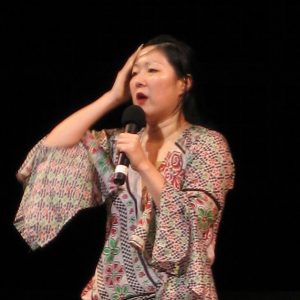
  • Comedians like Margaret Cho had to create spaces for themselves – they were not provided the way they are provided for, say, white cis/het men. I had to do the same thing. I had to learn to advocate for myself. To say “No, you are wrong. I DO belong here. I DO have the right to express myself and live my life authentically. You do NOT have the right to deny me happiness.” This power is how my humor grew from a simple defense mechanism to an olive branch – suddenly I was able to push back against barriers everywhere I went.
  • My SOH is my shield, sword and magic wand all in one. It protects me from suffering, and it gives me the courage to stand up and fight back.
  • At the same time, there are moments when it turns back against me and makes me question myself in ways I wouldn’t if I didn’t put myself out there into the world. Moments when I base my own worth on whether or not someone thinks I’m funny. Sometimes my home becomes more of a cage. And maybe that’s ok – maybe that’s part of what home IS sometimes. Because when I don’t feel funny, I feel homeless. And that’s ok.

What Is Hollywood’s Issue With Asian American Ladies?

I guess this is as good a time as any to do some word vomit regarding the visibility of female comedians in American media, especially in regards to how the landscape of TV has changed in the last few decades. This is something I have some passing knowledge of, but know is a treasure trove of still undiscovered facts.

http://flickr.com/photos/nohodamon/2515872200/in/set-72157605204002600/


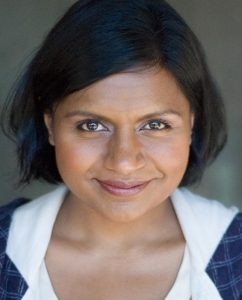
Mindy Kaling was something of a breakout star. Her appearance on “The Office” as bubbly but perpetually childish worker Kelly Kapoor was always the highlight of the show to me and my sister – she nailed the role and seemed so effortlessly perfect for it. More than any other character, it was her moments that would make me laugh. After The Office she scored her own show, “The Mindy Project”, that is currently wrapping up it’s sixth and final season.


https://www.flickr.com/photos/thecosmopolitan/5322011249

Then there was Aziz Ansari, who appeared as lovable but chronically shallow city worker Tom Haverford on Parks and Recreation, and similarly, was one of the best figures to grace the screen. Despite his fairly unsympathetic and cocky attitude, he still managed to make us cheer for him in the end. After Parks and Rec, Aziz appeared in his self produced show, “Master of None”, and gained a significant audience through his own stand up routines.

But years before either of these stars were even old enough to vote, Margaret Cho actually scored her own television show on ABC – the short lived “All American Girl“. This was significant because it was the first network sitcom that featured an all-Asian cast. It wouldn’t be until 2014’s “Fresh Off The Boat” that we would see that again. Speaking of which…

https://www.flickr.com/photos/disneyabc/16281191655

Constance at a 2015 Press Tour


That was the show that gave us Constance Wu, who plays the lovable and completely GIF-able mother, Jessica Huang. While I haven’t seen much of this show (that will be remedied soon) it’s significant to note that Constance is one of the most prominent Asian female actresses on TV today…not that she has much competition.

Randall Park Talking About Lack of Asian Americans on TV


Going back to All American Girl for a moment. At the time it aired in 1994, white America knew little about the Asian American experience. This was a time when Roseanne was dominating Nielsen ratings, and you don’t get much whiter than Roseanne (love you Roro!). The show actually suffered more from it’s reception by Asian American audiences, who criticized the fact that nearly everything about the show was birthed from antiquated stereotypes about Asians, and it was cancelled as a result.

So what really happened? How did we get from this mess to the success of Fresh of the Boat; from Margaret Cho being forced into losing 30 pounds in two weeks, causing her kidneys to collapse just to appeal to viewers, to Mindy Kaling jumping directly from successful show to successful book deal to successful show?

This is only the beginning, folks. We’re in for a wild ride.


The Meshing of Identity, Comedy, and Pain

Our main project has me thinking a lot about how I can incorporate the idea of ‘home’ into an understandable, cohesive form by this quarter’s end. At first I was clueless – maybe I’d do something about Pokemon? Cartoons?? All of it seemed like trying too hard. In the end it was Chico who made me realize the opportunity that lay in the world of comedy.

There’s a few things to note about comedy.

  • It’s subjective – that is, not everyone will think everything is funny.
  • It’s largely dominated by men as an industry, like nearly all fields.
  • It’s about forming a connection with the audience. Whether that connection is a personal one, a deep one, even a meaningfully shallow one. Without connection, there can be no comedy.

“Home” to me revolves around the idea of being appreciated, and that marries nicely with the act of telling funny stories, cracking jokes or using silly voices ( like we’ve been talking about – comedy.) I don’t need to be making people laugh to feel appreciated, but it’s hard not to feel wanted when they do.

So moving on, we have the idea of stand up comedians. Off the top of my head, the only Asian American comedians who have achieved significant success I can think of are Margaret Cho, Aziz Ansari, Mindy Kaling and Ken Jeong. That’s pretty pathetic, I must say. Regardless, we have to start somewhere.

Let’s start with Margaret, a comedian who I’ve admired since high school.


  • Margaret basis a large part of her act around her family, in particular her mother. In this example, we see that her impression of her mother is central to the humor of the situation. A lot of us can relate to having an embarrassing mother, but Margaret being Korean American adds another level of intersectionality to her act. On one level, it can seem almost offensive. After all, for a good chunk of American history, Asian Americans suffered tremendously at the hands of white folks monetizing mimicry of Asian speech and appearance. (Consider Mickey Rooney in Breakfast at Tiffanys. We learned a bit in A Short History about how only Asians of a certain ‘caliber’ were allowed into the country, and this reputation was almost immediately used against them.)
  • But the fact that Margaret is Korean American creates a new narrative – she infamously played Kim Jung Il on 30 Rock, and again, it would have been another Ghost In The Shell situation had she been anything but Korean. It changes the nature of the connection.
  • In my own life, my stand up act relies only occasionally on my identity as a biracial person. Sure, plenty of it is based on my status as a woman, but my race isn’t as significant as it is with Margaret’s act. The idea of creating representation, of using what was once insulting in a way that rewrites the story, is very much part of why comedy is home to me. That’s what I want to learn more about, as well as how comedy and humor in Asian communities has evolved in our own country and abroad.