Chinese Americans:
What I learned
- The majority of kung fu is movies are inspired or directly from the Shaolin monks
- There a limited number of Asian-Americans on the Walk of Fame

Chinese Americans:
What I learned
Kung fu – Gong fu
June
Lindo
Waverly
Ying Ying
Lena
An Mei
Rose
Suyuan
https://www.theverge.com/2012/5/9/3004622/otaku-spaces-patrick-galbraith-manga-anime-review
While anime and manga may seem to be just another form of media and entertainment, there is a huge community laying underneath with more problems and controversy.
In the year 1989, the first derogatory use of the word Otaku was born out of murder. A man named Tsutomu Miyazaki attempted to molest a young girl in a park. He was caught by the girl’s father and upon being arrested and having his apartment inspected, the remains and evidence of four girls were found. Along in his apartment were thousands of copies of manga, anime, graphic films, and porn. After being arrested, he was dubbed the name, “the Otaku Murderer.”
The word Otaku can easily be translated to “geek,” or “nerd,” but carries a more derogatory tone attached to it. Otaku are seen as people who are disconnected from reality and anti-social. While this is slowly being changed in Japan’s culture, overseas the word has morphed.
In the United States, for example, Otaku are people who watch and consume anime, manga, and other forms of Japanese media in a respectful manner. Usually learning the language and culture along the way and develop a sense of art critique or admonition for the art form. Unlike in Japan, these people who self-identify as Otaku are seen as well kept and proud fans.
On the other side of that coin, there are also Weeaboos, a word created in popularity on 4chan to describe a person of non-Asain descendant who has an over obsessive compulsive with anime and manga. Similar to Otaku, these people are often seen at the forefront of the anime community for their extreme personalities, as well as their disrespect towards others outside of the community. While living in a bubble of their own reality, these Weeaboos tend to mock and appropriate Japanese culture, while at the same time engoring themselves in as much anime and manga that they possibly can.
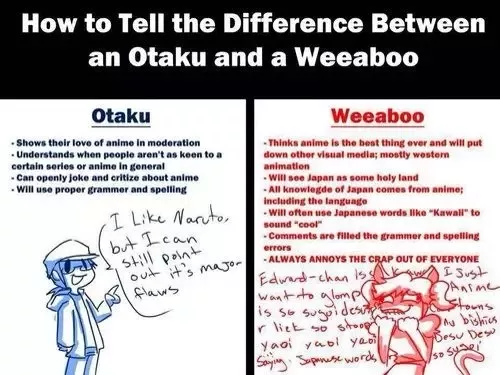
Pena, Eric. “What’s the Difference between a Weeaboo and Otaku?” Quora, Quora, 11 Dec. 2017.
Psychology References
Hutchings, Peter. The Horror Film. 1st ed., Routledge, 2004.
I’ve used this text as a beginning outline for my own research. The text itself explores the horror topic in a similar way to my own and can aid me in finding additional pathways in my own research.
Kerr, Margee. Scream: Chilling Adventures in the Science of Fear. 1st ed., PublicAffairs, 2017.
This text explores into the scariest experiences a human can face when it comes to horror, from willingly going into haunted houses and going into the mind of a serial killer.
Iaccino, James F. Psychological Reflections on Cinematic Terror: Jungian Archetypes in Horror Films. Praeger, 1994.
I used this text as a way to see how horror has changed throughout the year in the minds of those who consume them, the people who produce them, and what is considered to be successful horror.
Darwin, Charles. The Expression of the Emotions in Man and Animals. The University of Chicago Press, 1965.
This text goes into the many ways that ones experience fear and their reactions to it, from fight to flight and audible reactions.
BBC. Culture of Fear. Films on Demand, BBC, 2017.
I used to this documentary to see how different circumstances affect each person in signs of fear or danger. The documentary uses ten test subjects in order to see their reactions.
Bantinaki, Katerina. “The Paradox of Horror: Fear as a Positive Emotion.” The Journal of Aesthetics and Art Criticism, vol. 70, no. 4, 2012, pp. 383–392. JSTOR.
This study focuses on a human’s desire to consume horror media as an obsession. Including themes that surround popularity, the study goes farther into one’s mind for understanding the difference in enjoying this genre.
Beil, Laura. “Emotional Wounds: For Some Children, the Effects of a Disaster Reach Deeper than Anticipated.” Science News, vol. 186, no. 12, 2014, pp. 22–25. JSTOR.
A study on the long term effects of children who have faced traumatic situations, particularly life-threatening and natural disasters.
Raphael, Beverley, and Warwick Middleton. “After The Horror.” British Medical Journal (Clinical Research Edition), vol. 296, no. 6630, 1988, pp. 1142–1144. JSTOR.
This study focuses on the effects of PTSD on a child’s mind and the recovery of that child’s psyche.
Black, Dora, and Martin Newman. “Television Violence And Children: Its Effects Need To Be Seen In The Context Of Other Influences On Children’s Mental Health.” BMJ: British Medical Journal, vol. 310, no. 6975, 1995, pp. 273–274. JSTOR.
This study focuses on a child’s early expose to horror and disturbing media. I plan on using this research to explain what may have happened to early consumers of horror movies, television, and stories.
Game References
This playlist details a remake version of the original Corpse Party game. I used this source as window to the origin of Corpse Party, the original cast, and storyline that eventually drove it into pop culture media.
This playlist details to the international release of Corpse with it was remade through a studio. The game adds more plot and details to the original story, including new characters and villains, as well as changing the origin of some characters. The primary use of this source was to gather information about the horrific experiences the main cast experience and to note their reactions across the timeline of events.
This source adds additional details that weren’t added into the main game. The goal of the chapters listed is to give backstory to the personalities to the characters involved in the main game, prior to their deaths or traumatic experiences.
This source details the experiences the main cast feels after returning home from the last game. It shows the beginning stages of PTSD, depression, attempted suicide, and desperation that the characters feel due to the loss of their friends. The game also provides additional backstory to the deceased and their relationships with the main cast.
This source is a spin-off game that is a bit more joking than serious. While the contact of this game is met to be more lighthearted, the tone switches frequently. This game doesn’t take place on a specific timeline but does add additional backstory and plot details essential for the next game in the series.
Listed as the final game in the original timeline, this game showcases the last act of desperation the characters feel as a last shot to end their suffering. This source is not only important in showing the main casts progression since the first game, but also what has of become of them since the original events, their families reaction to their changing mental state, and just how far they are willing to go to reverse time.