1.Background
The TV-show RuPaul’s Drag Race has become a pop culture in the United States. In 2018, it received 12 major nominations and winning 6 awards in Emmy Awards. However, up to the present time, totally 13 Asian American drag queens are in that TV-show, out of about 140 queens. I wondered why less number of Asian American queens were in this show. I’d like to analysis it.
In this show, Kim Chi, whose ethnicity is Korean, is one of the famous Asian drag queens and is runner-up in season 8. She is the first Korean drag queen to be featured on American national television. She takes her cultural cues that are currently popular in Korea and represent it into the gay community. It was one of her strengths in this competition. Like this, I’d like to explore how Asian Americans drag queens represented their Asian culture into the performance in a good way, sometimes in a bad way too, as their identity.
(I’m thinking if I write this part)
Also, as one of the children of Asian-immigrants, she has been struggling with the relationship of her parent. She came out to her mother that she was gay. But, her mother doesn’t know that she’s a drag queen. Also, Plastique Tiara from season 11, whose ethnicity is Vietnamese, hasn’t explained to her parents what she’s actually doing as a performer. It might be related to the cultural and generational difference of understanding LGBTQ culture. Then, I’d like to explore the struggles of both being Asian and being gay, especially with focusing on family background and the stereotype of Asian, Gay, and Gay Asian.
2. Definition
What is Pop Culture
As I mentioned in the introduction, RuPaul’s Drag race has been seen as one of pop culture in the United States. However, how do we categorize that tv-show as pop culture? What is pop culture?
According to John Storey, there are 6 definitions of pop culture in their different, general ways.
The first definition is that “popular culture is simply culture which is widely favored or well-liked by many people.” (p.4) The second definition is that “popular culture is a residual category, there to accommodate texts and practices which fail to meet the required standards to qualify as high culture.” (p.5) The third definition is that “popular culture is a hopelessly commercial culture. It is mass produced for mass consumption. Its audience is a mass of non-discriminating consumers.” (p.6) It is mass culture. The fourth definition is that “popular culture is the culture which originates from ‘the people’.” (p.7) The fifth definition is that “popular culture as a site of struggle between the ‘resistance’ of subordinate groups and the forces of ‘incorporation’ operating in the interests of dominant groups” (p.8) The sixth definition is that in postmodernism, popular culture is “a culture which no longer recognizes the distinction between high and popular culture” (p.9)
Also, according to Mimi Thi Nguyen and Thuy Linh Nguyen Tu, “It is through culture, and particularly popular culture, that persons are taught how to be kinds of citizens— how to dress, listen, shop, love, desire, and behave.” It could be also a definition of popular culture because the culture that has effects on us, our lives is popular culture.
So, how do we categorize RuPaul’s drag race as a pop culture?
RuPaul’s Drag race received 12 major nominations and winning 6 awards in Emmy Awards. RuPaul’s drag race could be said to be widely favored or well-liked by many people, like the first definition.
Also, RuPaul’s drag race could be placed in the fourth definition and fifth definition. Originally, drag show and drag queen are from the LGBTQ community, queer culture. RuPaul’s drag race is rooted in queer culture. However, now it’s widely known not only by the LGBTQ community but also by outside of the LGBTQ community, whichever they favor it or not. And now, it can be one of the educational tools of queer studies and gender studies. It represents the diversity of gender and sexuality, which is related to the last definition by Mimi Thi Nguyen and Thuy Linh Nguyen Tu.
3. Asian drag queen
In this chapter, mainly I’d like to analysis Asian American drag queens’ performance in RuPaul’s drag race.
Kim Chi
Kim Chi is a Korean American drag queen from RuPaul’s drag race season 8. Her real name is Sang-Young Shin (신상영). She (/He) was born in the United States, moved to South Korea and lived there as a child and now lives in Chicago. She became the first Korean drag queen to be featured on American national television.
This clip shows overall her performances on RuPaul’s Drag Race season 8. She was one of the top three finalists on season 8. Even though she was not good at dancing, her talented and fantastical outfits had amazed the judges many times.
“Featuring in the show as its first Korean contestant was a great honor. I’ve always been proud of being a Korean and Korean culture, which I think is extremely beautiful. That’s the reason why I named my stage persona as Kim Chi — to promote Korea,” Kim Chi told the Korean Herald during a recent interview in Seoul. As she said, she uses a lot of K-pop themes in her performance and also actually represented Korean culture in the show on season 8.
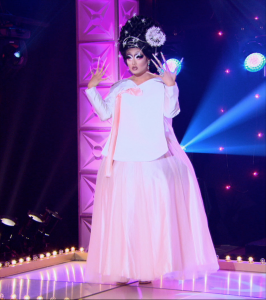 (https://www.wmagazine.com/story/kim-chi-rupauls-drag-race-marcjacobs)
This is one of her clothes from season 8. She expressed her mother’s looks with Korean traditional clothes for women, Hanbok.
This is the final of season 8. She performed her song “Fat, Fem & Asian” with a contemporary version of a Hanbok, which was pretty gorgeous. Also, a part of the lyrics is in Korean.
Analysis
“If you can’t love yourself, how in the hell you gonna love somebody else?” It’s one of the most famous RuPaul’s lines. As her line, the TV-show RuPaul’s drag race has long been concerned with self-love and non-conformity. RuPaul always expects the participants to represent themselves through their performances. I thought that her performance achieved Ru’s expectation and reproduced her identity and culture as being Asian in a good way.
Also, in her original lipsync song, she used the terms of being fat, feminine, and Asian, which are seen as deficient in the gay community. It could show us that she took her weak points as herself and overcame these. But also, it shows being fat, feminine, and Asian are not unattractive but actually attractive. Through her performance, I thought that she proved it.
Even the purpose of this shoe is to express themselves and themselves as more feminized, C. Winter Han, an associate professor of sociology at Middlebury College, said in the interview that “the Asian characters were heavily racialized in ways that the other contestants weren’t, and more importantly, the show rewarded the Asian contestants the more they Orientalized themselves.”
Manila Luzon
Manila Luzon is a Filipino American drag queen from season 3, All-Stars 1 and 3. Her real name is Karl Philip Michael Westerberg. She was a runner up of season 3. She was born in Minnesota and lives in Los Angeles. Her mother was born in the Philippines. Her drag name “Manila Luzon” is named from the capital city “Manila” and the largest island “Luzon” in the Philippines. She chose Manila Luzon because She wanted to celebrate my Filipino heritage.
Since she came back to All-Stars twice and won the main challenges in the show many times, she is a very talented drag queen. Actually, she made the judges laugh with her sense of humor and her clothes were so beautiful.
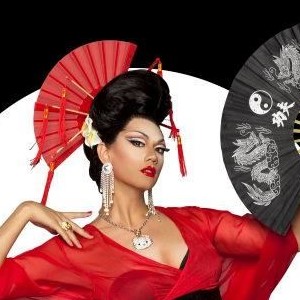
However, in season 3, she did a problematic performance. In episode 5, the main challenge was to be newscasters. Manila Luzon performed with a stereotypically pan-Asian accent. Also, in another episode, she wore a cheongsam, which was not directly related to her Asian heritage, for the challenge. These performances amazed the judges and she won those challenges.
After this season, other Asian American drag queens also did similar things.
One example is Gia Gunn who is Japanese American and was in season 6 and All-Stars 4. She used Asian accent as same as Manila Luzon did. In snatch game, in which contestants showcase their best celebrity impersonations in a game show setting, of All-Stars 4, Gia Gunn turned in an off-color performance as Jenny Bui, who is Cardi B’s Insta-famous nail technician. In the beginning, Gia Gunn said “Harro Ru! Konichiwa!” and kept speaking in very stereotypical Asia-ness accent. After the episode, Jenny Bui posted on Instagram, “Unfortunately that’s not my accent, and the only thing off the boat is the ‘fresh’ tilapia that you are allegedly serving.” Plus, in the show, Gia Gunn said that “I don’t know that much about Jenny.”
Another example is Plastique Tiara who is Vietnamese American and was on season 11, which is the latest season. This clip is the challenge of the parody film in episode 2. In this challenge, she used stereotypical Asian-ness accent as a part of her Asian identity and she was admired by the judges. However, even after this challenge, she continued to use stereotypical Asian-ness accent again and again since the judges liked her performance of Asian accent in the first challenge, which was funny.
Analysis
Since Manila Luzon represented Asian culture such as Chinese traditional cloth and performed stereotypically Asian-ness accents as a comedy in the show, and the judges including RuPaul admired her performance and gave her the MVP in each episode, other Asian drag queen misunderstood that these things were the acceptable and beneficial performance, then they just followed her. It’s important that Asian constants show their Asian identity in the show. However, it’s not a thing like since they are Asian, they can do whatever they want to perform as Asian identity.
At first, Manila’s cheongsam. Cheongsam is a Chinese traditional cloth. She was beautiful and well-performing in that episode. But, what do Chinese and Chinese Americans feel about it? Cheongsam is a part of Chinese culture, heritage. The contestants shouldn’t easily utilize their culture for themselves. Even Manila is a drag queen of Asian descent, she’s not Chinese. She can’t easily use Chinese culture to perform in the TV show and to express herself. She would better show her respect for another culture.
Also, about Gia Gunn’s imitation of Jenny Bui. Gia Gunn is Japanese American. She knew that Jenny Bui was Asian. That’s why Gia Gunn picked her up for the performance, she thought of being able to make fun of it. Both of them are Asian, but Jenny Bui is not Japanese. Therefore, “Konnichiwa” doesn’t make sense. Asian is not the same. Even if she was trying to include her own character with it, she would better have known about Jenny Bui more and respected. Asian is not the same.
Secondly, about Asian-ness accent that all of three Asian queens did. It could be seen as fun. However, using an Asian accent to make people laugh in the show, which is a part of the stereotype of Asian, is actually problematic and traumatic for people who actually speak in a similar way. Also, there’s a possibility for non-Asian to misunderstand that they can also use an Asian-ness accent as a joke because the TV-show, such RuPaul’s drag race, accepts the contestants to use it. As one of pop culture, which has a huge impact, the TV-show including others should be really careful.
Another problem is that Gia Gunn didn’t know about Jenny Bui that much, but she imitated Jenny Bui. There’s no respect. It’s just that she made Jenny Bui ashamed and hurt in the big TV-show. If she wanted to perform as Jenny Bui, she should have known and been respectful.
Also, about Plastique Tiara. Since she continued to use Asian-ness accent again and again, it seemed that all she can do is just like to speak in Asian-ness accent, which is not herself. At first, using the Asian-ness accent is not a good way to express Asian-ness, and she missed herself by using it many times to win.
Finally, about the judges. The judges admired Manila’s stereotypical Asian-ness accent and also her cheongsam and gave her the MVP. Also, they admired Plastique’s stereotypical Asian accent at first challenge. They shouldn’t have admired these things. Their admiration could mean the acceptance of these things, which are problematic and traumatic. And it could let the audience misunderstand and do the same thing, which could be racism, in general. As the judges on the TV show, which has a huge influence on the audience, they also should be careful in term of culture and ethnicity.
4. Conclusion
It’s a big success of LGBTQ culture that RuPaul’s drag race has become popular with the outside of the LGBTQ community, too, and seen as one of Pop culture in the United States. Through this show, people can see how the LGBTQ community and drag community are like. In term of the Asian community, even there are still less Asian American drag queens in the show, some of the Asian American drag queens are performing well and has achieved. Also, some of Asian American drag queens like Kim Chi did great jobs by representing her Asian culture as her own identity. Kim Chi showed the audience that Asian identity is attractive.
However, there are still problems in that TV-program as I mentioned. Even Asian American drag queens are trying to represent their culture as their identities, there are misrepresentations. As Asian drag queens on the show, they should represent themselves carefully. Also, the judges should be careful too. The TV-show ‘RuPaul’s drag race,’ the contestants and the judges, all of them make sure that they have huge impacts on a bunch of people in front of the TV.
wachstumshormone hgh kaufen
References:
gitea.geekelectronick.com
hgh injektion kaufen
References:
slowdating.ca
some examples of steroids are shown here.
References:
http://www.controlleriot.cn