Final Project Update: Week 9

Asian American Drag Queens in RuPaul’s Drag Race

Background

The TV-show RuPaul’s Drag Race has become a pop culture phenomenon in the United States. In 2018, it received 12 major nominations and won 6 Emmy awards in Emmy Awards. However, up to the present time, only 13 Asian American drag queens, out of about 140 drag queens, are in that TV show.

Among few Asian American drag queens in this show, Kim Chi, whose ethnicity is Korean, is one of the famous Asian drag queens and is a runner-up in season 8. She is the first Korean drag queen to be featured on American national television. She takes cultural cues that are currently popular in Korea and represent them into the gay community. It was one of her strengths in this competition. I’d like to explore how Asian Americans drag queens integrate their Asian cultures into the performance in a good way, sometimes in a bad, as part of their identity.

Definition

What is Pop Culture?
As I mentioned in the introduction, RuPaul’s Drag Race has been seen as an important pop culture in the United States. However, how do we categorize that TV show as a pop culture? To begin with, what is pop culture?

According to John Storey, there are 6 definitions of pop culture in their different, general ways. The first definition is that “popular culture is simply culture which is widely favored or well-liked by many people” (4). The second definition is that “popular culture is a residual category, there to accommodate texts and practices which fail to meet the required standards to qualify as high culture” (5). The third definition is that “popular culture is a hopelessly commercial culture. It is mass produced for mass consumption. Its audience is a mass of non-discriminating consumers” (6). It is mass culture. The fourth definition is that  “popular culture is the culture which originates from ‘the people’” (7). The fifth definition is that “popular culture as a site of struggle between the ‘resistance’ of subordinate groups and the forces of ‘incorporation’ operating in the interests of dominant groups” (8). The sixth definition is that in postmodernism, popular culture is “a culture which no longer recognizes the distinction between high and popular culture” (9).

Also, according to Mimi Thi Nguyen and Thuy Linh Nguyen Tu, “It is through culture, and particularly popular culture, that persons are taught how to be kinds of citizens— how to dress, listen, shop, love, desire, and behave” (8). It could be also a definition of popular culture because the culture that has effects on us, on our lives is popular culture.


So, how do we categorize RuPaul’s Drag Race as a pop culture?

Because RuPaul’s Drag Race received 12 major nominations and won 6 Emmy Awards, it could be said to be widely favored or well-liked by many people, like the first definition.

Also, RuPaul’s Drag Race could be placed in the fourth and fifth definitions. Originally, drag shows and drag queens are part of the LGBTQ community, queer culture. RuPaul’s Drag Race is rooted in queer culture. However, now it’s widely known not only by the LGBTQ community but also by outside of the LGBTQ community, whichever they favor it or not. And now, it can be one of the educational tools of queer studies and gender studies. It represents the diversity of gender and sexuality, which is related to the last definition by Mimi Thi Nguyen and Thuy Linh Nguyen Tu.


Asian Drag Queens

In this section, I’d like to analyze Asian American drag queens’ performance in RuPaul’s Drag Race.

Kim Chi
Kim Chi is a Korean American drag queen from RuPaul’s Drag Race, season 8. Her real name is Sang-Young Shin (신상영). She (/He) was born in the United States, moved to South Korea and lived there as a child and now lives in Chicago. She became the first Korean drag queen to be featured on American national television.

This clip shows her performances on RuPaul’s Drag Race season 8. She was one of the top three finalists in that season. Even though she was not good at dancing, her overall talent and fantastical outfits amazed the judges many times.

“Featuring in the show as its first Korean contestant was a great honor. I’ve always been proud of being a Korean and Korean culture, which I think is extremely beautiful. That’s the reason why I named my stage persona as Kim Chi — to promote Korea,” Kim Chi told the Korean Herald during a recent interview in Seoul (Dam-Yong). As she said, she uses a lot of K-pop themes in her performance and also actually represented Korean culture in the show on season 8.
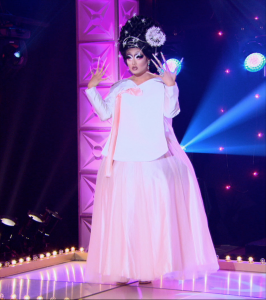
This is one of her clothes from season 8. She expressed her mother’s looks with Korean traditional clothes for women, the Hanbok.


This is her performance in the final of season 8. She performed her song, “Fat, Fem & Asian,” in a contemporary version of a Hanbok, which was pretty gorgeous.  Also, some of the lyrics are in Korean.

Analysis
“If you can’t love yourself, how in the hell you gonna love somebody else?” It’s one of the most famous RuPaul’s lines. As her line, the TV show RuPaul’s Drag Race has long been concerned with self-love and non-conformity. RuPaul always expects the participants to represent themselves through their performances. I thought that her performance achieved Ru’s expectations and reproduced her identity and culture as being Asian in a good way.
Also, in her original lip-sync song, she mentions being fat, feminine, and Asian, which are seen as deficient in the gay community. It could show us that she took her weak points as herself and overcame these. But also, it shows being fat, feminine, and Asian are not unattractive, but actually attractive. Through her performance, I thought that she proved it.


Even the purpose of this show is to express themselves and themselves as more feminized, C. Winter Han, an associate professor of sociology at Middlebury College, said in the interview that “the Asian characters were heavily racialized in ways that the other contestants weren’t, and more importantly, the show rewarded the Asian contestants the more they Orientalized themselves” (Kornhaber). Some Asian American participants were misrepresenting their identity and culture in the show. I’d like to analyze some of them in the following.

Manila Luzon
Manila Luzon is a Filipino American drag queen from season 3 and All-Stars 1 and 3. Her real name is Karl Philip Michael Westerberg. She was a runner up in season 3. She was born in Minnesota and lives in Los Angeles. Her mother was born in the Philippines. Her drag name, “Manila Luzon,” comes from the capital city “Manila” and the largest island “Luzon” in the Philippines. She chose Manila Luzon because She wanted to celebrate her Filipino heritage.


Since she came back to All-Stars twice and won the main challenges in the show many times, she is a very talented drag queen. Actually, she made the judges laugh with her sense of humor and her clothes were so beautiful.
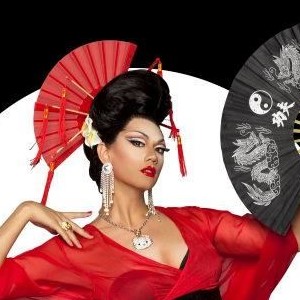
However, in season 3, there was a problematic performance. In episode 5, the main challenge was to be newscasters. Manila Luzon performed with a stereotypically pan-Asian accent. Also, in another episode, she wore a cheongsam, which was not directly related to her Asian heritage, for the challenge. These performances amazed the judges and she won those challenges.

After this season, other Asian American drag queens also did similar things.

Gia Gunn
One example is Gia Gunn, who is Japanese American and was in season 6 and All-Stars 4. She used an Asian accent in the same way that Manila Luzon did. In snatch game, in which contestants showcase their best celebrity impersonations in a game show setting, of All-Stars 4, Gia Gunn turned in an off-color performance as Jenny Bui, who is Cardi B’s Insta-famous nail technician. The above clip has a part of Gia Gunn’s performances as Jenny Bui. In the beginning, Gia Gunn said “Harro Ru! Konichiwa!” and kept speaking in very stereotypical Asia-ness accent. After the episode, Jenny Bui posted on Instagram, “Unfortunately that’s not my accent, and the only thing off the boat is the ‘fresh’ tilapia that you are allegedly serving.” Plus, in the show, Gia Gunn said that “I don’t know that much about Jenny.”

Plastique Tiara
Another example is Plastique Tiara, who is Vietnamese American, and was on season 11, which is the latest season. This clip is the challenge of the parody film in episode 2. In this challenge, she used a stereotypical Asian-like accent as a part of her Asian identity and she was admired by the judges. However, even after this challenge, she continued to use a stereotypical Asian-like accent again and again, since the judges liked her performance of the Asian accent in the first challenge, which was funny.

Analysis
Since Manila Luzon represented Asian culture in ways such as Chinese traditional clothing and performed stereotypically Asian-ness accents as comedy in the show, and the judges including RuPaul admired her performance and gave her the MVP in each episode, other Asian drag queen misunderstood that these things were acceptable and beneficial, then they just followed her. It’s important that Asian constants show their Asian identity in the show. However, it’s not a good thing that, since they are Asian, they can do whatever they want to perform as Asian identity.

At first, Manila’s cheongsam. Cheongsam is Chinese traditional clothing. She was beautiful and well-performing in that episode. But, how do Chinese and Chinese Americans feel about it? Cheongsam is a part of Chinese culture, heritage. The contestants shouldn’t easily utilize their culture for themselves to win the competition. Even though Manila is a drag queen of Asian descent, she’s not Chinese. She can’t simply use Chinese culture to perform in the TV show and to express herself. She would be better off showing her respect more for another culture.

Also, about Gia Gunn’s imitation of Jenny Bui. Gia Gunn is Japanese American. She knew that Jenny Bui was Asian. That’s why Gia Gunn picked her for the performance, she thought of being able to make fun of it. Both of them are Asian, but Jenny Bui is not Japanese. Therefore, “Konnichiwa” doesn’t make sense at all. Asian is not the same. Even if she was trying to include her own character with it, since she didn’t know about Jenny Bui much, it would have been better to have known about Jenny Bui more and to respect her.

Secondly, about Asian-ness accents that all of those three Asian queens did. It could be seen as fun, like as a joke. However, using an Asian accent to make people laugh in the show, which is a part of the stereotype of Asians, is actually problematic and traumatic for people who actually speak in a similar way. Also, there’s a possibility for non-Asians to misunderstand that they can also use an Asian-ness accent as a joke because the TV show, such RuPaul’s Drag Race, accepts the contestants to use it. As one of pop culture, which has a huge impact, the TV show including others should be really careful about the influence of pop culture.

Another problem is that Gia Gunn didn’t know about Jenny Bui that much, but she imitated Jenny Bui. There’s no respect. It’s just that she made Jenny Bui ashamed and hurt in the big TV show. The audiences might misunderstand about her and imitate her in the same way Gia Gunn did. If she wanted to perform as Jenny Bui, she should have known and been respectful for Jenny Bui to avoid problems.

Also, about Plastique Tiara. Since she continued to use an Asian-like accent again and again, it seemed that all she can do is just like to speak in an Asian-like accent, which is not herself. At first, using the Asian-ness accent is not a good way to express Asian-ness, and she seemed to miss herself, her identity, by using it many times to win.

Finally, about the judges. The judges admired Manila’s stereotypical Asian-like accent and also her cheongsam and gave her the MVP. Also, they admired Plastique’s stereotypical Asian accent at first challenge. They shouldn’t have admired these things. Their admiration could mean the acceptance of these things, which are problematic and traumatic. And it could let the audience misunderstand and do the same thing, which could be racism, in general. As the judges on the TV show, which has a huge influence on the audience, they also should be careful in term of culture and ethnicity.

Conclusion

It’s a big success of LGBTQ culture that RuPaul’s Drag Race has become popular outside of the LGBTQ community, too, and seen as important pop culture in the United States. Through this show, people can see what the LGBTQ community and drag community are like. In terms of the Asian community, even though there are still fewer Asian American drag queens in the show, some of the Asian American drag queens are performing well and have achieved success. Also, some of Asian American drag queens like Kim Chi did great jobs by representing her Asian culture as her own identity. Kim Chi showed the audience that Asian identity is attractive.

However, there are still problems in that TV program, as I mentioned. Even when Asian American drag queens are trying to represent their culture as their identities, there are misrepresentations. As Asian drag queens on the show, they should represent themselves respectfully and carefully. Also, the judges should be careful too. The TV show RuPaul’s Drag Race, the contestants, and the judges, all of them make sure that they have huge impacts on TV audiences.

Works Cited

Bui, Jenny. Instagram, 2018, www.instagram.com/nailson7th/p/Br-nIojB09D/.

Dam-Young, Hong. “Drag Queen Kim Chi Hopes to Spread Korean Culture to World.” AsiaOne, 2017, www.asiaone.com/entertainment/drag-queen-kim-chi-hopes-spread-korean-culture-world.

Fitzgerald, Christine. “Manila Luzon – The Socialite Life Interview.” Socialite Life, 14 Dec. 2018, socialitelife.com/manila-luzon-socialite-life-interview/.

Kornhaber, Spencer. “Fiercely ‘Femme, Fat, and Asian’.” The Atlantic, Atlantic Media Company, 19 May 2016, www.theatlantic.com/entertainment/archive/2016/05/kim-chi-rupauls-drag-race-femme-fat-asian-c-winter-han-interview-middlebury/483527/.

Nguyen, Mimi Thi, and Thuy Linh N. Tu. Alien Encounters: Popular Culture in Asian America. Duke University Press, 2007.

“List of Awards and Nominations Received by RuPaul’s Drag Race.” Wikipedia, Wikimedia Foundation, 22 May 2019, en.wikipedia.org/wiki/List_of_awards_and_nominations_received_by_RuPaul%27s_Drag_Race.

“RuPaul.” RuPaul’s Drag Race Wiki, rupaulsdragrace.fandom.com/wiki/RuPaul.

Storey, John. Cultural Theory and Popular Culture. Pearson Prentice Hall, 2006.

Class Notes: Week 9

Tuesday, May 28

Film: “My name is Khan” (2010)

Disability: Asperger Syndrome
In this film, the main actor is not disabled. It would be better that the real disabled person did to express accurate action. Like in the case of an Asian actor. However, it might be difficult.

Religion: Muslim and Hindoo
-Since 9.11 happened, Muslim American became a target of racism
-bullying, prejudice, obstruction of business
I thought that this film showed how beautiful the real religious spirts were. As one of the people who don’t have any religion, I thought that Khan’s strong and true spirit of religion was so beautiful. Prayer shouldn’t be upon the place and the people. And also, religion and clothes related to religion are a part of their identity. At the end of this film, Muslims such as Khan’s brother’s wife and the owner of a TV shop got proud of their religion and made an action. We shouldn’t judge people by religions or ethnicity.

“There are two kinds of people in the world. Good people and bad people. There’s no other difference.” I thought that Khan’s mother’s line was a key phrase of this film. There are people who do good things and people who do bad things. It reminds me of all important is the actions and deeds that people do, no matter they are. If a person is Muslim, it doesn’t mean to a bad person. Khan proofed it in this film. Plus, one thing I thought, as we are a part of society, we should study our history of this society. Why people hated/hate (which is sad) specific people. Why people celebrate various successes. What happened in the past… It connects to our ethnic studies and cultural studies.


Wednesday, May 29

D&R

Field trip


Friday, May 31

South Asia; India (Hinduism), Sri Lanka (Buddism), Bhutan (Buddism), Pakistan (Muslim), Nepal (Buddism), Maldives (Muslim), Bangladesh (Muslim), Afganistan (Muslim)

Final thoughts: South American

I learned the strong connection between South Asian and religion. I had the image of South Asia, which is Hinduism. I realized when I was thinking about South Asia, my image of it was just only about India. India and Hinduism were centric. In the presentation, I learned that other South Asian countries and other religions. In the film, because of the difference in religion, it was not easy to marry others. Also, after 9.11., many South Asian became a target of racism, which was sad. I don’t have religion. But, through that film, I felt the beauty of believing like Khan did. Religion is just one of the identities. I respect other religions because I thought that it’s beautiful. Even though, as Khan argued with one guy in the film, there might be a wrong way of believing, I believe that because of religion or skin color, we shouldn’t judge others by religion or skin color. And, we can be proud of our color and religion.

D&R: Week 9

identity

I’m still struggling with the idea of identity. It was a new word for me when I came here. And now, I’m getting it gradually.

In this article, Nazeera Dawood talked about her identity. She was asked “Are you more Indian or are you more American?” by a well-wisher. She was supposed to pick up one identity at that time. And then she was wondering “Am I more American or am I more Indian?”, “Does becoming more American make me less Indian?”. Through her experience, she figured out the answer to the first question. “I’m proudly becoming more of both.”

This article reminds me of the fluidity of identity. Indian identity is her identity. American identity is also herself. Cultural identity is not supposed to be only one. I’m glad that she’s proud of becoming both identities.

Final Project Update: Week 8

Asian American drag queens in “RuPaul’s Drag Race”

1.Background

The TV-show RuPaul’s Drag Race has become a pop culture in the United States. In 2018, it received 12 major nominations and winning 6 awards in Emmy Awards. However, up to the present time, totally 13 Asian American drag queens are in that TV-show, out of about 140 queens.

In this show, Kim Chi, whose ethnicity is Korean, is one of the famous Asian drag queens and is runner-up in season 8. She is the first Korean drag queen to be featured on American national television. She takes her cultural cues that are currently popular in Korea and represent it into the gay community. It was one of her strengths in this competition. Like this, I’d like to explore how Asian Americans drag queens represented their Asian culture into the performance in a good way, sometimes in a bad way too, as their identity.

2. Definition

What is Pop Culture

As I mentioned in the introduction, RuPaul’s Drag race has been seen as one of pop culture in the United States. However, how do we categorize that tv-show as pop culture? What is pop culture?

According to John Storey, there are 6 definitions of pop culture in their different, general ways.
The first definition is that “popular culture is simply culture which is widely favored or well-liked by many people.” (p.4) The second definition is that “popular culture is a residual category, there to accommodate texts and practices which fail to meet the required standards to qualify as high culture.” (p.5) The third definition is that “popular culture is a hopelessly commercial culture. It is mass produced for mass consumption. Its audience is a mass of non-discriminating consumers.” (p.6) It is mass culture. The fourth definition is that  “popular culture is the culture which originates from ‘the people’.” (p.7) The fifth definition is that “popular culture as a site of struggle between the ‘resistance’ of subordinate groups and the forces of ‘incorporation’ operating in the interests of dominant groups” (p.8) The sixth definition is that in postmodernism, popular culture is “a culture which no longer recognizes the distinction between high and popular culture” (p.9)

Also, according to Mimi Thi Nguyen and Thuy Linh Nguyen Tu, “It is through culture, and particularly popular culture, that persons are taught how to be kinds of citizens— how to dress, listen, shop, love, desire, and behave.” It could be also a definition of popular culture because the culture that has effects on us, our lives is popular culture.


So, how do we categorize RuPaul’s drag race as a pop culture?

RuPaul’s Drag race received 12 major nominations and winning 6 awards in Emmy Awards. RuPaul’s drag race could be said to be widely favored or well-liked by many people, like the first definition.

Also, RuPaul’s drag race could be placed in the fourth definition and fifth definition. Originally, drag show and drag queen are from the LGBTQ community, queer culture. RuPaul’s drag race is rooted in queer culture. However, now it’s widely known not only by the LGBTQ community but also by outside of the LGBTQ community, whichever they favor it or not. And now, it can be one of the educational tools of queer studies and gender studies. It represents the diversity of gender and sexuality, which is related to the last definition by Mimi Thi Nguyen and Thuy Linh Nguyen Tu.


3. Asian drag queen

In this chapter, mainly I’d like to analysis Asian American drag queens’ performance in RuPaul’s drag race.

Kim Chi
Kim Chi is a Korean American drag queen from RuPaul’s drag race season 8. Her real name is Sang-Young Shin (신상영). She (/He) was born in the United States, moved to South Korea and lived there as a child and now lives in Chicago. She became the first Korean drag queen to be featured on American national television.

This clip shows overall her performances on RuPaul’s Drag Race season 8. She was one of the top three finalists on season 8. Even though she was not good at dancing, her talented and fantastical outfits had amazed the judges many times.

“Featuring in the show as its first Korean contestant was a great honor. I’ve always been proud of being a Korean and Korean culture, which I think is extremely beautiful. That’s the reason why I named my stage persona as Kim Chi — to promote Korea,” Kim Chi told the Korean Herald during a recent interview in Seoul. As she said, she uses a lot of K-pop themes in her performance and also actually represented Korean culture in the show on season 8.

(https://www.wmagazine.com/story/kim-chi-rupauls-drag-race-marcjacobs)

This is one of her clothes from season 8. She expressed her mother’s looks with Korean traditional clothes for women, Hanbok.


This is the final of season 8. She performed her song “Fat, Fem & Asian” with a contemporary version of a Hanbok, which was pretty gorgeous.  Also, a part of the lyrics is in Korean.

Analysis
“If you can’t love yourself, how in the hell you gonna love somebody else?” It’s one of the most famous RuPaul’s lines. As her line, the TV-show RuPaul’s drag race has long been concerned with self-love and non-conformity. RuPaul always expects the participants to represent themselves through their performances. I thought that her performance achieved Ru’s expectation and reproduced her identity and culture as being Asian in a good way.
Also, in her original lipsync song, she used the terms of being fat, feminine, and Asian, which are seen as deficient in the gay community. It could show us that she took her weak points as herself and overcame these. But also, it shows being fat, feminine, and Asian are not unattractive but actually attractive. Through her performance, I thought that she proved it.


Even the purpose of this shoe is to express themselves and themselves as more feminized, C. Winter Han, an associate professor of sociology at Middlebury College, said in the interview that “the Asian characters were heavily racialized in ways that the other contestants weren’t, and more importantly, the show rewarded the Asian contestants the more they Orientalized themselves.”


Manila Luzon
Manila Luzon is a Filipino American drag queen from season 3, All-Stars 1 and 3. Her real name is Karl Philip Michael Westerberg. She was a runner up of season 3. She was born in Minnesota and lives in Los Angeles. Her mother was born in the Philippines. Her drag name “Manila Luzon” is named from the capital city “Manila” and the largest island “Luzon” in the Philippines. She chose Manila Luzon because She wanted to celebrate my Filipino heritage.


Since she came back to All-Stars twice and won the main challenges in the show many times, she is a very talented drag queen. Actually, she made the judges laugh with her sense of humor and her clothes were so beautiful.

However, in season 3, she did a problematic performance. In episode 5, the main challenge was to be newscasters. Manila Luzon performed with a stereotypically pan-Asian accent. Also, in another episode, she wore a cheongsam, which was not directly related to her Asian heritage, for the challenge. These performances amazed the judges and she won those challenges.

After this season, other Asian American drag queens also did similar things.

One example is Gia Gunn who is Japanese American and was in season 6 and All-Stars 4. She used Asian accent as same as Manila Luzon did. In snatch game, in which contestants showcase their best celebrity impersonations in a game show setting, of All-Stars 4, Gia Gunn turned in an off-color performance as Jenny Bui, who is Cardi B’s Insta-famous nail technician. In the beginning, Gia Gunn said “Harro Ru! Konichiwa!” and kept speaking in very stereotypical Asia-ness accent. After the episode, Jenny Bui posted on Instagram, “Unfortunately that’s not my accent, and the only thing off the boat is the ‘fresh’ tilapia that you are allegedly serving.” Plus, in the show, Gia Gunn said that “I don’t know that much about Jenny.”

Another example is Plastique Tiara who is Vietnamese American and was on season 11, which is the latest season. This clip is the challenge of the parody film in episode 2. In this challenge, she used stereotypical Asian-ness accent as a part of her Asian identity and she was admired by the judges. However, even after this challenge, she continued to use stereotypical Asian-ness accent again and again since the judges liked her performance of Asian accent in the first challenge, which was funny.

Analysis

Since Manila Luzon represented Asian culture such as Chinese traditional cloth and performed stereotypically Asian-ness accents as a comedy in the show, and the judges including RuPaul admired her performance and gave her the MVP in each episode, other Asian drag queen misunderstood that these things were the acceptable and beneficial performance, then they just followed her. It’s important that Asian constants show their Asian identity in the show. However, it’s not a thing like since they are Asian, they can do whatever they want to perform as Asian identity.

At first, Manila’s cheongsam. Cheongsam is a Chinese traditional cloth. She was beautiful and well-performing in that episode. But, what do Chinese and Chinese Americans feel about it? Cheongsam is a part of Chinese culture, heritage. The contestants shouldn’t easily utilize their culture for themselves. Even Manila is a drag queen of Asian descent, she’s not Chinese. She can’t easily use Chinese culture to perform in the TV show and to express herself. She would better show her respect for another culture.

Also, about Gia Gunn’s imitation of Jenny Bui. Gia Gunn is Japanese American. She knew that Jenny Bui was Asian. That’s why Gia Gunn picked her up for the performance, she thought of being able to make fun of it. Both of them are Asian, but Jenny Bui is not Japanese. Therefore, “Konnichiwa” doesn’t make sense. Asian is not the same. Even if she was trying to include her own character with it, she would better have known about Jenny Bui more and respected. Asian is not the same.

Secondly, about Asian-ness accent that all of three Asian queens did. It could be seen as fun. However, using an Asian accent to make people laugh in the show, which is a part of the stereotype of Asian, is actually problematic and traumatic for people who actually speak in a similar way. Also, there’s a possibility for non-Asian to misunderstand that they can also use an Asian-ness accent as a joke because the TV-show, such RuPaul’s drag race, accepts the contestants to use it. As one of pop culture, which has a huge impact, the TV-show including others should be really careful.

Another problem is that Gia Gunn didn’t know about Jenny Bui that much, but she imitated Jenny Bui. There’s no respect. It’s just that she made Jenny Bui ashamed and hurt in the big TV-show. If she wanted to perform as Jenny Bui, she should have known and been respectful.

Also, about Plastique Tiara. Since she continued to use Asian-ness accent again and again, it seemed that all she can do is just like to speak in Asian-ness accent, which is not herself. At first, using the Asian-ness accent is not a good way to express Asian-ness, and she missed herself by using it many times to win.

Finally, about the judges. The judges admired Manila’s stereotypical Asian-ness accent and also her cheongsam and gave her the MVP. Also, they admired Plastique’s stereotypical Asian accent at first challenge. They shouldn’t have admired these things. Their admiration could mean the acceptance of these things, which are problematic and traumatic. And it could let the audience misunderstand and do the same thing, which could be racism, in general. As the judges on the TV show, which has a huge influence on the audience, they also should be careful in term of culture and ethnicity.

4. Conclusion

It’s a big success of LGBTQ culture that RuPaul’s drag race has become popular with the outside of the LGBTQ community, too, and seen as one of Pop culture in the United States. Through this show, people can see how the LGBTQ community and drag community are like. In term of the Asian community, even there are still less Asian American drag queens in the show, some of the Asian American drag queens are performing well and has achieved. Also, some of Asian American drag queens like Kim Chi did great jobs by representing her Asian culture as her own identity. Kim Chi showed the audience that Asian identity is attractive.

However, there are still problems in that TV-program as I mentioned. Even Asian American drag queens are trying to represent their culture as their identities, there are misrepresentations. As Asian drag queens on the show, they should represent themselves carefully. Also, the judges should be careful too. The TV-show ‘RuPaul’s drag race,’ the contestants and the judges, all of them make sure that they have huge impacts on a bunch of people in front of the TV.


Works cited

Daems, Jim. The Makeup of RuPaul’s Drag Race: Essays on the Queen of Reality Shows. McFarland & Company, Inc., Publishers, 2014.

Han, C. Winter. Geisha of a Different Kind: Race and Sexuality in Gaysian America. New York University Press, 2015.

Kornhaber, Spencer. “Fiercely ‘Femme, Fat, and Asian’.” The Atlantic, Atlantic Media Company, 19 May 2016, www.theatlantic.com/entertainment/archive/2016/05/kim-chi-rupauls-drag-race-femme-fat-asian-c-winter-han-interview-middlebury/483527/.

Nguyen, Mimi Thi, and Thuy Linh N. Tu. Alien Encounters: Popular Culture in Asian America. Duke University Press, 2007.

“List of Awards and Nominations Received by RuPaul’s Drag Race.” Wikipedia, Wikimedia Foundation, 22 May 2019, en.wikipedia.org/wiki/List_of_awards_and_nominations_received_by_RuPaul%27s_Drag_Race.

“RuPaul.” RuPaul’s Drag Race Wiki, rupaulsdragrace.fandom.com/wiki/RuPaul.

Storey, John. Cultural Theory and Popular Culture. Pearson Prentice Hall, 2006.

Class Notes: Week8

Tuesday, May 21

The Beautiful Country (2004)

The boat to America
-It was so hard for immigrants to survive on the boat
-Some died during sailing
-Disease, smell, limited food, water, small space, uncomfortable sleep, non-privacy
-hierarchy system
-Captain and others on the boat looked down on the refugees

American dream
-America is cleaner, people have money
-After they arrived, it was not easy for them to make a living

Chinatown
-They end up in Chinatown
-Working at a Chinese restaurant, as delivery man
-Working at kinda bar? and prostitution which is unsafe but seems not to be no choice

Asian-ness name
-Binh’s father’s ex-wife called Binh “Ben”, which implies that it is difficult for some people to pronounce Asian-ness name.

Steve (Binh’s father)
-He’s blind
-I was curious if he realized his son or not
-“Blind”: don’t see people by looks and color.


Wednesday, May 22

Classmates’ final project

Non-fiction creative writing

D&R


Friday, May 24

Final thoughts: Vietnamese American

The boat to America (“The Beautiful Country” and the presentation)
I learned how hard the boat to America was: People died on the boat, Captain and sailer were looking down on them, Limited food and water, Disease and smell. 1 in every 2 people died on the sea.

Vietnamese food (Presentation)
Since Vietnam used to be French Indochina, Vietnamese food is inspired by French. I thought that a culture such as food culture is inextricably connected with the colony, history.

Final Project Update: New Outline

  1. Background
    1. RuPaul’s Drag Race introduction
      1. Popularity: Emmy Awards
    2. Notable Asian participant: Kim Chi
      1. Representation of Asian Culture in the show
      2. Struggle as Gay and as Asian
  2. Definition
    1. Pop Culture
      1. 6 definitions [Cultural Theory and Popular Culture]
      2. 1 definition [Alien Encounters]
    2. RuPaul’s drag race is Pop Culture
      1. Connects with some of the definitions
      2. Role as Pop culture
  3. Notable Asian American drag queen
    1. Kim Chi (an example of a good way of representation)
      1. Brief introduction
      2. Representation of Asian Culture, identity
        1. Clothes: Hanbok
          1. Explanation
        2. Performance: “Fat, Fem, and Asian”
          1. Explanation
      3. Analysis
    2. Manila Luzon (an example of a bad way of representation)
      1. Introduction
      2. Misrepresentation of Asian Culture, identity
        1. Asian accent
        2. Cheongsam
        3. The Judges’ critique
    3. Other Asian American drag queen influenced by Manila Luzon
      1. Gia Gunn
        1. Brief introduction
        2. Misrepresentation
          1. Asian Accent
            1. She didn’t know that much about Jenny Bui
      2. Plastique Tiara
        1. Brief introduction
        2. Misrepresentation
          1. Asian Accent
            1. She lost herself
    4. Analysis of three queens and the judges
      1. Not own Asian Culture
        1. Manila-Cheongsam
        2. Gia Gunn-Jenny Bui(Not Japanese)
      2. Pan-Asian Accent
        1. All three- even as a comedy; still hurts someone, traumatic, problematic
        2. Gia Gun-No respect for Jenny Bui
        3. Plastique Tiara- Lost her own identity
      3. The judges
        1. the judges shouldn’t have admired
        2. the audience might misunderstand
  4. Gay Asian American’s struggle
    1. Notable Gay Asian Americans’ (from the show)
      1. Kim Chi
        1. Parent lives in America
      2. Plastique Tiara
        1. Parents live in outside of America
      3. Analysis
    2. In general
      1. Generational gap
        1. The gap of the knowledge of sexual orientation
        2. The gap of the knowledge of gender presentation
      2. The stereotype: Racism, Homophobia, and  Racism and Homophobia
        1. of Asian
        2. of Gay
        3. of Gay Asian
  5. Conclusion

D&R: Week 8

UW Night Market

I visited UW for their annual night market, which was Taiwanese culture, on Saturday, May 11. It was my first time to visit UW. I was surprised by how huge and beautiful the campus was. On the same time, I was surprised by a number of Asian-look students. It seemed that the majority of students on the campus was Asian and Asian American. Since I don’t often see Asian American students on this Evergreen campus and even in Olympia compared to Seattle, it made me more surprised. And, I felt that I still didn’t know how the Asian community outside of here was like.

The market runs for one night and offers entertainment such as live music and games as well as food from over 30 shops in the Seattle area, showcasing a diverse array of cuisine from Taiwan and other Asian countries.

The night market is held by The Taiwanese Student Association (TSA). There’s an Asian Community in UW. And now, that night market has become an annual Seattle tradition. Taiwanese American brought Taiwanese culture into Seattle. I thought that this is also one of the achievements of Asian American.

There are a lot of delicious and cheap foods! Also, I enjoyed the music and dance of Asian culture. Also, the smell of stinky tofu reminded me of the night market in Taiwan. If you have time next year, I highly recommend visiting there 🙂


Final Project Update: Week 7

1.Background

The TV-show RuPaul’s Drag Race has become a pop culture in the United States. In 2018, it received 12 major nominations and winning 6 awards in Emmy Awards. However, up to the present time, totally 13 Asian American drag queens are in that TV-show, out of about 140 queens. I wondered why less number of Asian American queens were in this show. I’d like to analysis it.

In this show, Kim Chi, whose ethnicity is Korean, is one of the famous Asian drag queens and is runner-up in season 8. She is the first Korean drag queen to be featured on American national television. She takes her cultural cues that are currently popular in Korea and represent it into the gay community. It was one of her strengths in this competition. Like this, I’d like to explore how Asian Americans drag queens represented their Asian culture into the performance in a good way, sometimes in a bad way too, as their identity.


(I’m thinking if I write this part)

Also, as one of the children of Asian-immigrants, she has been struggling with the relationship of her parent. She came out to her mother that she was gay. But, her mother doesn’t know that she’s a drag queen. Also, Plastique Tiara from season 11, whose ethnicity is Vietnamese, hasn’t explained to her parents what she’s actually doing as a performer. It might be related to the cultural and generational difference of understanding LGBTQ culture. Then, I’d like to explore the struggles of both being Asian and being gay, especially with focusing on family background and the stereotype of Asian, Gay, and Gay Asian.


2. Definition

What is Pop Culture

As I mentioned in the introduction, RuPaul’s Drag race has been seen as one of pop culture in the United States. However, how do we categorize that tv-show as pop culture? What is pop culture?

According to John Storey, there are 6 definitions of pop culture in their different, general ways.
The first definition is that “popular culture is simply culture which is widely favored or well-liked by many people.” (p.4) The second definition is that “popular culture is a residual category, there to accommodate texts and practices which fail to meet the required standards to qualify as high culture.” (p.5) The third definition is that “popular culture is a hopelessly commercial culture. It is mass produced for mass consumption. Its audience is a mass of non-discriminating consumers.” (p.6) It is mass culture. The fourth definition is that  “popular culture is the culture which originates from ‘the people’.” (p.7) The fifth definition is that “popular culture as a site of struggle between the ‘resistance’ of subordinate groups and the forces of ‘incorporation’ operating in the interests of dominant groups” (p.8) The sixth definition is that in postmodernism, popular culture is “a culture which no longer recognizes the distinction between high and popular culture” (p.9)

Also, according to Mimi Thi Nguyen and Thuy Linh Nguyen Tu, “It is through culture, and particularly popular culture, that persons are taught how to be kinds of citizens— how to dress, listen, shop, love, desire, and behave.” It could be also a definition of popular culture because the culture that has effects on us, our lives is popular culture.


So, how do we categorize RuPaul’s drag race as a pop culture?

RuPaul’s Drag race received 12 major nominations and winning 6 awards in Emmy Awards. RuPaul’s drag race could be said to be widely favored or well-liked by many people, like the first definition.

Also, RuPaul’s drag race could be placed in the fourth definition and fifth definition. Originally, drag show and drag queen are from the LGBTQ community, queer culture. RuPaul’s drag race is rooted in queer culture. However, now it’s widely known not only by the LGBTQ community but also by outside of the LGBTQ community, whichever they favor it or not. And now, it can be one of the educational tools of queer studies and gender studies. It represents the diversity of gender and sexuality, which is related to the last definition by Mimi Thi Nguyen and Thuy Linh Nguyen Tu.


3. Asian drag queen

In this chapter, mainly I’d like to analysis Asian American drag queens’ performance in RuPaul’s drag race.

Kim Chi
Kim Chi is a Korean American drag queen from RuPaul’s drag race season 8. Her real name is Sang-Young Shin (신상영). She (/He) was born in the United States, moved to South Korea and lived there as a child and now lives in Chicago. She became the first Korean drag queen to be featured on American national television.

This clip shows overall her performances on RuPaul’s Drag Race season 8. She was one of the top three finalists on season 8. Even though she was not good at dancing, her talented and fantastical outfits had amazed the judges many times.

“Featuring in the show as its first Korean contestant was a great honor. I’ve always been proud of being a Korean and Korean culture, which I think is extremely beautiful. That’s the reason why I named my stage persona as Kim Chi — to promote Korea,” Kim Chi told the Korean Herald during a recent interview in Seoul. As she said, she uses a lot of K-pop themes in her performance and also actually represented Korean culture in the show on season 8.

(https://www.wmagazine.com/story/kim-chi-rupauls-drag-race-marcjacobs)

This is one of her clothes from season 8. She expressed her mother’s looks with Korean traditional clothes for women, Hanbok.


This is the final of season 8. She performed her song “Fat, Fem & Asian” with a contemporary version of a Hanbok, which was pretty gorgeous.  Also, a part of the lyrics is in Korean.

Analysis
“If you can’t love yourself, how in the hell you gonna love somebody else?” It’s one of the most famous RuPaul’s lines. As her line, the TV-show RuPaul’s drag race has long been concerned with self-love and non-conformity. RuPaul always expects the participants to represent themselves through their performances. I thought that her performance achieved Ru’s expectation and reproduced her identity and culture as being Asian in a good way.
Also, in her original lipsync song, she used the terms of being fat, feminine, and Asian, which are seen as deficient in the gay community. It could show us that she took her weak points as herself and overcame these. But also, it shows being fat, feminine, and Asian are not unattractive but actually attractive. Through her performance, I thought that she proved it.


Even the purpose of this shoe is to express themselves and themselves as more feminized, C. Winter Han, an associate professor of sociology at Middlebury College, said in the interview that “the Asian characters were heavily racialized in ways that the other contestants weren’t, and more importantly, the show rewarded the Asian contestants the more they Orientalized themselves.”


Manila Luzon
Manila Luzon is a Filipino American drag queen from season 3, All-Stars 1 and 3. Her real name is Karl Philip Michael Westerberg. She was a runner up of season 3. She was born in Minnesota and lives in Los Angeles. Her mother was born in the Philippines. Her drag name “Manila Luzon” is named from the capital city “Manila” and the largest island “Luzon” in the Philippines. She chose Manila Luzon because She wanted to celebrate my Filipino heritage.


Since she came back to All-Stars twice and won the main challenges in the show many times, she is a very talented drag queen. Actually, she made the judges laugh with her sense of humor and her clothes were so beautiful.

However, in season 3, she did a problematic performance. In episode 5, the main challenge was to be newscasters. Manila Luzon performed with a stereotypically pan-Asian accent. Also, in another episode, she wore a cheongsam, which was not directly related to her Asian heritage, for the challenge. These performances amazed the judges and she won those challenges.

After this season, other Asian American drag queens also did similar things.

One example is Gia Gunn who is Japanese American and was in season 6 and All-Stars 4. She used Asian accent as same as Manila Luzon did. In snatch game, in which contestants showcase their best celebrity impersonations in a game show setting, of All-Stars 4, Gia Gunn turned in an off-color performance as Jenny Bui, who is Cardi B’s Insta-famous nail technician. In the beginning, Gia Gunn said “Harro Ru! Konichiwa!” and kept speaking in very stereotypical Asia-ness accent. After the episode, Jenny Bui posted on Instagram, “Unfortunately that’s not my accent, and the only thing off the boat is the ‘fresh’ tilapia that you are allegedly serving.” Plus, in the show, Gia Gunn said that “I don’t know that much about Jenny.”

Another example is Plastique Tiara who is Vietnamese American and was on season 11, which is the latest season. This clip is the challenge of the parody film in episode 2. In this challenge, she used stereotypical Asian-ness accent as a part of her Asian identity and she was admired by the judges. However, even after this challenge, she continued to use stereotypical Asian-ness accent again and again since the judges liked her performance of Asian accent in the first challenge, which was funny.

Analysis

Since Manila Luzon represented Asian culture such as Chinese traditional cloth and performed stereotypically Asian-ness accents as a comedy in the show, and the judges including RuPaul admired her performance and gave her the MVP in each episode, other Asian drag queen misunderstood that these things were the acceptable and beneficial performance, then they just followed her. It’s important that Asian constants show their Asian identity in the show. However, it’s not a thing like since they are Asian, they can do whatever they want to perform as Asian identity.

At first, Manila’s cheongsam. Cheongsam is a Chinese traditional cloth. She was beautiful and well-performing in that episode. But, what do Chinese and Chinese Americans feel about it? Cheongsam is a part of Chinese culture, heritage. The contestants shouldn’t easily utilize their culture for themselves. Even Manila is a drag queen of Asian descent, she’s not Chinese. She can’t easily use Chinese culture to perform in the TV show and to express herself. She would better show her respect for another culture.

Also, about Gia Gunn’s imitation of Jenny Bui. Gia Gunn is Japanese American. She knew that Jenny Bui was Asian. That’s why Gia Gunn picked her up for the performance, she thought of being able to make fun of it. Both of them are Asian, but Jenny Bui is not Japanese. Therefore, “Konnichiwa” doesn’t make sense. Asian is not the same. Even if she was trying to include her own character with it, she would better have known about Jenny Bui more and respected. Asian is not the same.

Secondly, about Asian-ness accent that all of three Asian queens did. It could be seen as fun. However, using an Asian accent to make people laugh in the show, which is a part of the stereotype of Asian, is actually problematic and traumatic for people who actually speak in a similar way. Also, there’s a possibility for non-Asian to misunderstand that they can also use an Asian-ness accent as a joke because the TV-show, such RuPaul’s drag race, accepts the contestants to use it. As one of pop culture, which has a huge impact, the TV-show including others should be really careful.

Another problem is that Gia Gunn didn’t know about Jenny Bui that much, but she imitated Jenny Bui. There’s no respect. It’s just that she made Jenny Bui ashamed and hurt in the big TV-show. If she wanted to perform as Jenny Bui, she should have known and been respectful.

Also, about Plastique Tiara. Since she continued to use Asian-ness accent again and again, it seemed that all she can do is just like to speak in Asian-ness accent, which is not herself. At first, using the Asian-ness accent is not a good way to express Asian-ness, and she missed herself by using it many times to win.

Finally, about the judges. The judges admired Manila’s stereotypical Asian-ness accent and also her cheongsam and gave her the MVP. Also, they admired Plastique’s stereotypical Asian accent at first challenge. They shouldn’t have admired these things. Their admiration could mean the acceptance of these things, which are problematic and traumatic. And it could let the audience misunderstand and do the same thing, which could be racism, in general. As the judges on the TV show, which has a huge influence on the audience, they also should be careful in term of culture and ethnicity.

4. Conclusion

It’s a big success of LGBTQ culture that RuPaul’s drag race has become popular with the outside of the LGBTQ community, too, and seen as one of Pop culture in the United States. Through this show, people can see how the LGBTQ community and drag community are like. In term of the Asian community, even there are still less Asian American drag queens in the show, some of the Asian American drag queens are performing well and has achieved. Also, some of Asian American drag queens like Kim Chi did great jobs by representing her Asian culture as her own identity. Kim Chi showed the audience that Asian identity is attractive.

However, there are still problems in that TV-program as I mentioned. Even Asian American drag queens are trying to represent their culture as their identities, there are misrepresentations. As Asian drag queens on the show, they should represent themselves carefully. Also, the judges should be careful too. The TV-show ‘RuPaul’s drag race,’ the contestants and the judges, all of them make sure that they have huge impacts on a bunch of people in front of the TV.

Class Notes: Week 7

Tuesday, May 14

Film “Gook” (2017)

Black-and-white movie
-many reasons
-budget
-focusing on what’s going on; character; motion without interruption

Low-income family
-Child labor
-Dropping-out children

1992 Los Angeles riots
-Conflicts between Korean and Black

Korean owner’s preconception of Black people: stealing

American dream
-Mr. Kim and Eli’s father came to LA to give their kids a better life
-They started to run a shoe store in the black community
-It was not easy because of theft and conflict between Korean and Black

Conflicts between Black and Korean
-Korean came to the Black community
-Korean saw them as thieves
-Korean exploited Black workers (I couldn’t have seen in this film)

Gun society
-The thing which people treat others with, even they don’t want to kill others
-The thing which people can kill someone easily with
-It’s so easy that even children can get a gun

“Flower” which Kamilla put on her head
-The neighborhood is dirty and dangerous
-She found it there
-I thought that it expressed that there are hope and love in even these neighborhood

Kamilla’s death
-Even her death was an accident if there have been no conflicts between Keith and Eli, she wouldn’t have died. She died because of Keith’s madness toward Eli. After they took her hospital, Keith was still mad at Eli. I was sad that Keith didn’t understand why it had happened.


Wednesday, May 15

Film: “Twinsters” (2015)

Intercountry adoption
-South Korea was the first country to send children to the United States for adoption and for many years sent the most children

Social Network made a miracle of being able to meet sisters
-a profit of Social Network: even though they live far away, they could know each other through Social Network Service. It’s a miracle.

A DNA test showed that they were biological sisters
– I wondered if that DNA test hadn’t shown that result, what would have happened to their relationship
-I thought that they were connected by similarities. DNA test made that connection stronger.

Identity
-Who we are. Not where we are from.
-We can identify ourselves by ourselves
-Identity is not only one for each. It’s like a river flow

Family
-After they met each other, Anaïs said she felt she got a bigger family.
-Samantha said she loves family, I love parents, brothers, sister, and also birth mother
-They are not angry about their birth mother, but happy to give them birth
-I was sad that they couldn’t meet their mother even though they wanted to meet

The commonality among  Drifting house, gook, and Twinsters

Lost of family
Gook: Eli’s father was killed, Kamilla’s mother was killed too
Twinsters: Birth mother is separated from Anaïs and Samantha

Identity
“multiple identities”, “Fluidity”

“Teenage brain”
“impulsivity”


Friday, May 17

“Korean American: Final Thoughts”
1992 LA idiots
-conflicts between Korean and Black
-Korean moved in the Black community to live and run their businesses
-The black community was exploited by them
-The stereotype of Black: Stealing
Conflicts happened among each community

Intercountry adoption
-South Korea was the first country to send children to the United States for adoption and for many years sent the most children

KPOP is a huge industry in Korea
-is supported by the Korean government as one of industry
-has a big impact on the U.S.
-To be an idol, it’s very competitive

The importance of History
In ethnic studies and cultural studies, history is necessary. In this week’s presentation, in the introduction, they were talking about Korean history. That information helped us learning the immigrants, what brought them to here.
Korean war is related to immigrants.

Final Project Update: Week 6 Partial draft [in progress]

1.Introduction

Background

The TV-show RuPaul’s Drag Race has become a pop culture in the United States. In 2018, it received12 major nominations and winning 6 awards in Emmy Awards.

Up to the present time, totally 13 Asian American drag queens are in that TV-show, out of about 140 queens.

Kim Chi, whose ethnicity is Korean, is one of the famous Asian drag queens and is runner-up in season 8. She is the first Korean drag queen to be featured on American national television. She takes her cultural cues that are currently popular in Korea and represent it into the gay community. It was one of her strengths in this competition. Like this, I’d like to explore how Asian Americans drag queens represented their Asian culture into the performance in a good way, sometimes in a bad way too, as their identity.

Also, as one of the children of Asian-immigrants, she has been struggling with the relationship of her parent. She came out to her mother that she was gay. But, her mother doesn’t know that she’s a drag queen. Also, Plastique Tiara from season 11, whose ethnicity is Vietnamese, hasn’t explained to her parents what she’s actually doing as a performer. It might be related to the cultural and generational difference of understanding LGBTQ culture. Then, I’d like to explore the struggles of both being Asian and being gay.

[Finally, I’m planning to explore the impact of pop culture on the LGBTQ community and Non-LGBTQ community]


What is Pop Culture

-It’s connected to how “RuPaul’s Drag race” is identified as Pop Culture
(John Storey. “Cultural Theory and Popular Culture.” The University of Georgia Press. 2006)
(Mimi Thi Nguyen.”Alien Encounters: Popular Culture in Asian America.” Duke University Press. 2007)

Who is Asian American

-It’s related to Asian American drag queen. Who is Asian American drag queen?

2. Asian Culture in Pop culture “Representation of Asian Culture in RuPaul’s Drag race”

The history of Drag show and drag queen
-Connects to RuPaul’s drag race

The introduction of “RuPaul’s drag race”
-History and Origin
-As pop culture
-Who’s Audience

Asian American drag queens in RuPaul’s Drag Race
-13 Asian American queens
Gia Gunn (Season 6, All stars 4) Japanese
Jiggly Caliente (Season 4) Filipino
Jujubee (Season 2, All stars 1) Laotian
Kim Chi (Season 8) Korean
Kimora Black (Season 9) Vietnamese
Manila Luzon (Season 3, All stars 1, 4) Filipino
Ongina (Season 1) Filipino
Phi Phi O’Hara (Season 4, All stars 2) Portuguese-Filipino
Plastique Tiara (Season 11) Vietnamese
Raja (Season 3) Dutch-Indonesian
Soju (Season 11) Korean
Vivienne Pinay (Season 5) Filippino
Yuhua Hamasaki (Season 10) Han Chinese

The way to represent their Asian Culture in the show
-representation
-misrepresentation
-Stereotype of Asian
-Asian clothes
-Comedy


3. Gay Asian American
The stereotype of Asian and gay Asian


The struggles as Gay Asian American (drag queen)
-Racism in the LGBTQ community
-Homophobia in the Asian community
-Generational gap


4. Conclusion