Net farm income refers to the monetary return to farm businesses for their labor, management, and capital after all expenses have been paid – in 2017, the net farm income is forecast to decline by 8.7 percent to $62.3 billion, the fourth consecutive year of declines after reaching a record high in 2013.[1]
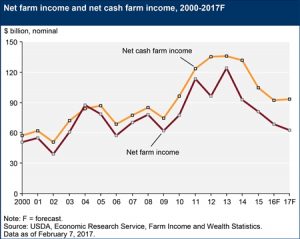
If realized, net farm income in 2017 will be the lowest since 2002, in inflation-adjusted terms. [1]
An analysis by the Federation of American Scientists on the current status of the United States’ agricultural economics reads –
The outlook for a fourth year of lower net farm income, coupled with a third year of lower farm wealth, suggests a weakening financial picture for the agricultural sector as a whole heading into 2017, with substantial regional variation. Relatively weak prices for most major program crops signal tougher times ahead. Low prices are expected to trigger substantial payments under the new safety net programs of the 2014 farm bill; however, eventual 2017 agricultural economic well-being will hinge on crop prospects and prices, as well as both domestic and international macroeconomic factors, including economic growth and consumer demand.[2]
Agriculture is an inherently volatile industry – through which means can we increase the profits of farmers whilst keeping food costs low? How can we invest in rural infrastructure that supports livelihoods and happiness?
[1] https://www.ers.usda.gov/topics/farm-economy/farm-sector-income-finances/highlights-from-the-farm-income-forecast/
[2] https://fas.org/sgp/crs/misc/R40152.pdf