If you have eaten an organic egg in the United States, there’s a good chance you’ve indirectly eaten grains that were shipped across the Pacific Ocean.
Consumer demand for organic products in the United States has grown by double-digits nearly every year since the 1990s,[1] yet only 0.8 percent of U.S. farmland is certified organic.[2]
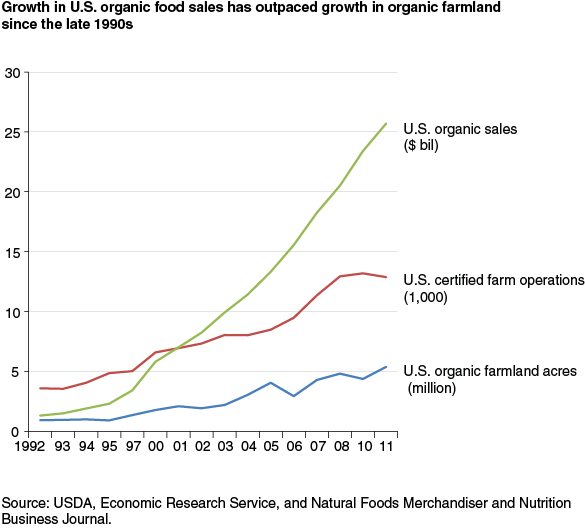
This has led to imports of organic corn into the United States more than tripling from 2015 to 2016.[3]
To help aid farmers who are transitioning to organic production (and to increase supply of domestic organic products), the Organic Trade Association and the USDA recently (January 11, 2017) developed a national program to develop a federal Certified Transitional label for crops and farmland in transition to USDA Certified Organic production.[4] Kashi (now owned by Kellogg’s) and the organic certifier Quality Assurance International (QAI) have created their own Certified Transitional label to help sell their emerging product lines that use “Transitional Organic” crops.[5]
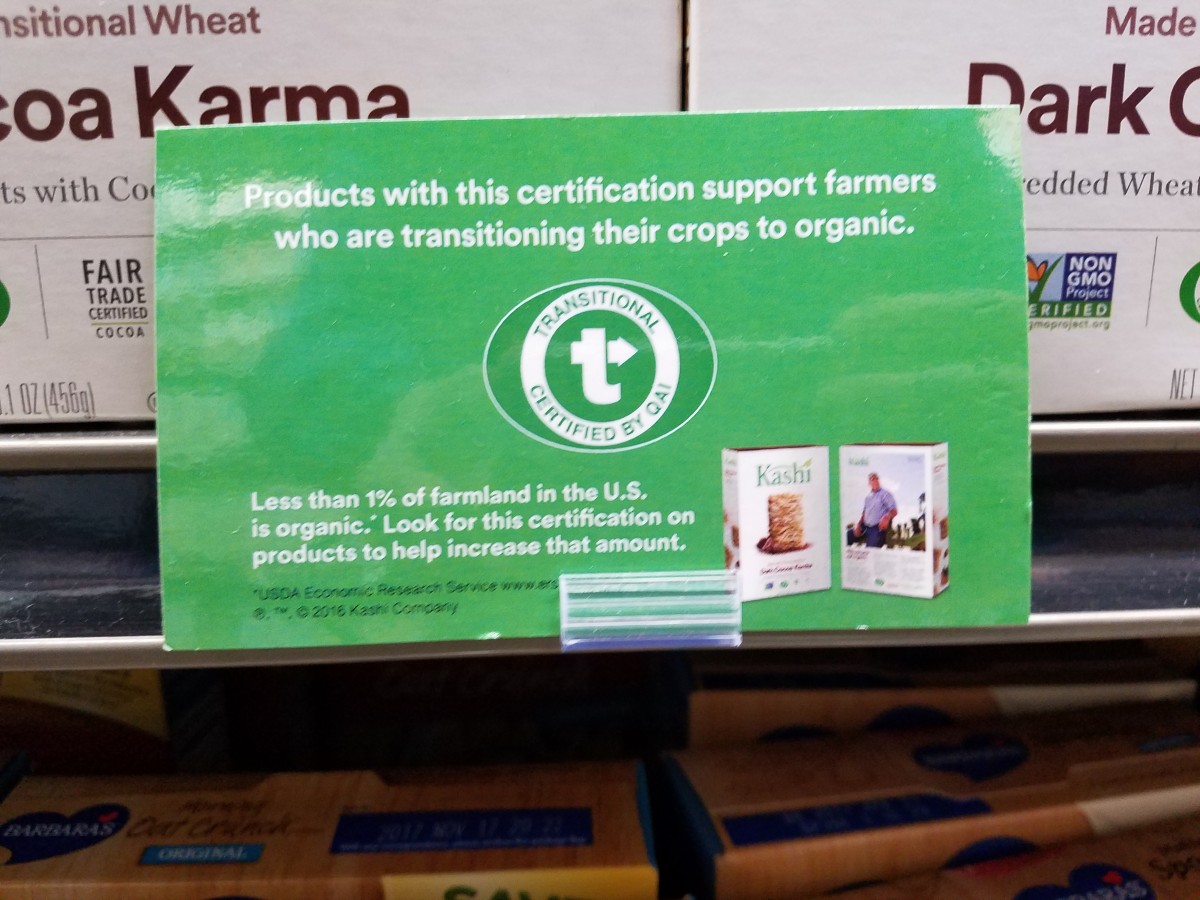 QAI’s Certified Transitional Label on store shelves.
For farmland to produce USDA Certified Organic crops, it must have had no synthetic fertilizers or pesticides applied to it for at least 3 years before harvest of the marketable product. For agricultural producers with cropland in non-organic production who are seeking to transition to USDA Organic production, this regulation forces agricultural producers to produce crops using USDA Organic practices that cannot be marketed as USDA Organic.
The new federal Transitional Organic label should help producers financially bear the period of time in-between conventional and organic production.
A recent event at the biennial Organicology conference convened a meeting of industry stakeholders to discuss the changing organic market. I have distilled key points below.
- agricultural producers do not know what to plant for the following seasons
- some organic famers need contracts to plant anything in the ground
- according to the Organic Trade Association, millennials account for 52 percent of organic purchases in the United States of America
- it’s imperative that buyers know how much the farmers need to make to make food production long-term profitable
- on the same token, transparency on the buying side is imperative as well
- a representative for Kashi said they have five products on the market and people “love” hearing about the story of moving towards Organic production. Kroger was highly interested. Kashi now has 3500 acres in transition this year, up from 848 in 2015.
- a study conducted by Edward C. Jaenicke of Penn State University showed that counties with high level of organic agricultural activity had lower poverty rates and higher median household incomes.
[1] http://ota.com/sites/default/files/indexed_files/OTA_StateofIndustry_2016.pdf
[2] https://www.ers.usda.gov/data-products/organic-production/documentation/
[3] http://www.seattletimes.com/business/as-demand-for-organic-feed-surges-us-cows-feast-on-romanian-corn/
[4] http://ota.com/news/press-releases/19470
[5] https://transitional.kashi.com/en_US/home.html