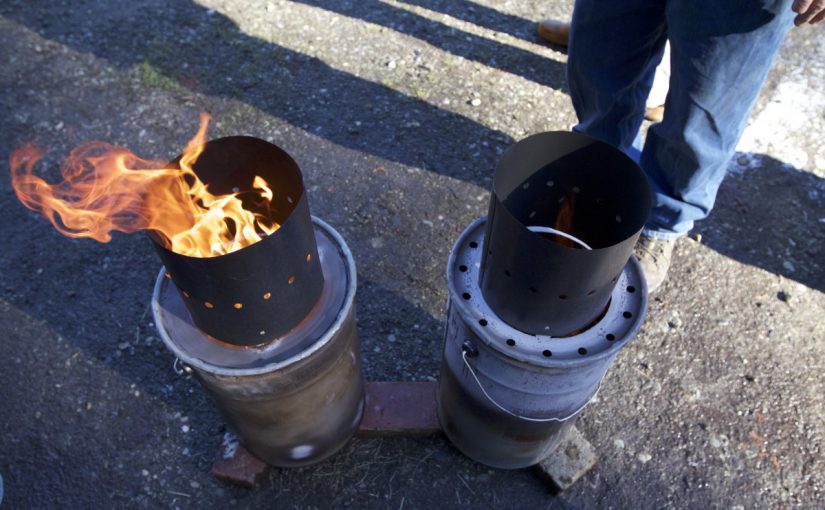
Well it was truly amazing to have the opportunity to go up to Sequim to visit our good friend Norman Baker. Norman is an exceptionally friendly guy that is savvy in the ways of biochar. Not only does he know a thing or two about biochar, but he is even crafting some of the cleanest burning pyrolysis units using metal 55-gallon drums. Norman has been working with biochar for close to ten years only after running an incredibly nursery specializing in Day Lilies, but also attaining his Ph.D. in entomology. Currently he is working on his 17th version of a TLUD. Each one better than the last. Norman and his wife Peggy invited Avi, Arden and I to stay
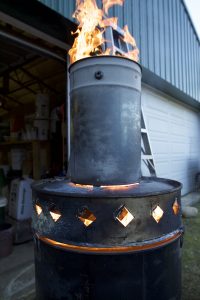
with him for a weekend up in Sequim while he taught us how to make his most current model of TLUD so we can produce biochar to commence our thorough analysis of certain feedstocks. Not only do we get a clean burning unit, but Norman can still collect data relative to his designs and continue to share information with his many contacts.
Norman told us about how he has worked with a couple of institutions to test his emissions from his TLUDs. So he’s quite confident that he’s producing minimal emissions with the data to back that. I’ll have to get in touch with him for his exact figures on this matter. Norm allowed us to work in his massive shop and utilize his tools to cut through the metal and shape our final products. I was able to take plenty of notes and pictures which will be uploaded soon. We spent nearly 2 and half days building two different types of TLUDs, but three in total. Together we had 2 – 55 gallon drum units and 1 – 5 gallon drum unit for biochar production. Throughout the buildout, Norman would fill us in with info such as, for maximum efficiency he found that 10% primary air intake would create the cleanest burn. So with that, he designed a prototype that is engineered for 10% air intake! He also brought up what is called “The Ring of Fire.” This is basically forming the metal to direct the turbulent air from fire into a ring so that the flame actually makes more contact with the air and produces less syngas.
Even during our breaks of making the TLUDs we would discuss biochar and it’s many applications. Norman would show us around his property and show us some of his methods of incorporating it into his garden. Not only does he put it in his soil, but he puts it into his chicken coop where we has seen an increase in the egg size, and his chickens lay longer for the season and their lifetime. He’s also noticed a decrease in disease in his chickens. Also we were graced with such awesome support from his lovely wife Peggy. She would come down and make sure that we were staying on schedule and would even bring us some of the finest coffee and foods from all the land. Literally, ranked.
In the end we were able to finally finish our TLUDs and have our first burn with them. We did one burn in a large and one in the small units. We successfully produced biochar using alder wood chips that Norman had supplied! Unfortunately we weren’t able to bring it home simply because we were in a rush (it was late) and still hot. So we just gave it all to Norman for him to use!