Author: Sjoukje


Wrapping up at GRuB
While my time at GRuB is almost up, the farm is just getting into the swing of things. Nearly all of the beds have been planted now, and some of them are on their second go around already, those in the greenhouses. Much of the focus of the last week has been on transplanting, irrigation and trellising set ups, and harvesting for the market and food bank.

I helped to put up a trellis for two rows of peas planted a few weeks ago, getting t-posts into place, and wrapping a white plastic net between them. Testing and adjusting the drip irrigation systems is a challenging task that requires patience, but one that I enjoy because it feels like doing a puzzle. Additionally, a youth and I worked to wrap up our raspberry patch in a way so we can walk between the rows for harvesting when the time comes. The plants are as tall as I am at the point and needed to have some support for branches that leaned into the path ways. With wire and more t-posts the plants were wrapped back into an upright position.
In the past two weeks we have planted more than a hundred tomato plants in two of our greenhouses as well as outside. Tomatillos, cucumbers, summer and winter squash, basil, eggplant, corn, beets, carrots, lettuce mixes and snow and snap peas. With the help of volunteers and the high school youth, we have been able to make rapid changes to the look of the place. There has been a shift of energy recently, a faster work pace and faster plant growth. The bees are out excitedly pollinating our raspberry patch, the strawberries are almost ready, and the native salmon berry batch we have on site has perfectly ripened fruit!

An additional new thing I learned was to directly supply nutrients to plants by pouring a nutrient rich mixture to the base of young plants. The mixture was a combination of feather meal and compost stirred into water. We did this with our cucumber plants the other day, which Heather called side-sloshing. I imagine this high concentration of nutrients helps in the establishment of the roots of the plants in the soil, and with the rapid growth that is desired at this point in the season. Directly applying compost to perennial plants I have heard of previously as being a helpful application for young orchards and blueberry patches.
It is a bitter sweet experience to witness the farm take off, and to know that my time as a regular part of the crew is finished. With that said, I plan on returning for the drop in volunteer hours on Wednesday throughout the summer. To continue the relationships I’ve built with the interns and the youth that will be returning. Not having the ability to continue to work for the full farming season is a sad realization, and is why I will continue to show up when I can to witness the changes, and support the farm and staff when I can. I hope to continue to learn from this farm throughout this year, and will continue to explore agricultural and farming after I graduate. Above all, I have learned that continuously engaging with the natural rhythms of the season, and growing and gathering food, is extremely rewarding and supportive to my own health and well being.

Sunfield Bio-Dynamic Farm Tour
On Friday early evening, I met Ezra, one of the farm managers at Sunfield Bio-Dynamic Farm, Waldorf School and Community Education Center. He toured me around the 80 acres of land the organization acquired from a farming land trust. An imperative piece of bio-dynamics is providing for native wildlife and natural ecosystems. From what Ezra explained the majority of the property is left for wildlife habitat, with only a dozen or so being in cultivation or having structures built on it. This goes above and beyond the requirement for being a certified bio-dynamic (BD) farm of having 10% of the property left for wild species to flourish.
Much of the land is a forested ridge of large secondary growth trees. There are also several acres of wetlands that play an important role in cleansing the waters of the local watershed that provides water to approximately 4000 local residents. They produce several acres of grass for hay for their live stock as well as allow some of it to go to seed, which they collect as a part of a seed contract they have with a Bio-Dynamic seed provider. About an acre of the land is producing vegetables, many of which go to local businesses or are sold at their new farm stand on site. They also collect seeds from many of these vegetables as a part of the same contract. There is a seasonal creek that runs through the property with willow and cottonwood trees on its banks and large hedgerows of wild roses and native berries that provide critical habitat for wildlife, especially song birds.
 A portion of what they cultivate on site is used to make the BD preparations, and many of the plants used grow wildly, without the need to sow seeds. Ezra mentioned having already collected Dandelion flowers, which had been saved to make one of the preparations in the fall. I also came across some Yarrow growing between the creek and where they had recently planted an orchard. Yarrow is another main ingredient for one of the preparations. We also spent about 25 minutes harvesting Chamomile flowers for the preparations, to be dried and used in the fall. The care and attention given to this part of the process was intriguing to me. He asked that I only pick the flowers whose petals were at a 90 degree angle from the flowers center, and to avoid bug eaten ones and those with missing petals. Ezra described the preparations and medicines for the fields, which was the first time I had heard that particular description of the BD preparations. It put it into a new perspective for me, and helped to explain the care and attention put into the harvesting process.
The abundant medicine offered by native wild plants and common garden plants for people is something I have studies independently over the past year through an herbal apprenticeship. One of the lessons taught by a local herbalist was on flower essences, which works with the energetics of flowers rather than the physical medicine of the plants. Through a complex process involving capturing the flower in a bowl of water exposed for a long period of time to direct sunlight, the gentle medicine of each plants unique flower is collected and used in an extremely diluted manor similar to homeopathy.
In my exposure to the preparations, it is my understanding that they are a sort of combination of both the physical medicine of the plant and other ingredients as well as an energetic, homeopathic-like medicine. Because the preps are buried over winter or even longer, they undergo a fermentation process. And then before application, some of them are diluted greatly in a large vat of water and stirred for an hour, which is said to change the energetic, polarity of the water. While this is very etherical practice that I am only beginning to understand the theory behind, by drawing these correlations to medicinal practices and the relationships of plants and people, I have reached a new understanding of the potential power the preparations have to heal the land they are applied to.
Through the experience of witnessing and engaging with a BD farm, I have affirmed the parts of the practices used that I really appreciate, including the providing of natural habitats for wildlife and ecosystem functions, as well as the heart and care that is put into the work. Treating the entirety of the land as a living dynamic system and seeing the farmer’s role as that of steward and cultivar also aligns with a more holistic perspective that carries over into the world of Waldorf Education. While I haven’t had the chance to see the two systems working in tandem (as the children were out of school at the time that I visited), the shared perspective and practices of whole system care that is less goal-oriented and more processed-focused is something that I see as an incredible alternative to large scale industrial agriculture and the public school system’s practice of standardized testing. It is a world that I wish to engage with further and hope to gain a deeper understanding of through hands-on experiences in my near future.

Forest Day- Stories in the Understory
The Monday of week 8 I was ill, and had to miss my regular day at Bird Song. I was able to make it up by attending the Wednesday gathering instead. As I spoke to in one of my earlier posts, the routine structure that Ms Aimee has built, where each day has its set activities, flow, and meal plan, establishes a structure of predictability that allows the young ones to thrive. Being able to know what is coming up next in the course of a day, and what the associated expectations are, provides a sense of security for the children, and it is this security and the assurance of routine that allows them the freedom to thrive as individuals within the structured system.
And so, hopping into the Wednesday routine, I was once again amazed by the behavior of the children. You see, Wednesday is the day that the whole group meets at the Evergreen State College F parking lot for an afternoon of frolicking in the forest. Once everyone had arrived, we began with a welcoming circle, which is something normally done as a transitional activity on Mondays, but here acted as a tuning in activity, where everyone comes to the same page and shares in song and body movement. I discussed with Aimee later in the week, that these circles serve multiple purposes; those that I just stated above, and also as a way to help the child connect to their body, and their senses. It challenges them to practice balance, impulse control, and to develop cross-body movements, also known as “crossing the mid-line.”
Once circle was finished, we headed out into the forest, following the same series of forest paths that they have for many years. For the students that have been at Bird Song for three years, they are extremely familiar with not only the route and flow of the routine that each stop provides, but also with the plants and animals along the way, and at various points in the trek. Our first stop was brief as we were running a bit behind schedule. We stopped in a small clearing with a few fallen trees and stumps, one of which was a make believe store that a student had established the week prior, and she promptly set up shop again, offering treats and forest finds for trade or free. I was gifted a particularly plush array of moss! Others, climbed large stumps, found slugs and centipedes and played games.
We departed the first stop, and crossed the main path to a small side trail, where Ms Aimee briefly reminded everyone to use their fox feet and owl ears, in other words, to step quietly and to listen for the sounds in the forest. We walked silently through along the path, listening to birds chirping, bugs whirling, and the breeze passing through the trees. When we made it to the next stop, everyone excitedly shared what they had heard and seen along the way. Then it was story time. The children found their seats in the circle of logs and listen quietly as Ms Aimee painted a picture with her words. When reflecting on storytelling with Aimee in our meeting, she shared that part of the goal of that is to have the children experience the story internally, to see and feel her words in their minds and bodies, another tool for connecting child to their sense.
The next activity was to run from this spot to the next, allowing the children to use their bodies to their fullest, after a time of quiet restfulness. They practiced listening to Ms Aimee say “On your left!” and they responded by all moving in unison to the right side of the trail, allowing her to pass. With her taking the lead, we were off, each running at our own pace, a few in the back strolled leisurely as they desired, with the other accompanying adult trailing behind in support. The rest ran down a little path a few exercising their practiced words, and passing their classmates. When we reached the next clearing, we all stopped and settled into snack time, each finding a seat below a tall tree of their choosing, as the adults passed out cheese, bread and apples.
Once snack was complete, and they were excused from their spots, they were free to play in the area for quiet some time, in a fairly large range. A few children wanted to go check on a birds nest that was discovered the week prior by a little one that is particularly in tune with animals and had observed the mama bird flying into and out of a low crack in a tree several times. When she approached the tree, she discovered 5 tiny eggs in a little nest. Impressive for a little one to have such keen observation skills and awareness of her environment to make such a discovery!

When we were running around this area, I was excited to share something I had recently learned about a plant, and asked a few of them, “do you want to learn something about this plant?” to which they replied “No.” I immediately recognized my mistake. Rather than taking the opportunity to translate my excitement into a story or game, I instead tried to just tell them a fact. Boring. I had to laugh at myself for my failed attempt, and resolved to learn from this experience. While I didn’t make another attempt, I did discuss it later with Aimee and we had a good laugh about it. She pointed out the difference in being told something is true, verses learning it to be true through personal experience, through witnessing it with your own senses.
As the day continued, they pointed out plants along the way, crying “sticky-weed!” as we came along a patch of cleavers. They pulled some out and gave me a tail! Another spot along the way, they asked for the licorice that had been plentiful the week before but was no longer available. Instead, we found salmon berries to share with the group, and pointed out plentiful Oso berries adorning Indian Plum, almost, but not quiet ripe for eating. I was impressed by their knowledge of plants, of which we can and cannot eat. This is something I have been learning in another educational experience outside of school with a local herbalist. One of the things she tells us is the value in experiencing the growing cycles of these plants throughout the year. Of seeing how they change with the seasons, and by observing this for multiple years. The more time you spend with the same plants in the same area the more you can learn about them, and the more in tune with your environment you will be.
Although there is much more to this day than I can fit into this post, the last thing I wanted to speak to was at the very end of our time on campus. When we walked into Red Square to catch the bus, we came across the bouncy houses, obstacle courses and slides that were out for the play day event. How can you deny 4-6 year old the opportunity to slide down a big inflatable slide and bounce in bounce house? We had less than ten minutes to make the bus, which the children were well aware of and understood. They each took their turn on the slide, with one exception, setting down their backpacks and taking off their boots, and then the same at the bounce house, except all at once. When we said it was time to go and put your boots and bag back on they all did so promptly and without fighting it. They respected the time restrictions and all hustled to make the bus on time. Once on the bus they all excitedly shared the story of their experience on the slide and how they were going to tell their parents! No complaints that they only got to go once, just pure joy from the experience. I must say it was a shock that we didn’t miss the bus, and that there wasn’t a single issue that arose during a highly stimulating experience.
All in all, this day opened me up to a whole new kind of outdoor, nature-based education. While I didn’t have much experience in this realm prior to this day, the ones that I did were much more educationally bound and lesson oriented. I greatly appreciate the self-directed learning style that Waldorf Education offers. The free play time in all sorts of settings, as well as the familiarity of the routine throughout the year and potentially for multiple years sets the children up for self- and environmental-exploration, and the results, in my experience, are quiet profound.
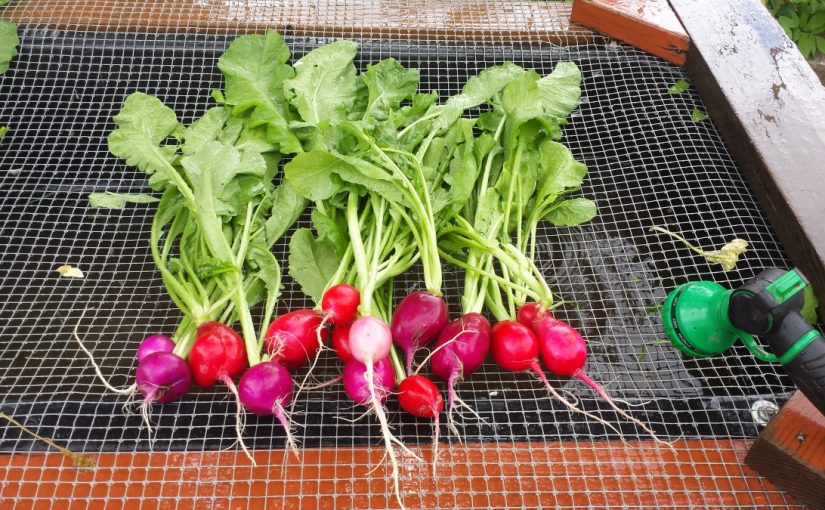
The First Harvest
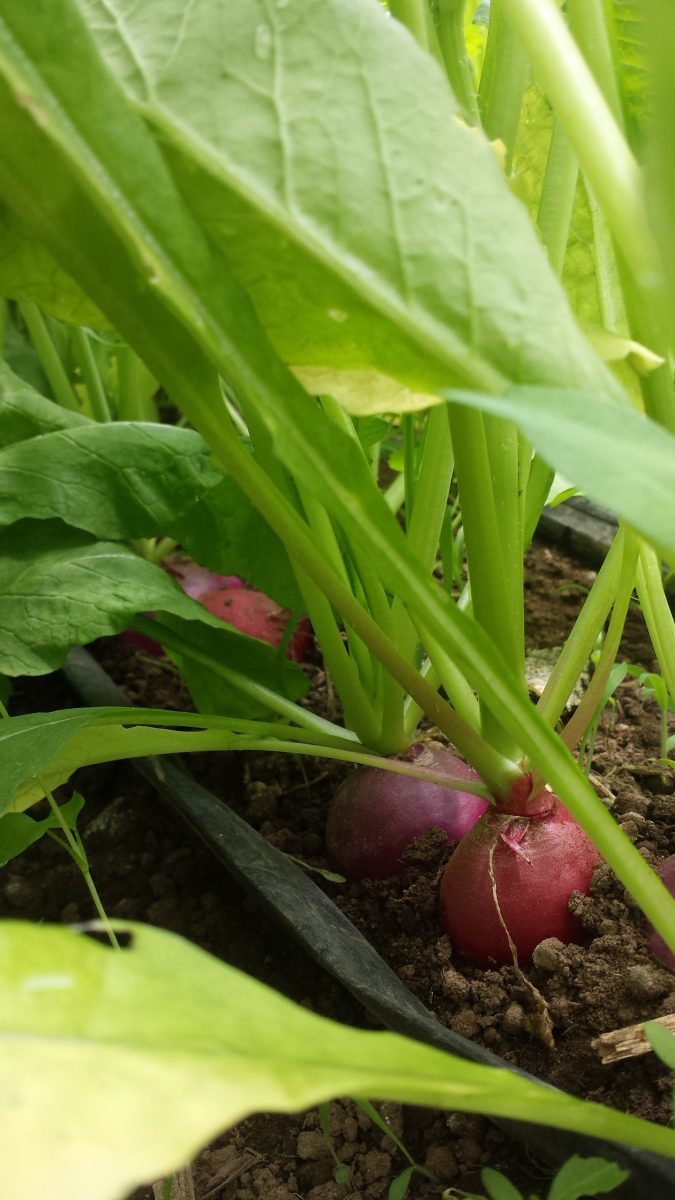 I fell in love with radishes today. I was tasked with harvesting two-thirds of the radish crop we planted back in March. I had no idea when I set out with a large tote in hand how much I would enjoy the harvest. Radishes are among the fasted growing agricultural crop in production being ready in as little as 4 weeks. A large portion of the patch had begun to bolt, so we decide to pull them out of the ground. Their bulbous roots and bright colors were also peaking through the soil hinting at the spicy juicy bites to come. With just a gentle tug of a stalk the whole plant uproots in your hand.
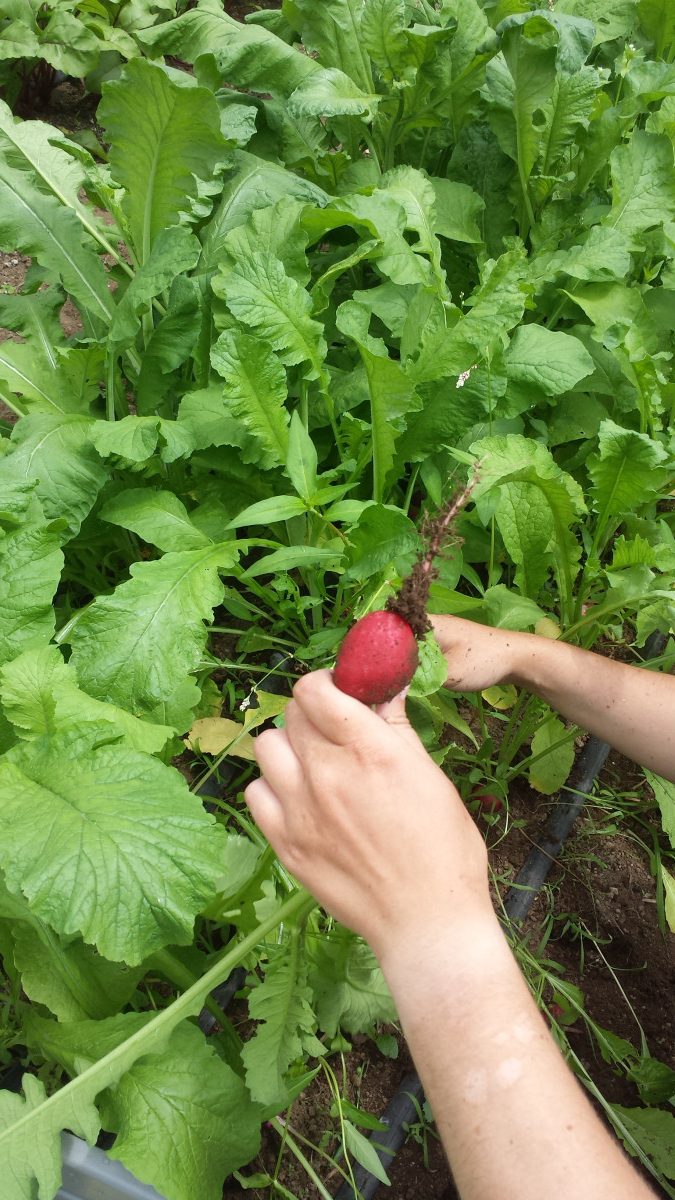
One of the first things my eye catches is the bright color of the flesh of the radish root that was under the moist soil and how the color fades just above the soil line. Then as I pick a handful, a rainbow of purple, red, pink, and white is revealed. One of the seed packet types of radishes planted is a mix known as Easter Egg, which produces the variety of color seen.
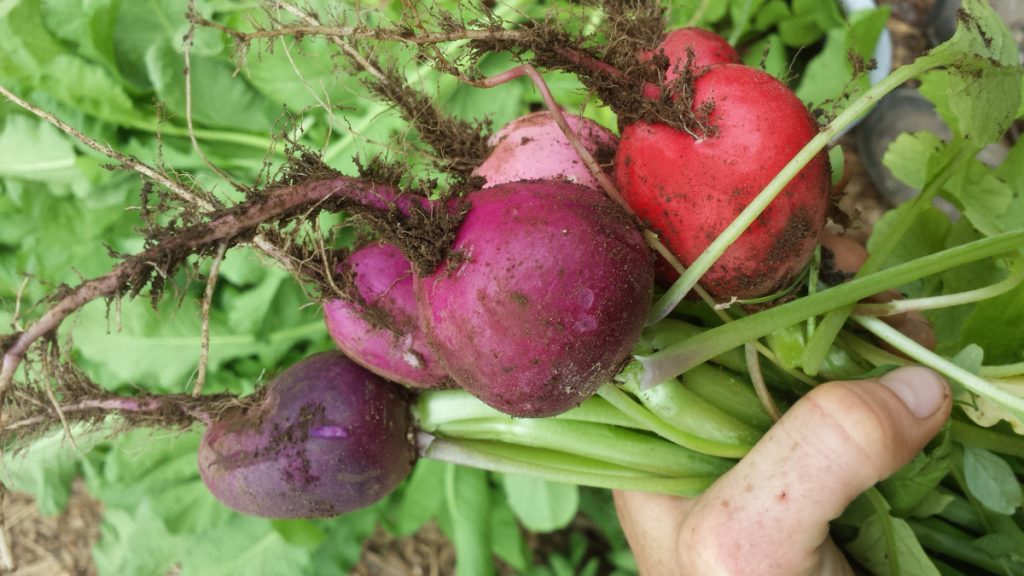
After I pulled the crop, I took them to our washing station. The large black tubs that come up to waist height with an optional mesh covering are useful in washing large amounts of produce at a time. With things such as our spinach and salad mix the tubs are filled and the plants submerged to wash then spun to dry. For the radishes, and turnips I did later in the week, sorting them on top of the mesh and spraying them off works well to get the dirt out of the roots without damaging the leafs. The small and bug eaten leafs are removed first then the radishes are sorted into groups that have bolted and are destined for staff and the food bank, and those that are able to be sold at our market stand.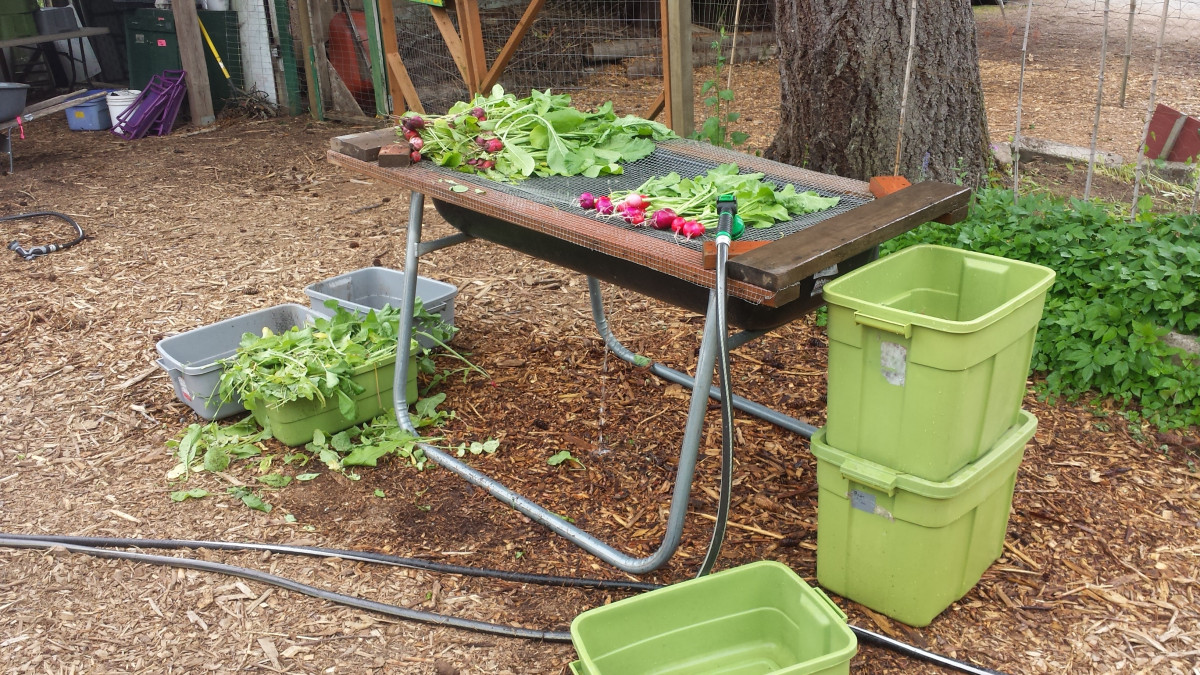
When the radishes are washed they brighten in color drastically and the whole plant seems to perk up and shine. I felt such a joyful connection to these plants throughout the process of getting them ready to eat, taking gentle care of their leafs and admiring each of their unique shapes, sizes and colors. They are bundled by the handful and stored in our walk in cooler until they are ready to be weighed and sent away. I took a few handfuls myself and have enjoyed the spicy snack and fresh greens throughout the week!

Farm Tasks and Soil Science
The change in the weather over the past two weeks has finally allowed us to get some plants into the ground outside of the greenhouses. Last week consisted mostly of preparing the soil with amendment, tilling, and digging and shaping beds. With most of that work done last week with the help of the high school youth and community volunteers, this week we were able to focus on transplanting our starts.
On our volunteer drop in hours with week, we were able to plant out a row of lettuce, four rows of brassicas, as well as accomplish some weeding, more bedding digging and shaping, irrigation set up, farm chores, and the repair of a fence. Earlier in the day, the other farm interns and myself worked on laying drip tape in one of the greenhouses. This process requires a lot of patience as leaks occur frequently and one must test and repair the lines multiple times before everything is secure.
The following day a group of farm interns and staff plus two youth worked on planting the potatoes we had prepared two days prior. We had cut the seed potatoes, and covered the exposed areas with fir bark powder to prevent mold from growing and rotting the crop. When it came time to plant them in the furrows plowed by Heather, the farm manager, we spaced them a foot apart and covered the sprouts with an inch or two of soil. As they grow we will continue to cover them up until the rows are mounded rather than trenched. We then covered the five, 130 foot rows with row cover to protect the seedlings from the heat of the coming days. The brassicas planted the day prior were also given row cover.
One morning this week was spent learning the ingredients of and building a pile of potting soil, and what there purpose is. The main base ingredients include compost which offers life and body to the pile. Re-hydrated coconut fiber is included for water retention and has a neutral pH. Propagation perlite is a porous volcanic rock which allows for air and water to move through the mixture and drainage to occur. Vermiculite is a mineral that is included to increase the cation exchange capacity of the soil mixture, making essential nutrients more available for a longer period of time as they bond to the vermiculite until used by the plant. The last base ingredient is pre-made organic potting mix, which is added just to add more body to the mixture.
The following ingredients are mixed separately first before being mixed with the base ingredients on a tarp. They are added in much smaller quantities than the main ingredients. A bit of sand is added for drainage. Lime is included to add calcium and raise the pH. Alfalfa Meal which contains an NPK ratio of 3-1-2 stimulates growth in the young plants we use the potting mix for. Kelp meal (0-0-2) helps with root growth and provides trace minerals. Rock Phosphate (0-3-0) or alternatively bone meal (1-12-0) are added for their phosphorous. Azomite provides trace elements and minerals to the soil. Lastly, crab meal (4-3-0) is added to combat soil pests that young plants are very vulnerable to.
The potting soil recipe used by GRuB has been adjusted over the years to adapt to the needs of the plants. For example, the starts used to grow a large amount of green mold on top of the young seedlings. Heather, the farm manager has since modified the ratios of these ingredients, and the issue has significantly declined. Maintaining a proper nutrient balance in potting soil and in your fields is extremely important for production and the health of the plants. While I understand the basic concepts of nutrient cycling, the components of a healthy soil, what each of the ingredients does for the soil, and how to build compost, the skill of knowing what and how to adjust the mixtures and amendments to meet the needs of the plants is something I believe takes more experience to learn.

Mid-Quarter Self Evaluation
I am really enjoying the work that I am doing! And I am excited that that is the case. The more I work with the young children at Bird Song, the deeper in love I fall with them, and with my goal of having my own school garden project. It is affirming to realize that the work you are doing brings you joy and fulfillment. And with GRuB, I feel very similar, though I have learned I am not as in love with a field trip setting, simply because you don’t get to build relationships with the students involved. They come and go so quickly, and I’d much prefer to get to know the youth I am engaging with on a deeper level so as to better support their growth and learning.
Working with the high school youth at GRuB is very rewarding and challenging. Because they are much more socially and culturally aware, and are learning to navigate the world as young adults, interacting with them takes a different sort of patience and attentiveness. There are much more subtle ways in which one of these students may signify that their needs are not being met, and your response to them must be much different. It goes beyond providing basic needs, and requires skills in supporting the youth to be self empowered and self confident. Although, as I say that, I realize that this is also what is being offered to the young children, just in different ways. There we are encouraging them to put their shoes on themselves, and they are learning how to use their bodies to move through their environment. But with the high schoolers, the empowerment piece ranges from teaching them to grow and cook their own food, to engaging in social activism.
Either way, the principles of supporting their growth, development, and education are the same, and as I navigate this work, I am learning new tools and skills for doing just that. Learning when to engage and when to let things play out on their own is one of the biggest lessons I am learning right now. There are certain things that the high school students say or do that you can tell they are trying to get a reaction or attention (and the same goes for the young ones), but when they cross into inappropriate or unsafe behaviors, that is when I believe engaging is necessary. Often it just takes a gentle reminder. Other times though, it becomes necessary to pull individuals aside and as GRuB would call it, “Request a Change in Behavior.” Aimee at Bird Song demonstrated a few of her strategies that I discussed in my previous post “Lessons in Storytelling”.
These and other tools I am picking up through my readings as well. For the piece of my contract specific to farming, I have been mostly reading about soil science. At the farm, we have been building up the soil, by adding amendments and compost to it. While I haven’t directly participated in the amendment process, we were taught about what we add to the soil at GRuB and why, and those that did the soil amendments have shared their experiences with me a bit. The biggest things that have stood out are that people were surprised by the amounts that we have to add, were uncomfortable with how the worms in the compost reacted to the amendments, and have had lung concerns since. Organic agricultural practice are certainly far better than modern agriculture’s chemical warfare waged against the natural ecosystem functions. But is it the most in-sync with the the ecological systems in place?
I am realizing that I am not so sure that organic goes far enough. I have more research to do on Biodynamic, but what I know about the Preparations thus far leads me to believe that my fellow interns and myself would not have had such negative reactions to the amendment process, and seemingly the soil creatures would be less affected as well. What I do not know, is if the quality of the plant grown, the nutritional value, is higher than when using organic farming techniques. Hopefully some answers will arise in my studies over the coming weeks. I am feeling a pull, which I believe comes through in my writings, toward a more spiritual connection to my environment, and I think diving deeper into biodynamics will lead me to ways more aligned with my values, in relating to food and agriculture.

Farming for Food and Feelings
One core value held by the GRuB community is a reverence for the land under their care. They know its history and give thanks for all those who tended to it before, and for all that it has provided. Take one handful of soil and move it through your fingers and you can see and feel how well cared for it is. Although, I don’t know much in the way of soil science presently (though it is one subject I will dive a bit deeper into in my studies this quarter), I do know how it makes me feel putting my hands in the soil there- that is, happy!
In the first week’s work we shaped a few beds in one of the green houses. At first I felt awkward in my body mechanics, but quickly built a rhythm and began to feel comfortable and confident in my movements. As I did this, a sense of calm and joy filled me as the reality of my new role here settled in. I became excited at the opportunity I have to get to know this piece of land I’ve worked on for two years more intimately. As an intern, I see myself as a co-steward of the land. The lives of the plants, animals, insects, microorganisms, mycelium, and all the wildlife that frequents the area are impacted by the work we do there and therefore fall under our responsibility. A Biodynamic principle I learned at the workshop says to not only do no harm to the ecosystem in your care, but to also take steps to regenerate it. The role of a farmer is to grow food, but the way in which one chooses to do so has great and lasting effects.
It is my intention for the quarter to engage with each task with my full attention and heart. This means, when I am working in the beds, I am connected to my center using healthy posture and body mechanics, listening to my body’s needs, and I am checking in on the plants we are working with, adjusting their habitat to suit their needs. Wondering thoughts are natural for me when doing a repetitive task and working with my hands. I appreciate weeding for that very reason, as it offers me a safe space to mentally process and release some of what has been on my mind. The practice is therapeutic when I choose to view weeding as a metaphor for the personal work I am completing.
Although this may seem counter to my earlier statement of giving my full attention to the work I am engaged with, I think the two can overlap nicely, where my mind and hands are attentive to the task I am completing, and my subconscious is engage in a deeper layer of work, unearthing and releasing things on the back of my mind. I believe engaging with the work in this way, calm and methodical, rather than rushed and stressful, does the land a huge service. By tuning into the slow and smooth rhythms apparent in nature and matching our activities and mentalities to them, I believe we can know and care for a farm or garden in a more holistic way.
As I work more with the soil, and the amendments we add to it in the coming weeks, I plan to infuse it with not only micro-nutrients and organic and particulate matter to achieve rich and productive soil, but also with my love and gratitude- with my hope that the reciprocal relationship between the dirt, the plants, wildlife, and the farmers grows stronger, healthier and more bountiful with each new season. By honoring and prioritizing these relationships, I feel that I am able to more genuinely engage with the community there and the result is increased happiness and health for myself and the farm community, which is one of GRuB’s missions as an organization.

Returning to the Field Trip Program
Beginning week two, a group of six high school GRuB students, the farm manager Heather, a farm intern, Devon, and myself began preparing for hosting field trips on the farm. With having worked so closely with the program last year, my role this rotation was to assist Heather with some of the organization and planning of the structure of the field trips and the training of the youth and my fellow intern on hosting groups of various ages, sizes, and abilities. We are attempting a new structure this year where the visiting group’s leader selects a theme for their visit. Based on the feedback we received last year, and reflecting on the structure of the program with GRuB staff, we decided to try on this alternative model.
Rather than leading every group through three of four workshops and a farm tour, we are instead teaching more in depth around one or two topics, and include a farm work portion to the visit. This looks like splitting the visitors into groups of less than ten people led by one or two of us on tours, in which we stop at the compost pile for 20-30 minutes to listen and learn from one of GRuB’s youth about how and why we compost, and then all jumping into work on building up our existing compost-in-progress pile. At another point in the tour we stopped for a water break by the herb garden and played a decomposition themed tag game and watched a demonstration about topsoil. This style of filed trip structure seems to allow for more in depth learning in to a focused area, this rotation was specifically compost. Next week, there will be a bigger group that may need to be broken up into 3+ workshops simply for organizational purposes. It is much harder to get 50 2nd graders to build a compost pile or successfully mulch or weed an area than it is for 20 6th graders.
Jumping into this program again, and being the main authority on the content has put me in a unique educational role. Through the work and support I offered over the last two weeks I consulted/instructed people in four different classifications- the visiting tour group, the high school facilitators, the intern (who would go on to train other farm interns on preparing the youth for the job), and Heather, the director of the Field Trip Program, who sought and headed my advice for many aspects of the week’s activities. In most of these roles I felt my contributions and performance were well executed, a part from the actual leading of a tour for 6th graders. My first one since last spring, I felt rusty in my abilities to keep the group focused and respectful of myself and the youth facilitators. The age of the group, and the culture that exists at that age led to some pretty distracted side conversations and general rowdiness. The teacher from the class also contributed to this rather than keeping the group’s behaviors in check.
Upon reflection, I see that I could have asked her directly for more support, or tried to change the way in which I was engaging with the group to match their energy and try to direct it back to the topics at hand. That is a skill I’d like to cultivate more this season. To adjust more readily to each respective group rather than try to force one specific style or framework on to each. I think that is one of those “teacher skills” that build over time as you learn new strategies for engaging youth and specific tools to interrupt unwanted behaviors and introduce alternatives that work for everyone involved (ideally). I found myself quite frustrated by some of the behaviors of my tour group, which I think led me to not engage with as much enthusiasm and passion as I know I am capable of, for fear of showing my frustration. I think an important thing for me to remember is that it is okay to not stick to the plan exactly and to allow for each group to self direct the learning based on their own interest, engagement and questions.

Lessons in Story Telling
I have now spent two Mondays with the Children at Birdsong, and with Ms Aimee and Ms Louise the lead educator and her assistant educator. One of the first things I noticed is how well the group of three to six year old children knew and respected the day’s schedule. They understand the confines and freedoms that comes with each activity and for the most part engage happily in each without fighting the rhythm. The was the school is set up, each day has its own set of activities, snacks, outdoors time, a creative endeavor, and schedule.
I think because of the predictability of the routine the children know what to expect and what is expected of them. I believe that creates a sense of security for them. Because of how well established thier routines are, it was easy for a first time volunteer like myself to jump in without causing a wave of distration. I found great pleasure in observing and participating in the whimsical play time of fourteen young, creative minds, as they run about the house trailing scarves and strings.
On my second day with the group I paid a bit more attention to how Ms Aimee engages with the individual children. For the most part, it seems to be a pretty hands-off, play-based, minimal directives given dynamic. One child in particular becomes rather wheepy at points throughout the day, and she does get involved to assure fair play is happening. I will have to pay more attention to how she interacts with him in multiple settings to better understand his particular set of needs.
At another point, a few children were playing the classic, “it’s opposite day” game. Initially Ms Aimee engaged with them in it, and then recognized the error in her ways and said something along the lines of, “this game can become confusing… I am sorry I engaged with you on this.” They momentarily attempted to continue with opposites, when she interjected by asking, ” What’s the opposite of ________?” The children were quickly captivated by the mental challenge of this line of questioning, and so was I. We went through more than ten pairs of opposites before transitioning to the next task, and opposite day was left behind.
This was such a cleaver thing she did, I believe, turning a nucence of a game into an educational opportunity. She did something similar when a student fell from his seat, and there wer a few giggles from other students. She said we must check with the fallen boy first to see if this is funny or if he is hurt- he determines that. She proceeded to tell a related story where based on one person’s reaction to an event that directly impacted them, the witnesses determined how to respond by matching the feelings of the effected individual. This was such a simple lesson woven brilliantly on the fly with a story, encouraging safety checks, and social awareness.
Lastly, I was able to participate in the birthday celebration of one of the students which was centered around story telling. Ms Aimee performed a puppet show, telling about herself encountering animals and chasing them to play with her, and them all running away. Then, she sat still, and they all came and sat near her, of their own free will. The children all sat very still and quite, listening and watching very intently to the beautiful story. Later, at lunch, a story was told for every year of the child’s life, sweet memories of the birthday girl.
I recognized throughout the day the significance and power that story telling has, especially for young, curious minds. Engaging multiple senses and connecting to emotions leaves an impact on these children; they understand the lessons when they are “shown” rather than simply told what to do. Monkey see, monkey do, right?