
THEORY
The figure/ground and form/facture/ “Post-Feminism”/the photographic/ abstraction and more creative copying
Reading: Painting Today: ch’s on Abstraction, Photographic, and Post-Feminism; PDF:Shutz-Sillman interview
Podcast/Video: TJ Clark on Rembrandt (for Thursday’s studio workshop)
I still don’t really appreciate abstraction. At least not in the ways that I think it’s meant to be appreciated. If it’s meant to be appreciated or meant to be anything at all.
For the Photographic Chapter, I thought it was funny when Godfrey pointed out that ever since photography was invented that there has been guilt on both sides of painting and photography over their connection but now they go hand in hand. I think photography is so convenient at this point that it’s hard to justify not taking some kind of advantage of it as a reference resource in my opinion. I usually draw from imagination and memory, but this reminds me of the last time I tabled at Chibi Chibi Con, I was running a drawing game table and a lot of the teenagers who came to draw with us only wanted to use No. 2 pencils and had their phones out to use reference images while drawing. I thought it was weird that so many kids did that (and that they were taking the game so seriously), photography can be a real crutch, It’s strange how often one can tell when a painting or a drawing is photo-based.
Shout out to Godfrey at the beginning of Post-feminism chapter for being aware and acknowledging the lack of diverse representation of artists in his work. Even though Art has been historically dominated by dudes, most of the artists I’ve known and met in person throughout my life have been women.
PRACTICE
Studio: Drawing and painting the figure from observation and from a photograph; copying from reproductions. Prepare alternate surfaces to prime and paint on. Keep these small since they are for experiments: board (masonite, board, ) heavy paper (Lenox sheets, museum or mat board), cardboard or other found material, glass, old painting. Paint on 2 alternate surfaces, 1 for each of your 2 creative copy assignments.
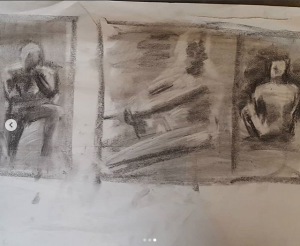
Figure painting was good this week. I was surprised by how easy it was for me, or rather how smoothly it went. I usually do figure drawing with markers because it’s more fun and every now and then I’ve worked in charcoal. But for painting, painting forces me to use a different kind of vocabulary from ink drawing and charcoal. I think painting went smoothly though because since I’ve done so much figure drawing in the past, I was able to represent things through painting that I’ve noticed while drawing but was unable to depict. Painting was unrestricting for me.

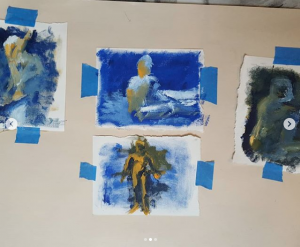
Creative copy: due Wednesday for critique, 2 copies of a figure painting with a focus on facture, the structure of the figure and the figure/ground relationship. Choose from Frank Auerbach, Head of Catherine, p 174; Fang Lijun, 19931 No. 1, p 176; John Currin, Ms Omni p 178; Lisa Yuskavage, Brood, p 204; Jenny Saville, Reverse, p 393; or Lynette Yiadon-Boakye An Insistence of Amber (Links to an external site.), Citrine by the Ounce (Links to an external site.) or any of the portraits here (Links to an external site.)
I chose Fang Lijun because his painting looked exciting and colorful, but also because I appreciated the sense of humor in his work. I chose to copy Lisa Yuskavage because I thought the body horror theme was interesting. I made Lisa Yuskavage’s Brood the creative copy by using Fang Lijun’s colors because I thought that would be a good joke. I painted both paintings simultaneously. I did a grey acrylic underpainting for both and ran into problems again with underpainting clashing with upper-painting. Particularly with using yellow over any area that wasn’t white.

Copying from a photograph: for Thursday, bring a photograph of a head from the shoulders up.
I still need to work on this. I think I understand what the assignment is now.
Writing: due Tuesday @ 7:00pm: Ekphrastic Essay (Group 1) & Thursday @ 10:00am: Response Essay (Group 2) [Find out your group/who you’re responding to here.]
Bea’s paper was really good, I’ll writing more like that next time I do an Ekphrastic Essay.
Terms –
Figure – From conference I learned that figure actually could refer to anything in art and may not be exclusive to depictions of bodies.
Theory – The way I understand it, art theories are ways for people to think about art: what art is, what art does, and other questions. I guess the main thing is that theories are questions.
Subject – The topic or primary theme of the work. I wanted to reaffirm what subject referred to.
Content – Content refers to the intellectual, psychological, spiritual, narrative or aesthetic aspect of the work.
Objectness – This is the state of being a physical object. The way I understand it, this term can relate to the vessel of art. Like taking into account the paper words are printed on, the screen of light that a video is projected through, or that a painting is chunks of paint on canvas hanging by nails and string.
Skills –
Painting Abstraction
Vibrant Color Painting
Essay Response
Figure Painting
Learning Synthesis
Artist Research –
Pablo Picasso – Las Meninas of Pablo Picasso
Painted in 1957. A series of 58 paintings: 45 interpretations of Valasquez’s Las Meninas, 9 scenes of a dove, 3 landscapes, and a portrait of Jacqueline. “If someone want to copy Las Meninas, entirely in good faith, for example, upon reaching a certain point and if that one was me, I would say..what if you put them a little more to the right or left? I’ll try to do it my way, forgetting about Velázquez. The test would surely bring me to modify or change the light because of having changed the position of a character. So, little by little, that would be a detestable Meninas for a traditional painter, but would be my Meninas.” – Picasso
I’m interested in this painting because I was looking at Fang Lijun’s paintings and thinking about the things I liked about them. One thing that I pinpointed was the use of repetition in and throughout his works. I liked the humor of his work and the repeating figures are something that added to that humor for me because I read repetition as a joke or something. Like, a bunch of identical bald toddlers swirling around in an endless vortex? (Fang Lijun, 30th Mary). That’s funny. So after picking repetition, I remembered Pablo Picasso’s Las Meninas from a Shaw lecture. I’m interested now in what repetition does and what comes forth through repetition. I think this may be what my project is about.
Andy Warhol – Silk Screens
When thinking of repetition, Andy Warhol also came to mind. I’m not very familiar with this artist, but I’m aware that part of his work was repeated images through silk screens. From research, Andy Warhol’s silk screens were intentionally imperfect so that repetitions would have variety between them. This is the page I was reading about his silk screens,
Prince of Boredom: The Repetitions and Passivities of Andy Warhol
By William S. Wilson, 1968:
Prince of Boredom: The Repetitions and Passivities of Andy Warhol
It says that some of the themes that came from sloppily using silk screen replication (which could easily be more precise) were: variance and invariance, and carelessness vs carefulness. The page also says that the repetition extends into film and the films are about the bodily actions we repeat throughout our lives (sleeping, eating, sex).
“But even as Warhol shows that repetition cannot be achieved, he shows that it cannot be avoided. He shows repetition as a glory, as a jest, and as a riddle, and he shows the sufferance in suffering.” (William Willson)
For my project – This is What I have So far
SUBJECT – Repetition, absurdity, and humor.
THEORY – What repetition does and what comes forth through repetitions.
ARTISTS/WORKS – Fang Lijun, Pablo Picasso, Andy Warhol
List and explain 4 aspects that are most impactful and why. What connections can you make between them?
- Process – I’m interested in that concept of painters being sucked into their paint. I wonder if I can be a painter like that.
- Obsession – A lot of painters seem to really zero in on some kind of obsession when it comes to the content of their work. Like Fang Lijun and bald headed people.
- Objectness – I’m always interested in playing with objectness in art. A lot of the art I’ve done across mediums has involved bringing attention to that, although breaking the fourth wall has never been a main focus of mine. It’s always been a side thing for me.
- Alchemy – This has mostly to do with accident and experimentation for me.
For me, these 4 aspects connect together as an artistic identity and that’s why I resonate with them. These are four areas that I’m interested in pursuing.

Leave a Reply