
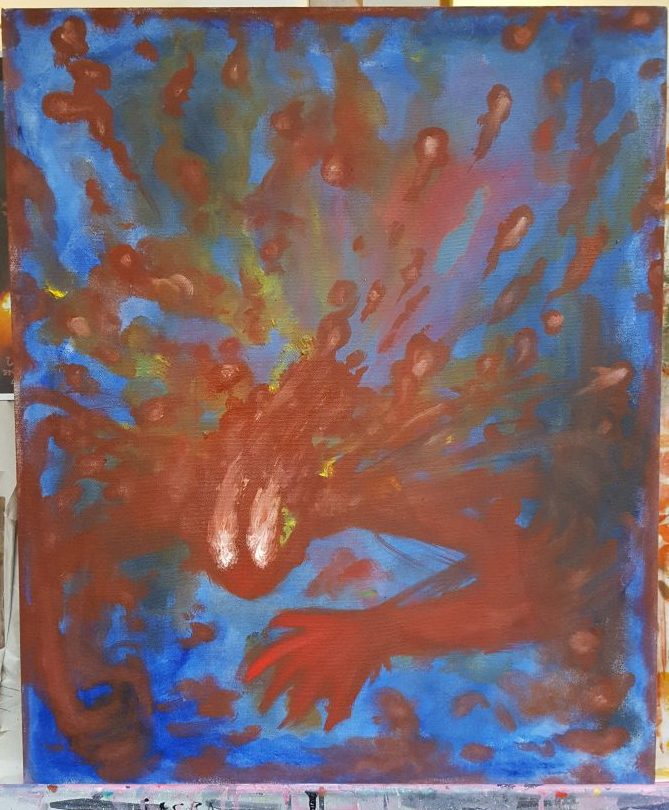
On Tuesday I greatly edited my large painting and made slight edits to all of my other paintings. I completely redid the large painting pretty much. I hadn’t done much for it yet but was dissatisfied with what I did have, so I painted over it completely with shades of blue. The painting at this point was very muddled and chaotic, completely covered with unique shapes. So I kept flipping the canvas over and over again until I saw a potential painting amongst the random shapes. This is how I did most of my paintings this quarter. Especially with the toothbrush plate painting, where I loosely globbed gesso on it and came up with a painting based on a composition I saw in the random gesso shapes. The gesso shapes are still visible beneath the paint.
I also edited my essay some. I should’ve made edits before the break when the feedback was fresh and I was still in the essay mindset. But when I got to it this week, I was burned out and unmotivated, so only did simple revisions. Originally I was planning on adding a whole new level of research (along with a shitload of painting), but instead, I went to my parent’s house and indulged in nothingness for a week and that actually felt pretty good. But I totally fell off the horse.
Wednesday Critique – I forget the guest critiquer’s name, but I was in awe at how quick, engaged, and in-depth his critiques were. A lot of what he talked about though was relating our art to other artists and arts he knew about, although it seemed helpful, I think those were the most filler-y parts. Maybe I’m just a little distrustful because I lack that art knowledge and when it comes to classmates I often expect them to adopt filler/cookie cutter strategies.
Either way, that critique guest’s skills are clearly the result of having a lot of critiques under his belt and a well-developed knowledge of art. He’s a good example of what we should be trying to work towards as student critiquers. I think it’s a shame how little research and critique I’ve had before taking Junior+ classes here.
Anyways, two things he pointed out in my work that stuck with me: red pushing into blue and a compulsion to paint on objects. I kind of had a vague grasp on what I was doing with the relationship between red and blue in my paintings, but I liked that observation, of the red struggling against the blue. He related my painting on objects to a trend amongst outsider artists to “compulsively paint on anything they could get their hands on,” and I thought that was an interesting observation. I am mostly self-taught with little painting experience before this program, that might be related to the compulsion? Of course, I’m no outsider, but I do think “compulsion” is accurate, after this class I had even planned to continue painting on found and recycled materials. I like it a lot for some reason (and recycling makes me feel good like I’m extracting supremely juicy value out of worthless waste material).
I forget who else commented on my work, I was taking notes but forgot to jot the speakers down. I think it was Vieve who interpreted childhood dread and the experience of acknowledging one’s body and physicality. Those two are accurate observations, I did have some horror/dread vibes in mind while painting. Vieve’s comment about liking to think that she was just a blob of thoughts without bodily attachment is related to the “eye” plate for me, in my head, the paint looked like brain noodles and so I painted a red brain submerged in vast blue brain matter. I decided that trying to make the paint into an obvious brain might make the project too obvious as a whole, so I ended up leaving the paint somewhat ambiguous.
The Idaho observation hit me like a freight train. I did not see that at all until now. Damn, what a fool I was! The Idaho compositions were a result of chance rather than intent in both cases. The bedroom painting was copied from a doodle I did, except in that doodle the figure wasn’t releasing a cloud of smoke covering the top right corner, I just added that because I thought it would be cool and add to the cosmic feel. The plate was the result of me doing the random gesso application and painting an image based on what I ended up with. I have nothing to do with Idaho!
I like the suggestion of having my pieces displayed separately. I don’t think it is necessary for them to be shown together and their style is consistent enough to be associated with each other without being side by side. I don’t know how I want them displayed, besides that, I think they should all be on the wall. Also, right now I’m testing if a lot of tape will hold my plates on the wall overnight haha.
Overall, I like (almost) all of the projects students did. I also found it interesting to learn a little about what everyone has been thinking about while working. I look forward to presentations.
On Friday I worked on my big painting again. For hours, I kept adding color and taking away color and adding details and taking away details until the painting was too wet to work on without messing it up more. I left the studio thinking I messed up by muddying my colors at the end and losing a lot of the strange details in the background by painting over it so much.
FINAL:
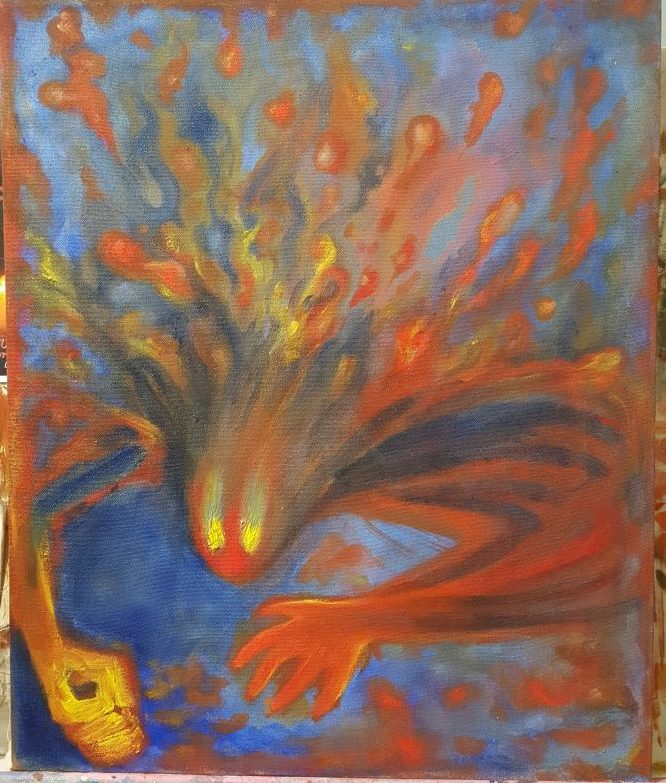
On Sunday I came back to do final edits but didn’t end up working on any of my paintings. After evaluating all of them, I determined that they were conceivably finished. Upon looking at the big painting with fresh eyes, I liked it just fine, originally I was planning to add more details and color again, maybe “even out” the features of the painting more or add more thickly painted areas. But in the end, I decided that the painting was interesting for having such a large variety to it. I also liked the muddled areas (I was planning on getting rid of them) because they were a unique feature and reminded me of when a colorful fire gives off a dense stream of foggy smoke.
For the rest of my paintings. Honestly, I’ve just felt done with them for a while, I’d rather make new paintings or repaint them than mess with them right now. One edit I considered making that was suggested in critique, was to add bright red to the dull red pieces for the sake of consistency. I considered this suggestion only because it was not an intentional choice, and those dull pieces were made before I started using the bright reds. But I chose not to because, although it doesn’t have a purpose, I like that this lack of consistency is an observable feature that can potentially be interpreted, even if I don’t have an intended meaning in it. I could give my own interpretations on what the dull reds are indicating in comparison to the bright reds, but that would feel illegitimate to me.
MORE FINALS:
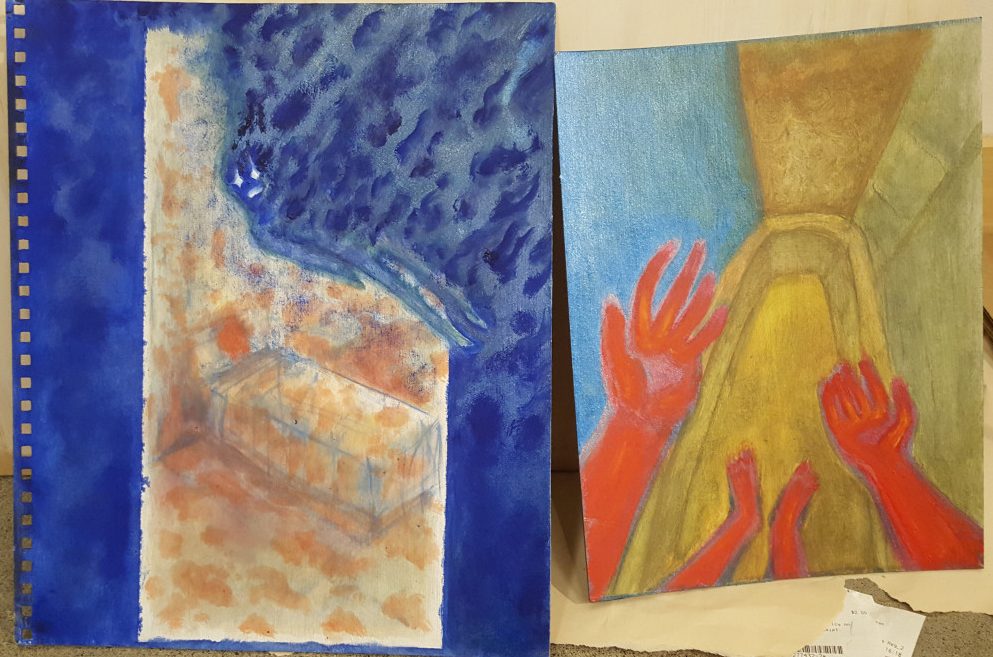
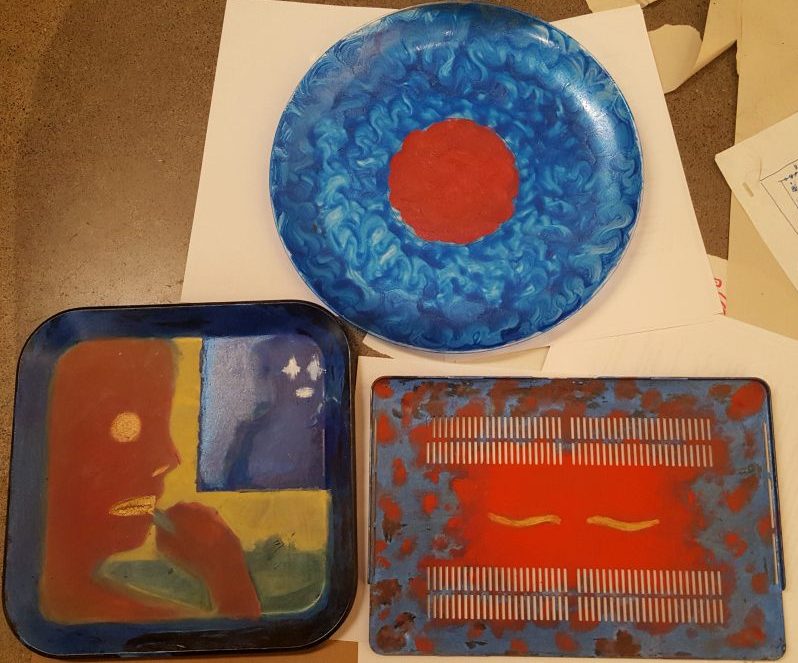
I feel good about all the work I did for this program. After this class, I’m going back to doing studies and plein-air painting though. I think the imagination paintings I churned out this quarter are a solid combination of all the things I learned from the practice assignments. For example, the Fang Lijun studies were the biggest influence on my color usage. In those studies, I worked with vibrant blues, oranges, and reds. But my final assignments don’t go too much further than what I had already practiced this quarter (in my opinion), which is why I want to do more studies and stuff so that when I do imagination paintings again they will be more complicated.

Leave a Reply