Bamboo is the largest and most sustainable grass in the world. The list of uses for this large grass never ends and researchers are still adding to that list! Check out this blog too see why bamboo is such a smart material for construction around the world.
Bamboo for construction:
-Bamboos vascular bundles are spatially separated in the internodes, giving it awesome flexibility and allow them to split/cut easier than timber.
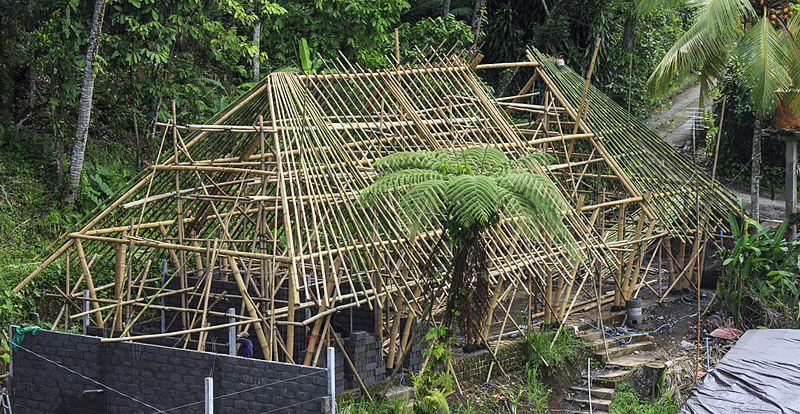
Bamboo Home in Bali -Photo by CEphoto, Uwe Aranas / © CEphoto, Uwe Aranas (alternatively)
-The depletion of timber wood in many countries have made the prices go way up, hurting people in rural areas. The introduction of bamboo can be seen as a solution to this. Bamboos light weight, flexibility and fast growth, make it an attractive building material in many underdeveloped countries.
-Bamboo has a greater tensile strength than steel (the ability to be pulled apart). It also can withstand compression better than concrete.
-It is great for scaffolding. Very light weight, flexible and cheap.
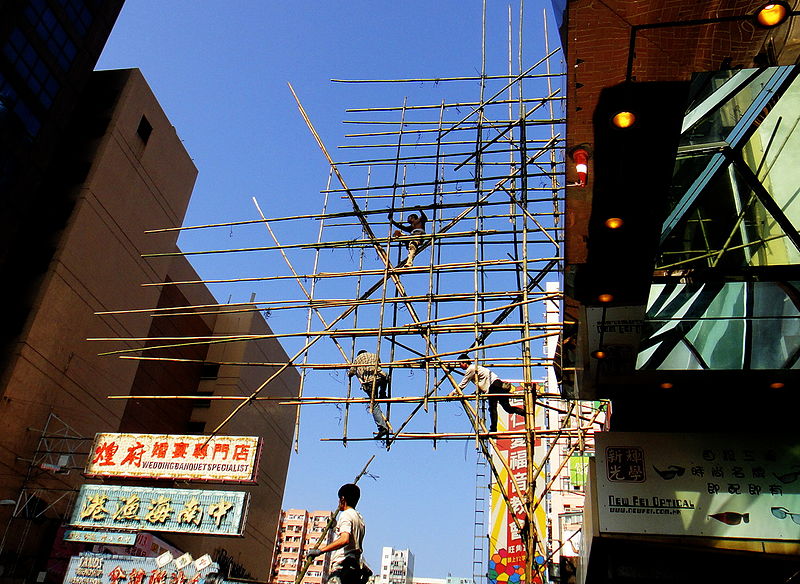
Bamboo Scaffolding in Hong Kong by HK Arun
-While wood has many “rays” in their interior, weakening the wood (showing their vascular movement), bamboo does not. Bamboo is 50% parenchyma cells which keep its vascular bundles in line. Therefore, making bamboo stronger than lumber.
-Bamboo will not shatter at failure which means that they are very earthquake resistant.
-When harvesting bamboo for construction, you will not get any soil erosion due to their rhizomes being under ground. Their complex root system is made up of rhizomes (underground). This is a huge benefit for harvesting construction materials because when wood is harvested, the roots die. When big amounts of roots are dying off we get an access release of carbon (that the roots were storing) and in turn, we get soil erosion. Bamboo also only takes 4-6 years to harvest, generating a faster income for farmers.
-Harvesting bamboo also leaves a smaller carbon foot-print on our planet. It takes less fuel to cut down a bamboo culm when compared to cutting down a tree. Also, less fuel is used in the transportation of bamboo because you do not need a big semi-truck to take them from one place to another. Thus reducing the carbon footprint once again.
-Check out this cool video on the versatility of this plant (by clicking the “video” link)
Growing and farming bamboo instead of hardwood or timber will slow the depletion of old and new growth forests around the world. This will aid in sequestering a greater amount of carbon and is sustainable alternative for construction products.
*Check out this Link to check out more on bamboo and what it is composed of.*
Works Cited:
- Dutta Bora, E, et al. “Utilization Aspects of Bamboo and Its Market Value.” Indianenvironmentportal.org, 2008, indiaenvironmentportal.org.in/files/Bamboo and its market value.pdf.
- Solomon-Aeya, K.A. “Use of Bamboo for Buildings- A Sustainable, Strong, Versatile and Economic Option for the Preservation in Ghana .” Humanitarianlibrary.org, 2004, www.humanitarianlibrary.org/sites/default/files/2014/02/USE OF BAMBOO FOR BUILDINGS – A SUSTAINABLE, STRONG, VERSATILE AND ECONOMIC OPTION FOR THE PRESERVATION OF IN GHANA.pdf.
- “Bamboo vs Trees.” Bambooliving.com, www.bambooliving.com/index.php/why-bamboo/bamboo-vs-trees.