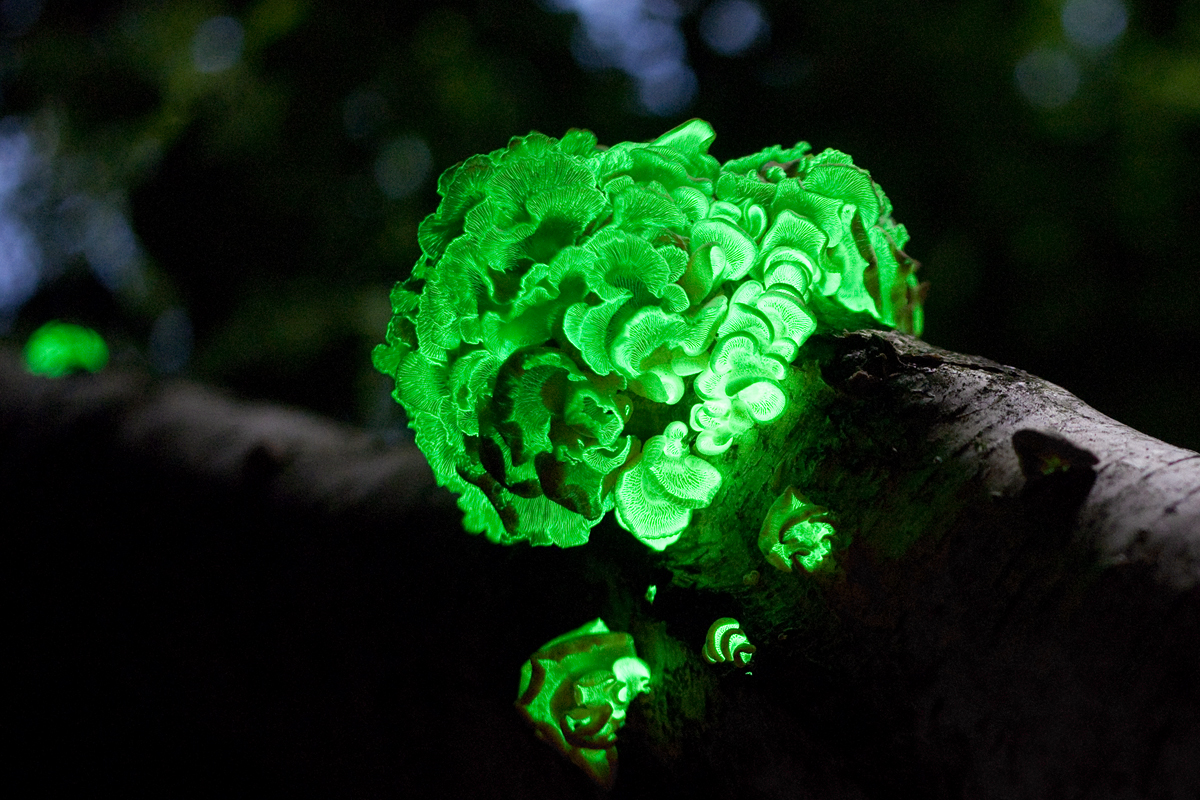
(Public Domain) Panellus stipticus <aka> Bitter Oyster
Reading by fire fly light seems like a living dream, but it’s not fair to trap the little things at our convenience.
Instead, why not read by the light of the Watercress.
Scientists at MIT have created a prototype of what may be the lamp of the future. There’s no outlets involved with this lamp though, just bio luminescence (News Staff 2017)(more on bio luminescence).
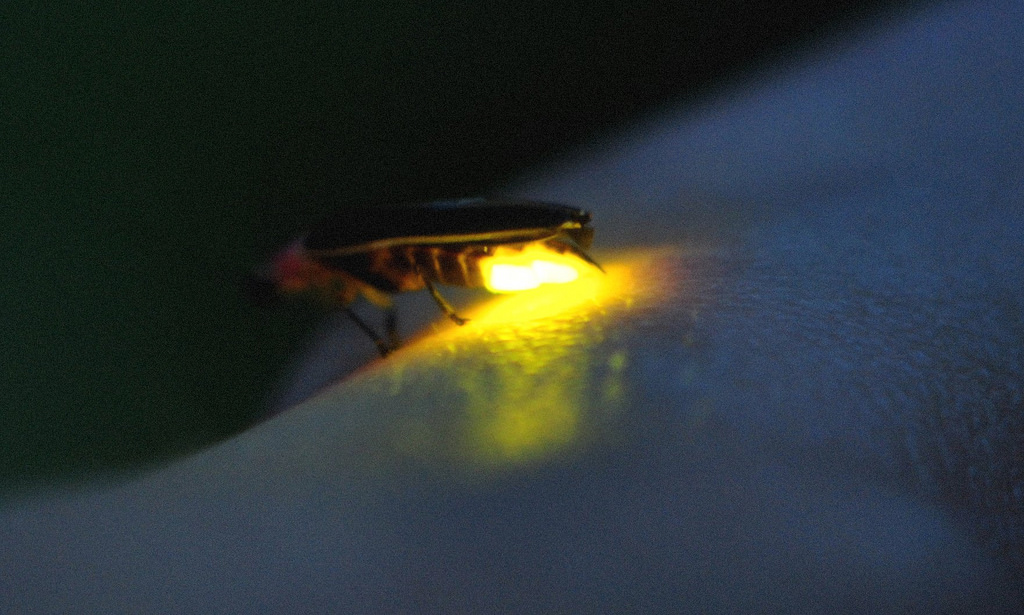
(Firefly) Flickr
Photographer:
Ashley Harrigan
Firefly’s are possibly earths most famous bio luminescers. Less known are glowing fungi like the bitter oyster. But unknown at all are bio luminescent plants… Because they don’t exist.
Not naturally anyway.
To force these plants to glow, researchers have had to dunk them in to a liquid bath full of different chemicals necessary for bio luminescence, such as the chemicals firefly’s use. On top of this they pressurize the whole system to force the chemicals inside of the plants through pores called stomata that plants use to breathe.
We’ve made plants glow before with genetic engineering but it’s practically nothing compared to this. The Tobacco plants we genetically engineered to glow back in 1986 could only be seen after 10 whole minutes in a pitch black room with them.(Jr., Harold 1986)(Kwak 2017)(MIT 2017)
With these new experiments”The results are mature watercress plants that emit greater than 1.44 × 10¹²photons/sec or 50% of 1 μW commercial luminescent diodes and modulate “off” and “on” states by chemical addition of dehydroluciferin and coenzyme A”.(Kwak 2017) For reference your average lightbulb gives off 3×10^20 photons/sec. and the light keeps coming for around 4 hours.(Kwak 2017)
The key to this intense jump in brightness is that they’ve packed the responsible chemicals inside of nano particles, which help direct them to the proper part of the plant once inside. Most importantly these nano particles shield the whole process from factors that would only allow a glow 100,000X dimmer than this. This is because going higher than the concentration of luciferin (one of the glowy chemicals) necessary for that light makes the luciferin toxic. The hope is that in time this will become bright enough to light up space near as well as light bulbs do while dramatically cutting the electricity usage and material cost.(Kwak 2017)(News Staff 2017)
Bibliography:
- MITNewsOffice. “Glowing Plants.” YouTube, YouTube, 13 Dec. 2017, www.youtube.com/watch?v=hp-vqd8zJM4.
- Kwak, Seon-Yeong et al. “A Nanobionic Light-Emitting Plant.” ACS Publications, ACS Publications, 17 Nov. 2017, pubs.acs.org/doi/abs/10.1021/acs.nanolett.7b04369.
- Jr., Harold M. Schmeck. “TOBACCO PLANT WITH FIREFLY GENE IMPLANT GROWS.” The New York Times, The New York Times, 7 Nov. 1986, www.nytimes.com/1986/11/07/us/tobacco-plant-with-firefly-gene-implant-grows.html.
- News Staff. “Researchers Create Nanobionic Light-Emitting Plants | Biology, Neuroscience.”Breaking Science News | Sci-News.com, Sci-News, 14 Dec. 2017, www.sci-news.com/biology/nanobionic-light-emitting-plants-05533.html.
Leave a Reply