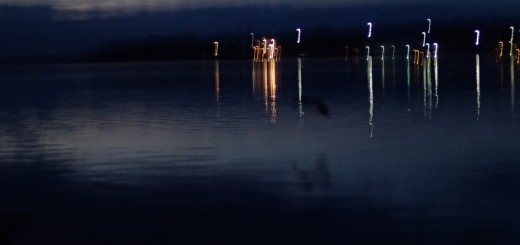
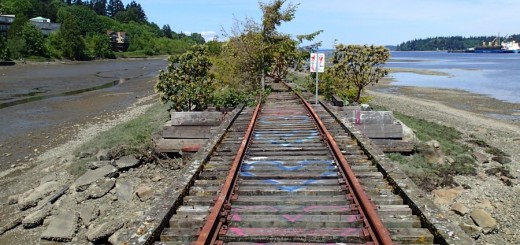
I chose a spot close to the top of the 5th Avenue Dam, on the threshold of the boundary for sea level rise. I am often drawn to this particular edge of downtown to walk across the bridge, observe the birds on Capitol Lake, look at inter tidal life, watch the salmon run, and to be amidst the modest bustle of a small city. One of my observation points was facing the 4th Avenue Bridge, another Capitol Lake, and the third up 5th avenue towards the heart of downtown.
One of the more pressing pieces in this process of trying to capture change was the level of difficulty doing it, which was dependent on technical skill, ecological and historical knowledge, technological and time constraints, and the psychological impact of maintaining a presence in a place that is outside of my immediate control.
Anticipating change creates anxiety, and the degree of climate change we are meant to see and plan for in the near future is going to create many opportunities for complex interactions. I thought a lot about opportunism and the ways in which various species, including humans, repurpose spaces. Design outside of intention can be compelling.
How do you emotionally and materially prepare for liminal space, unknown territory, change that is slow but powerful? What does grief and resilience look like in these unspoken places for communities that are on the forefront of these changes and will suffer heavy losses?
According to my 4 meter floode map, as the water level increases, the 5th Avenue Bridge will flood. I have a lot of unanswered questions about the engineering of the 4th and 5th Avenue Bridges and how they will fare with higher tides. I also have questions about whether the dam will come down; whether a rebuilt estuary will actually increase the flow of nutrients in Budd Inlet and rid the lake of stagnant, unhealthy water; whether that will solve the potential for septic overflow during flooding; and what the quality of water during flooding King Tides will be, especially for people living in unintentional living spaces. The oil and chemicals on the roadside will surely find their way into Budd Inlet even if the septic water doesn’t. This may be a non-issue if the estuary is restored and serves its natural ecological function as a giant filter, but even that will surely have limits.
The populations of non-human wildlife that draw me to the area like seals and miscellaneous birds will surely change as the sea also becomes more acidic. Barnacles, blue mussels, and fish will have problems adjusting to higher acid levels and will eventually stop filtering the toxic water that leaves the lake as they die off. This will impact the types of birds that feed on all three and are often seen fishing or breaking open mussels at low tide. Salmon wil have a harder time finding food and metastasizing the acidic water as well.
“Arcadia, Artemis’s favorite haunt, was for the Greeks not a ‘pastoral realm,’ but a ‘wild and dangerous, rude, and barbarous land…where things are as they are in themselves, not as shaped and manipulated by humankind.’ Yet unlike the primordial earth goddess Gaia, Artemis is ‘wilderness within the human world’: Agrotera, the world outside human civilization. Matt Cartmill suggests that hunting has thus to do with the ‘boundary where the human domain confronts the wild.’ Perhaps, he infers, ‘one of the reasons why the hunt plays a large role in Greek mythology–and in later Western thought about human origins–is that it takes place on that boundary, and thus marks the edge of the human world.’ The hunter is thus, as Artemis was, a ‘liminal and ambiguous figure.’
Intrinsic to the idea of boundaries is their permeability; in effect, they exist to be crossed over. Dawn and dusk, the boundary-times between night and day, are the best times for hunting. The best places are those edges where one kind of habitat gives way to another (forest to meadow, for example, or along a lakeshore or riverbank). Hunting the edges, one perceives that in its workings, the world is far more complex and subtle than the intellect’s too-ready distinctions seek to make it: wild/tame, animal/human, nature/culture, female/male. It is therefore not surprising that the Mistress of the Beasts in a goddess of sacrifice and transformation, death and renewal, of boundary situations. As remote as the moon or the mountain-top, as intimate as a first cry or last breath, she commands recognition that in our beginnings are our ends.”
“Woman the Hunter,” M. Zeiss-Stange