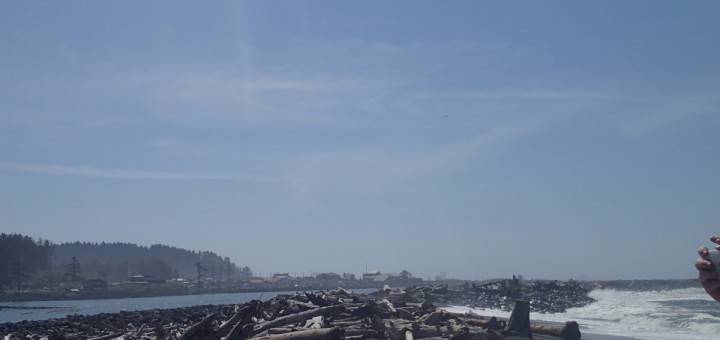
Impermanence, and the immorality of climate change.
Just as sandcastles erode and disappear, coastlines, livelihoods, and heritage can topple and wash away in the face of the climate crisis. On this trip I was very inspired by the scope of the Tahola Village relocation project, but was left with a feeling of impending calamity a certain sentimentality for a place I have never called “home”.

I titled this photograph “Sandcastle Like Sea Stack”. I was very drawn to the deeper meaning implied here, that the coast is always changing and nothing is safe from the waves, no matter how sturdy the appearance. While on this trip I began to form themes around impermanence and the immorality of climate change, specifically how climate change is a social and environmental justice issue. I thought about how the Quileute tribe in La Push is threatened by climate change, and how Indigenous people all over the world are as well more so than non-native people. I realized I would never know what it would be like to lose a place that your ancestors have inhabited since time immemorial, though I can imagine.

Great Grandma June’s Boat
My great grandmother June who is now 90 used to fish commercially out of La Push. She is tough, a total bad ass. I want to continue that heritage within my own family in the future, but that future seems uncertain now with warming and acidifying waters. “Reflecting at Second Beach” was taken when I was thinking about all of this.


Our first day in the field was at Rialto Beach. We spent three or so hours at the Jetty before heading off to the tide pools at the north end of the beach. Pictured above are notes from that day (4.19.16 12:00 pm. at high tide of 2.3 meters, mild wind, 73 degrees F.) and a sketch of the curve of the beach. I spent a lot of time thinking about Jettys’ and their functions to create harbors and protect coastal towns. They are comparable to sea walls, and other means of reflecting waves. With sea level rise and climate change bringing increased storm surges, jettys will play an interesting and important role. They will need to be maintained much more often too.

My favorite part of the trip was hearing from Robert and Kelsey, two of the planners in the Tahola Village relocation project. This is the kind of work I want to do as a career, I think it is so important to give people on the frontlines of climate change the option to move to safer housing and to protect their future and community. I was most inspired by how the main goal of the project was to “sustain the people of Quinault” as said by Robert. This is frankly a radical idea for coastal Washington. The plan is looking at biomass, wind turbines, solar and lowhead hydro-power to fuel the new village site.

Tahola Village Relocation; Tsunami Flood Zone
I asked what kind of skills or degrees one would need to work on projects like these. Robert replied that he got his degree in landscape architecture, while Kelsey got his in urban planning and mapping. These are the skill and jobs that are used in relocation; architects, civil engineers, GIS mapping, land use planners. archaeologists, historians, artists, long term thinking, creativity, and of course, grant writers. I felt happpy at this response! There is not just one way to get to this work, I have options. I hope to visit Tahola again and possibly intern or do a report on this project next year. Now, I want to look closely at Westport, Grayland, and Tokeland Washington and their plans to adapt and mitigate climate change.

That is all for now, toodles!
-Ali