One of my favorite summer activities is pruning tomato plants. I like needing to regularly re-prune, at least every week until later in the season when the fruits swell. I like the sickly sweet smell of the tomato alkaloids, the same smell that others despise. I even like the yellow, green, and purple residue that linkers on my fingers after going down the whole row and pinching off plant suckers.
Trellis Systems
At GRuB, we are using a couple of different methods to trellis the tomatoes. In the Hilton greenhouse, we’ve tied nine-foot long strings to the support beams that run across the top of the house overhead the tomato bed. Each plant is set up to have 2-3 strings. The cherry-sized indeterminate tomatoes will likely reach all the way to where the string meets the support beams (the key being that they are indeterminate). As the tomato plants grow taller, we have gently twisted the strings around the central leaders and loosely tied the end of the strings near the base of each plant. The strings act as leaders so the vines do not fall from their own weight. If the strings were not in place, the vines would fall, and possibly snap, or they would take root. For the plant, taking root horizontally on the ground wouldn’t necessarily be a bad thing, but for our farmers, it’s not the most convenient to work around.
In the Motel 6 hoop-house and the outside plants, I set up two different trellis systems. For the outside plants, I used the Florida Weave. In this system, I buried T-posts into the row, about every six to eight feet. Then, I used twine to weave around every plant until reaching the next t-post. After reaching the t-post, I brought the twine back in the same direction it came from, but I wove it around the opposite side it was originally. Here is a photo:
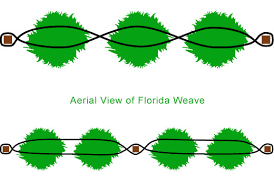
As the plants have grown upwards, we have added more twine around the t-posts, however this twine has been woven about 6-12inches above the first line.
Inside the Motel 6, I did a modified version of the Florida Weave. Instead of running the twine back around on the other side of each plant, I ran one line all the way to the end of the row. I then took a second line of twine and ran it 6-12inches above the first. However, with this line, I wove it around the plants on the opposite side of the first.
Pruning the plants
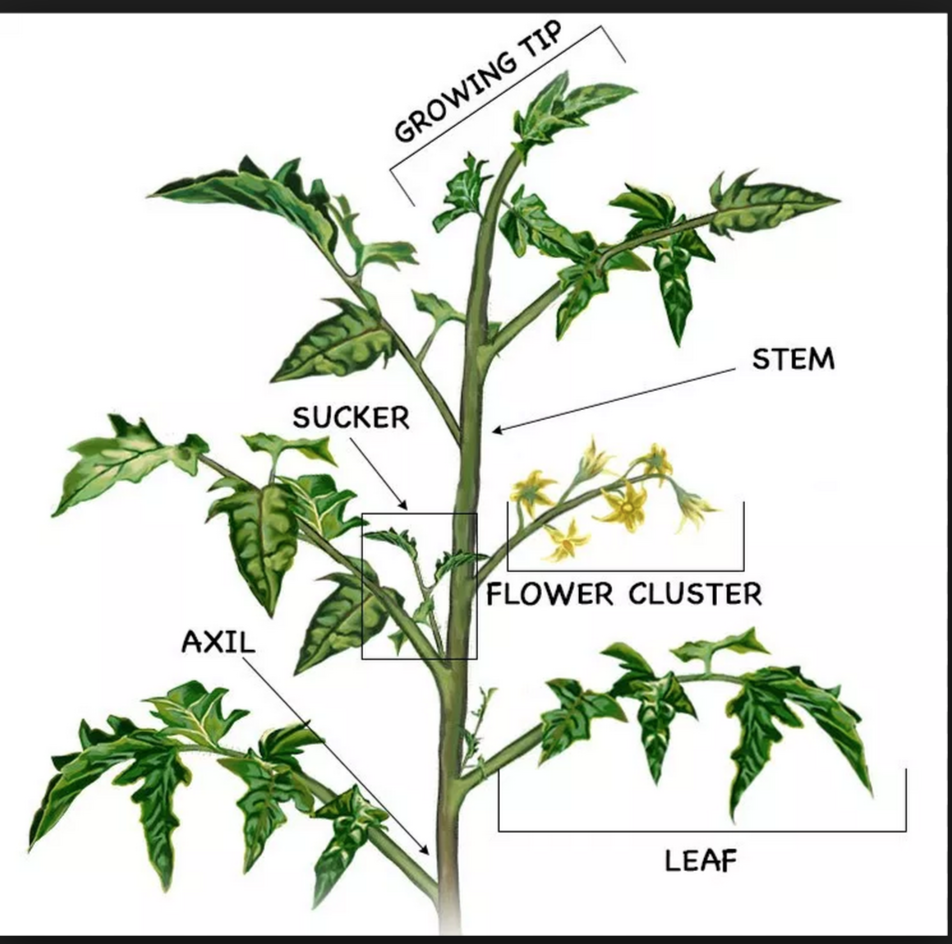
When beginning to prune the tomato plants, begin by looking for any diseased or dying leaves. Start by removing these parts. If you do have diseased plants, sanitize your pruners before moving on to other plants so as not to spread the disease. After doing this, it is up to the person pruning to find a method that works best for them. For myself, I typically begin by removing any leaves that touch or are angled towards the ground. I do not want these leaves to hit the soil and pick up any soil diseases. Sometimes, I will cut leaves in half so that the plant can still use them for photosynthesis. Next, I will remove any suckers that I do not want to grow into main stems. Suckers typically form in the axils of the plants, and if they are not removed can take energy away from the main stems. The result is a plant the divides its energy to all fruits, ending up with smaller tomatoes. Occasionally, I will remove some of the leaves that grow into other plants. As long as they are not the closest leaf to a fruit cluster, I will take them out. Tomatoes are resilient, and can take a lot of damage and still produce fruit. However, some common mistakes include cutting the plants along the stem and therefore removing the growing tip. The plant needs the growing tip to grow taller. If you accidentally cut the growing tip, you will notice that the plant will begin to bush-out more as it recovers. A second mistake is not recognizing a fruit cluster and removing that. Don’t remove the fruit clusters! A tomato plant without fruit is a toxic non-edible weed.
Here is a diagram of a tomato plant and the parts that I referred to above: