

Budget and Revenue Bills Emerge as the One Week Anniversary of Special Session Nears

The somewhat slow pace by which legislators hit the ground last Monday has been replaced by at least a jog as the one week timeline for the first special session of 2010 nears. 

Over the last few days the major pieces needed for the Legislature to adjourn and go home have emerged in the process. With that said, doubts remain whether the emergence of key revenue and budget bills in the last couple of days is enough to reach adjournment by Monday, the one week deadline many legislators set out to meet when the special session was convened.

The Senate passed their proposed 2010 supplemental operating budget on the first day of the special session. Since then proposals on the $30.6 billion operating budget have been exchanged between the House and Senate in search of a compromise.  For the moment, however, the bill (ESSB 6444) awaits further consideration on the House floor. 

Yesterday, the House passed their proposed 2010 supplemental capital budget. Not much negotiation has taken place with regard to the capital budget. Leaders on the capital buget continue to wait for decisions on revenue and operating dollars to determine how much money is available for capital. The bill (ESHB 2836) awaits further consideration in the Senate Ways & Means Committee.

Also yesterday, the Senate passed, 25-18, a revenue generating bill (SESSB 6143) which is half of a two bill revenue package that would raise $809 million through June 30, 2011.  The bill is the same as the revenue bill passed by the Senate in the regular session except for two changes. The first is a reduction in a sales tax increase from a three-tenths proposed increased to two-tenths. In addition, under the revised version, realtors, research and development businesses, and nonprofit and public hospitals would not be affected by the surcharge.

Other than these changes, the bill remains the same as the original bill.  The revised bill : (1) closes dozens of tax loopholes, (2) extends the sales tax to bottled water for three years, and (3) increases the occupation tax on service businesses by one-quarter of 1 percent for three years each. Finally, the bill doubles the small business tax credit permanently for service businesses and funds the implementation of the Working Families Tax Rebate. Low-income families would start receiving checks in 2012.

The Senate’s two-bill revenue package also includes Senate Bill 6874 to increase state cigarette taxes by $1 per pack. SB 6874  still needs to be approved by the full Senate.

Today, the House passed a revised version of SESSB 6143 with a vote of 53-42. 

The revised bill passed by the House is a plan that was offerd by Governor Gregorie as a compromise between the differing House and Senate proposals. The plan would generate nearly $800 million in new revenue without a sales tax increase. Instead the plan, which includes elements from the Senate and the House proposals,  is a temporary business-and-occupations tax surcharge of 0.25 percent on some service businesses.  Finally, the plan would close tax loopholes, extend the sales tax to bottled water, and overhaul the way taxes are charged to out-of-state businesses.  The Senate and House continue to remain divided on the implementation of a sales tax, with the Senate favoring a sales taxes increase and the House opposing an increase.

Like the Senate, the House’s proposal consists of a two-bill revenue package. House Bill 2493 , like SB 6874, raises state cigarette taxes by $1 per pack and increases taxes on other tobacco products. Yesterday, the House passed HB 2493 witha  vote of 54-42. The bill now awaits further consideration on the Senate floor.
 

Activities Move from Floor to Committee in the Senate

For the first time this special session, the activity moved away from the decorated chamber floor of the Senate to the more utilitarian committee rooms.

The Senate spent most of the morning in caucus, moving a single bill prior to adjourning until Noon tomorrow. The action then moved to the Senate Ways & Means Committee who held a work session, several public hearings, and finally moved a handful of bills to the floor.

The Committee held a work session on new language put forth by Sen. Rockefeller that would provide substance to Senate Bill 6853 which currenlty exists in “title only” format. 

The Rockefeller language, which has been in development for some time, recognizes the intent of the Washington Legislature to review tax preferences in the same manner as budget expenditures.  The language sets standards for what should be considered in future tax preference legislation and changes  membership of the Citizen Commission on the Performance Review of Tax Measures to include the State Treasurer and two members appointed by the Governor of which one must be a citizen representing working families or a nonprofit organization. In addition, the Governor would be required, when submitting tax preference requests to the Legislature, to offset the cost of any preference by reductions/eliminations of existing preferences. Finally, the language would require the Washington Department of Revenue to provide the tax exemption report every 2 years rather than every 4 years.

The Committee took no action on the bill.

Though the Committee took action on several bills, moving them forward to the floor for further consideration, the Commitee only held a public hearing on the one bill of interest to Evergreen. House Bill 2854 was heard before Senate Ways & Means Committee. House Bill 2854 establishes a low interest state loan for students seeking a college education. The Committee took no further action on the bill this afternoon.

Special Session: Day 2

The second day of the first 2010 special session was much more alive, actually feeling a bit like a regular session. A handful of committees held work sessions on various topics of interest and both the House and the Senate spent serious time on the floor considering legislation.

The Senate took action on eight bills today before they adjourned until 10:00 a.m. tomorrow. Of the eight bills, two are of particular interest to Evergreen.

The Senate reintroduced and passed with a vote of 30-11 Engrossed Substitute Senate Bill 6503. ESSB 6503 is the compension reduction savings bill that failed to pass the House in the regular session. The bill, which passed with a vote of 32-10 directs state agencies, including higher education institutions to achieve a $69.2 million reduction in employee compensation costs from the near General Fund through mandatory and voluntary compensation reduction activities (i.e. furloughs, leave without pay, reduced work hours, voluntary retirements and separations, layoffs, and other methods).

The second bill, which passed 32-10, Engrossed Second Substitute Senate Bill 6409 creates the Opportunity Pathways Account. Beginning in state fiscal year 2011, all net revenues from in-state lotterygames that are not otherwise dedicated to debt service on the Safeco Stadium and QwestField and Exhibition Center are dedicated to the Opportunity Pathways Account. All net income from the multi-state lottery games, other than those dedicated to the Problem Gambling Account, are deposited into the Washington Opportunity Pathways Account rather than into the General Fund.

The Washington Opportunity Pathways Account is subject to appropriation by the Legislature, and may only be used for the following programs: recruitment of entrepreneurial researchers, innovation partnership zones, and research teams; the early childhood education and assistance program (ECEAP); the State Need Grant; the State Work Study program; College Bound Scholarships; Washington Promise Scholarships; Washington Scholars; the Washington Award for Vocational Excellence (WAVE); the Passport to

College Promise; the Educational Opportunity Grant; and GET Ready for Math & Science Scholarships.

The House took action on 14 bills prior to adjourning until 10:00 a.m. tomorrow. Of the 14 bills passed two were of interest to Evergreen.

Engrossed House Bill 2561 authorizes the State Finance Committee to issue $861 million in general obligation bonds, to be known as Jobs Act Bonds (Act), for the purpose of creating jobs by constructing capital improvements that lead to energy-related cost savings in public schools, state colleges and universities, and other public facilities. As reported earlier through this blog, EHB 2561 passed with a close vote of 54-39.

Second Substitute House Bill 2854, which passed 58-35, creates the Higher Education Loan Program (HELP).

Finally, today, the Senate’s proposed 2010 supplemental operating budget was placed on the second reading calendar on the House floor.

Representative Dunshee’s Jobs Bill Passes House After Contentious Debate

A bill that proposed the creation of jobs by issuing bonds for energy savings and repairs to educational institutions’ buildings endured an intense debate on the House floor before being passed with a vote of 54 yeas, 39 nays and 5 excused.

The bill would create an estimated 30,000 jobs and increase the state’s debt limit by 1.7%. $861 million will be appropriated, around $200 million of which withiin the House Capital Budget for K-12 schools. Opponents of the bill pointed to the speculative nature of the increase in debt and the theoretical, not concrete, jobs that are forecast to be created. They also cited the short-term nature of potential jobs, given the relatively small amount of money appropriated per forecast position.

Supporters countered these arguments by calling the bill a gesture of responsible leadership and claiming that the debt limit increase was not substantial enough to justify alarm. They also expressed their concern for the condition of school buildings, many of which have leaking roofs, missing ceiling tiles, poor insulation and old windows. By invoking the paramount duty of the legislature to provide access to all of Washington’s children to education, several of those speaking in support sought to tie the jobs bill directly to issues regarding funding for K-12 education.

The Latest on Federal Financial Aid

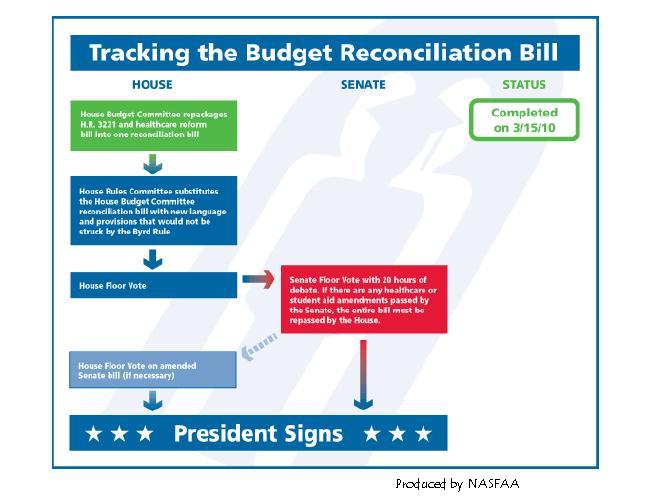
Yesterday, Congress passed a reconciliation bill that includes provisions to eliminate the Federal Family Education Loan Program (FFELP) and significantly boost funding for the Pell Grant program. The House Budget Committee voted 21 to 16 to report the bill to the full House for a vote.

The reconciliation bill marked-up by the House Budget Committee contained the Student Aid and Fiscal Responsibility Act (SAFRA). That SAFRA language is expected to be replaced with a streamlined bill when the reconciliation bill is sent to the House Rules Committee. The House could vote on the reconciliation bill as early as this week. While the new language has not been released, reports suggest the bill will include the following: 

  • Savings of $68 billion by eliminating FFELP and moving to direct lending.
  • Pay off a portion of the Pell Grant program shortfall and automatically increase the maximum Pell Grant by the Consumer Price Index (CPI)
  • Provide additional funding for Minority Serving Institutions

Unlike SAFRA, the new language is not expected to include:

  •  The Perkins Loan Program overhaul
  • The American Graduation Initiative to provide $10 billion to Community Colleges
  • The $3.5 billion College Access and Completion Fund

Efforts to pass student financial aid legislation still focus on combining an aid bill with health care legislation through budget reconciliation. Specifically, the House plans to pass the healthcare reform legislation that has already been passed by the Senate, clearing that bill to be signed into law. The House also plans to pass a separate reconciliation bill that would combine student aid reform with healthcare provisions to amend the healthcare reform bill passed by the Senate. Senate Democrats would then have to secure 50 votes to clear the reconciliation bill for the President, with Vice President Joe Biden casting the 51st vote.

Reconciliation ProcessBesides the Pell Grant funding provided in the reconciliation bill, the healthcare reform legislation passed by the Senate includes more than $510 million for student aid in the 2010 fiscal year. The Senate healthcare bill would:

  • Eliminate the requirement for independent students to supply parental financial information to apply for aid from the Department of Health and Human Services
  • Increase annual and aggregate Nursing Student Loan
  • Create a pediatric specialty loan repayment
  • Create a Public Health Workforce Loan Repayment Program
  • Make grants to institutions to award scholarships to individuals employed in public and allied health positions
  • Set authorized funding levels for the National Health Service Corps
  • Make grants to institutions to provide need-based financial assistance in family medicine, general internal medicine, or general pediatrics
  • Make grants to institutions to provide tuition and fee assistance to workers employed in long-term care settings
  • Make grants to institutions for financial assistance to general, pediatric, and public health dentistry students
  • Establish various support programs for practitioners of geriatric medicine
  • Make nurse faculty eligible for the existing Nursing Student Loan Repayment Program.
  • Create a United States Public Health Sciences Track, giving students tuition remission and a stipend for up to 4 years, in exchange for a service obligation.
  • Reauthorizes Scholarships for Disadvantaged Students through 2015.
  • Excludes from taxable income all amounts received under the National Health Service Corps Loan Repayment Program, certain related state programs, or under any other State loan repayment or loan forgiveness program that provides for health care services in under-served or shortage areas.

In addition, the bill would require insurance companies offering health insurance that provides dependent coverage of children to continue to make such coverage available for unmarried adult children until the age of 26. The bill specifically allows schools to continue offering their own student health plans.

The bill now goes to the full U.S. House of Representatives for a vote.

House Revisits Several Bills from Regular Session

The House moved several bills, previously considered during the 2010 regular legislative session, to the floor for further consideration during the first special session of 2010.

The House moved twenty-six bills forward to be considered during special session. Of these bills three specifically relate to higher education.

Engrossed House Bill 2561 authorizes the State Finance Committee to issue $861 million in general obligation bonds, to be known as Jobs Act Bonds (Act), for the purpose of creating jobs by constructing capital improvements that lead to energy-related cost savings in public schools, state colleges and universities, and other public facilities.

Second Substitute House Bill 2854 creates the Higher Education Loan Program (HELP).

Finally, House Bill 3193 reduces the bonus for National Board for Professional Teaching Standards (National Board) certified teachers teaching in high poverty schools from $5,000 to $2,500 during the 2010-11 school year.

In addition to these three bills the House moved forward the following bills for further consideration this special session.

  • HB2197  – DSHS
  • HB 2360  – AIDS grants
  • HB 2416 – Energy efficiency
  • HB 2576 – Charities
  • HB 2617 – Boards & Commissions
  • HB 2630 – Opportunity express
  • HB 2641 – Small business development
  • HB 2672 – Aluminum smelters
  • HB 2694 – BS/Nursing
  • HB 2753 – Wa works housing
  • HB 2782 – Security lifeline
  • HB 2875 – Health savings accounts
  • HB 2954 – Nursing and bording home fees
  • HB 2956 – Hospital safety net
  • HB 2969 – Office of the printer
  • HB 3014 – Rural counties
  • HB 3048 – Medicaid administration
  • HB 3147 – Data centers
  • HB 3177 – Affordable housing
  • HB 3181 – Clean water
  • HB 3182 – Unfunded mandates
  • HB 3186 – Community residential services
  • HB 3197 – Budget stabilization

Deja Vu in the Senate

This afternoon the Senate took action on several familiar bills and then adjourned until 10:00 a.m. tomorrow.

The Senate passed 25-19 Engrossed Substitute Senate Bill 6444 (ESSB 6444) the Senate’s proposed 2010 supplemental operating budget. 

Here is a refresher on the Senate’s proposed operating budget as it relates to Evergreen and other higher education priorities.

  • Increases health benefits and salaries by $4,000.  
  • Appropriates $50,000 for research support to the Quality Education Council.
  • Reduces state funding by $1.18 million
  • Assumes a savings of $426,000 in compensation reduction activities. 
  • Shifts Maintenance & & Operation (M&O) funds from the Capital budget to the Operating budget in the amount of $3.247 for Evergreen.
  • Restores funding to the State Need Grant
  •  Reduces funding for public colleges and universities by $69.5 million
  •  Increases worker retraining funds by $27.8 million
  • Reduces state work study by 30% in the second year of the biennium
  • Suspends funding for the health professional conditional scholarship and loan repayment program. Funding will continue to complete scholarship commitments to current recipients, but no new applicants will be selected.
  • Suspends the Educational Opportunity Grant. Funding will continue to complete grant commitments to current recipients, but no new applicants will be selected.
  • Continues funding to complete commitments to students who receive the Washington Scholar and Washington Award for Vocational Excellence funds but no new applicants will be selected for 2010. 
  • Suspends the Future Teachers Scholarship. Funding will continue for current recipeints who were awarded the scholarships in prior years to complete their studies.  
  • Suspends matching funds to support innovations in child care delivery at the public universities.
  • Reduces the Passport to College program by 30%
  • Reduces funding by 30% to the State-funded GEAR UP Projects
  • Suspends the Western Interstate Compact for Higher Education Professional Student Exchange program. Funding is continued to maintain commitments to current recipients
  • Suspends funding for state work study experience for students considering careers in math and science instruction.
  • Suspends the state contribution in the second year of the biennium for the Foster Care Endowed Scholarship
  • Suspends funding for the Leadership 1000 program

The Senate passed four other bills that were left behind upon ajdournment of the 2010 regular session. Engrossed Substitute Senate Bill 5899 provides businesses with 20 employees or less a credit against the Business and Occupation Tax for the creation of new employment positions for  which the business offers a health care plan. The credits are based on the amount of wages and are capped at a maximum of $10 million per year.

Second Substitute Senate Bill 6675 creates the Washington Global Health Technologies Product Development Competitiveness Program to be administered by a Board appointed by the Governor. The Board is charged to solicit funds from businesses, foundations, and the federal government, and make grants for the development of global health technologies and products.

Substitute Senate Bill 6706 requires state universities (by definition in the bill UW and WSU) to perform one of the following: (1) Provide collaborative research and tech-transfer opportunities; (2) Make commercialization processes and resources accessible; (3) Pair researchers, entrepreneurs, and investors through workshops, events, and websites; and (4) Provide opportunities through training for direct involvement in research and industry interactions. To achieve these ends, state universities are authorized to establish and administer bridge funding programs with federal and private funds.

Senate Joint Resolution 8225 changes the definition of interest payments for calculating the state debt limit to substract direct federal subsidies.

Finally, the Senate took action to move two bills from committee to the Senate floor for further consideration during special session.

Substitute Senate Bill 6503 directs state agencies, including higher education institutions to achieve a $69.2 million reduction in employee compensation costs from the near General Fund through mandatory and voluntary compensation reduction activities (i.e. furloughs, leave without pay, reduced work hours, voluntary retirements and separations, layoffs, and other methods).

Senate Bill 6789 provides a sales and use tax exemption for eligible server equipment and power infrastructure for eligible computer data centers. In order to qualify a data center must: (1) Be located in a rural county; (2) have at least 20,000 square feet dedicated to housing servers; and (3) have commenced construction between April 1, 2010, and before July 1, 2011. The tax credit expires April 1, 2018.

Washington Legislature Begins Special Session

Today at Noon the Washington Legislature convened the 2010 first special session. The Senate held a Pro Forma session at Noon to pass resolutions that determine the rules that will guide policymakers during this session.

In particular, both the House and Senate passed House Concurrent Resolution 4409 which specifies the status of bills, memorials, and resolutions for the 2010 first special session of the sixty-first legislature.

The passage of HCR 4409 allows the legislature to consider bills, joint resolutions, joint memorials and concurrent resolutions introduced during the 2010 regular legislative session during the special session.  In addition, all bills, joint resolutions, joint memorials and concurrent resolutions introduced in the 2010 regular session are reintroduced in the chamber in which they originated and will retain the same number and be given the highest legislative status attained upon adjournment.

So now what was old is new again.

Overhaul of No Child Left Behind to Focus on College

Over the weekend, the Obama Administration unveiled their plan to change the Elemenatry and Secondary Education Act (ESEA), a.ka. No Child Left Behind. The Administration’s blueprint for revising ESEA  focuses on assisting states in raising expectations of students and rewarding schools for producing dramatic gains in student achievement.

The blueprint provides incentives for states to adopt academic standards that prepare students to succeed in college and the workplace and create accountability systems that measure student growth toward meeting the goal that all children graduate and succeed in college rather than grade-level proficiency.

In addition, the Administration’s blueprint would allow states to use subjects (i.e. art, history, science) other than reading and math as part of their measures for meeting federal goals. Also for the first time in the 45-year history of the law the Administration proposes a $4 billion increase in federal education spending, most of which would go to increase the competition among states for grant money and move away from formula-based funding.

Other highlights of the blueprint include:

  • By 2020 all students graduating from high school would need to be ready for college or a career.
  • Provides more rewards (i.e. money and flexibility) to high-poverty schools that are seeing big gains in student achievement and uses them as a model for other schools in low-income neighborhoods that struggle with performance.
  • Punishes the lowest-performing 5 % of schools using aggressive measures (i.e. state takeover of federal funding for poor students, replacing principals and 50% of teaching staff, closing the school).

The Administration’s blueprint now goes before the U.S. House Education and Labor Committee this week.

Federal Financial Aid Bill May Be Lighter in Content

What does federal health care legislation have to do with student financial aid legislation? Quite alot in Washington D.C.

Though it remains far from certain, though the odds are increasing, Congress continues to consider merging the Student Aid and Fiscal Responsibility Act (SAFRA) (H.R. 3221) into the health care legislation. 

The practice of budget reconciliation which has become synonymous with passing federal health care legislation can only be used once per budget cycle.  Budget reconciliation allows policymakers to pass legislation with only a majority of lawmakers instead of the 60 votes required under the regular Senate rules.  Though 50 is still a majority vote in Congress, in the Senate it takes 60 votes to avoid a filibuster a tactic that policymakers can use to disallow a bill to go to the floor for a straight up and down vote.

To make a long story a bit shorter, Congress cannot use budget reconciliation both to pass health care legislation and student financial aid legislation, a tactic which seems necessary for both because of the contentious policies included in both bills.

In the last few days the student financial aid bill (SAFRA) has become lighter in content so as to not discourage policymakers from supporting the health care legislation.  How a stripped-down student financial aid bill would look if passed has become clearer over this time.

  • The bill would fall short of the Obama admininstration’s original proposal to transform the student aid programs.
  • Pell Grants would remain the legislation’s top priority, though because of the program’s rapidly escalating costs, the value of the maximum grant would rise less than originally planned.
  • Community colleges would get little or none of the nearly $10 million they would have been slated to receive.
  • Historically black, hispanic, and otehr colleges would likely benefit
  • Some of the savings from the loan overhaul may be used to help pay for health care reform.

More specifically, several cuts have been made to ensure that the costs of SAFRA are under the $61 billion over 10 years ceiling budget.

  • $8 billion for early childhood education
  • $4 billion for school modernization
  • $12 billion over 10 years for the American Graduation Initiative, grant and construction funds for community colleges.
  • No plan to revamp Perkins Loan program.
  • While a majority of funding will go to Pell, the bill removes the idea of adding 1% point to increase the grant annually and reduce the maximum grant to $6,400 by 2019 rather than $6,800.

So what happend? A lot.

Sen. Conrad (ND-D), Chair Senate Budget Committee, decided to use the more recent and lower estimate provide by the Congressional Budget Office (CBO) ($67 billion). The Obama Administration had counted on generating $87 billion in revenue over 10 years by switching to direct lending. 

The Administration had won support for this controversial move to direct lending by planning to spread the expected savings to a wide range of priorities including boosting funds for the Pell Grant and establishing it as an entitlement; creating a new grant program for community colleges; expanding and remaking the Perkins Loan Program, and creating a new $3 billion Access and Completion Fund to reward states and institutions that found ways to increase degree production.

However since the release of the Obama Administration’s proposal many institutions have self-selected to move to the direct loan program which reduced the potential savings planned by the Administraiton to support other education initiatives.

At the same time the number of students eligible for the Pell Grant dramatically increased the projected costs of the administration’s plan to increase the maximum Pell Grant award and tie future increases to the Consumer Price Index plus 1%.  These developments have also created a massive shortfall in the Pell Grant program (approx. $19 billion) that Congress must find a way to cover.

In addition, last spring Congress passed a budget resolution that the health care legislation reduce the deficit. There is concern that on its own, health care legislation cannot produce enough bugetary savings to meet this requirement. So a major element for Democrats to incorporate the student loan provisions into the health legislation is the fact that they could use some of the billions generated by the loan changes to meet deficit reduction requirements.  As a result even less money is likely to be available for students and colleges should SAFRA pass.

So what is next. The CBO will release a revised accounting of the budget bill early this week to make clear the exact cost and savings of the legislation.