Senate Takes Action on Higher Education Purchasing Bill

Saturday the  Senate passed House Bill 2858. 

HB 2858, initiated by the four-year public baccalaureate institutions, the bill would allow purchases of personal services; materials, supplies, or equipment; or information services made by state institutions of higher education  through group purchasing organizations.

The bill passed with a vote of 40-0. HB 2858 now goes to the Governor for her signature.

Senate Passes 2010 Proposed Supplemental Operating Budget

Saturday the Senate passed their proposed 2010 supplemental operating budget (Substitute Senate Bill 6444). The budget passed with a vote of 25.19.

Four amendments were proposed to the 2010 supplemental operating budget.  Only one of the proposed amendments passed and was amended to the bill.

Amendment 036, proposed by Sen. Murray, deletes language creating a global health program and makes funding provided solely to implement the provisions of SSB 6675 (global health program). The amendment also states that if the bill is not enacted by June 30, 2010, the $1 million provided in the subsection will lapse.

The amendment adopted does not impact higher education nor did any of the amendments that were not adopted by the Senate.

The Senate’s proposed 2010 supplemental budget now moves to the House for further consideration.

Senate Ways and Means Hears Biomass Bill

The Senate Ways & Means Committee met early this Saturday morning to hear a variety of bills and take action on several more.

The deadline for the Committee to consider House bills with a fiscal impact is end of day Monday, March 1.

As  a part of the public hearing process this morning , Evergreen testified in support of House Bill 2481. HB 2481 is a bill discussed often on this blog, but is worth further discussion because it looks different at this stage in the legislative process than it did earlier on. The bill would:

 
  • Allow Department of Natural Resources (DNR) to enter into contract terms up to 15 years when an entity plans and commits to a capital investment of at least $50 million prior to the contract and completes that investment before removal of biomass under the contract;
  • Allow DNR to include provisions in the agreement that are periodically adjusted for market conditions;
  • Require the contract to include provisions that allow DNR, when it is in the best interest of the trust beneficiaries, to maintain access to existing users of biomass;
  • Ensure that biomass volume conveyed under this act will not be counted toward DNR’s sustainable harvest target, except that appraised timber sold in a conventional timber sale will count toward the target whether individual trees are ultimately used by that purchaser for timber or biomass energy;
  • Remove wood from old growth forests from the definition of what is not included in forest biomass; and
  • Require DNR to conduct a survey of scientific literature regarding the carbon neutrality of forest biomass and report to the Legislature by December 15, 2010.

Evergreen believes that the passage of House Bill 2481 would provide the Washington Department of Natural Resources with the tools necessary to be a viable player in the emerging biomass industry and a potential partner with Evergreen as we move forward to construct our Biomass Gasification Project.

The Committee took no further action on the bill.

Senate Moves Proposed 2010 Supplemental Budget

The Senate Ways & Mean Committee took action on the Senate’s proposed 2010 supplemental operating budget late last night.

The Committee passed a subsitute bill last night that modified language in the original budget bill. An initial examination of Substitute Senate Bill 6444 showed no difference between the original bill and the substitute bill for Evergreen.

The Senate is expected to take action on the bill on the Senate Floor this afternoon, Saturday, February 27.

Federal Policy Focuses on Financial Aid

In the other Washington (i.e. Washington D.C.) efforts to move legislation that directly impacts higher education (i.e. financial aid) received a much needed push by the White House.

Yesterday morning, the Secretary of Education Arne Duncan testified before the House Budget Committee urging Congress to support the President’s FY11 budget, which assumes passage of the Student Aid and Fiscal Responsibility Act (SAFRA) (H.R. 3221).

SAFRA increases funding for the Pell Grant program and creates low-cost student loans among other things. SAFRA is now in the U.S. Senate has been referred to referred to the Senate Committee on Health, Education, Labor, and Pensions.

Also yesterday morning the Senate passed the first of what is to be expected multiple job bills. While higher education advocates have and continue to lobby for an additional $300 million for the Federal Work-Study (FWS) program, these additional funds were not included in the $15 billion Senate bill passed yesterday.

The additional $300 million comes from the U.S. House of Representatives’ jobs package bill. The $154 billion package, passed in December, included these funds for the FWS program. The additional $300 million would keep funding level with this year’s ARRA-supplemented (stimulus dollars) appropriation.

While higher education lobbyists will continue to advocate for these additional dollars the next step in the process is unclear.

The Senate is expected to pass multiple bills as a part of their job-creation initiative to make passage easier. The more narrow a bill the better the passage is the thinking behind this strategy.

The House is also strategizing whether or not to try and reconcile their bill with the Senate bill or simply start over.

House Moves Proposed 2010 Supplemental Operating Budget to the Floor

The House Ways & Means Committee took action on the House’s proposed 2010 supplemental operating budget this afternoon.

Members considered 42 proposed amendments to House Bill 2824.

Of the 42 amendments, six were of interest to Evergreen. Of these only two were passed by the committee and amended to the bill.

1.  Amendment 217: Provides clarifying language regarding alternate routes to teacher certification program funding. Specifies that at least 85% of endorsements be in math, science, bilingual, or special education.

2. Amendment 057: Savings from information technology savings is not to impact revenue collection efforts.

The House is expected to take action on the budget in the next few days.

Legislature Week 8: What is Happening

The eighth week of the 2010 supplemental session will be focused on budget and revenue.

Both the House and Senate released their proposed 2010 supplemental operating budgets this past week. The Senate has yet to release its proposed 2010 supplemental capital budget and the House has yet to release a revenue package.

Fiscal committees will be busy through Monday of next week moving the proposed budget and revenue packages forward as well as any remaining bills in their committees. Both committees must have moved bills from the opposite chamber to the floor by end of day Monday, March 1.

Tuesday through the adjournment of the 2010 supplemental session will be focused on finalizing budgets and revenue packages. So the floors of both chambers will be the center of legislative action from here on out.

Having said that it is worth keeping an eye on the House and Senate fiscal committees for a conference budget and bills (i.e. fiscal and policy) that are Necessary to Implement the Budget (NITB) (i.e. Senate Ways & Means and House Ways & Means).

It is also worth watching legislative policy committees (i.e. House Higher Education and Senate Higher Education & Workforce Development) . Many of the policy committees will hold work sessions next week on hot issues or plans for the Interim.

Thursday on The Hill

Thursday morning students, trustees, faculty, and presidents from the six public baccalaureate institutions met for breakfast with over a dozen legislators, from both chambers and both sides of the aisle, to discuss the proposed supplemental budgets, the interim, and what the tea leaves have to say about higher education in Washington.

The hour with legislators focused on appreciation for the investment in student state financial aid proposed in the 2010 budgets, the need to maintain this investment and the investment in institutions, and what the public baccalaureate sector needs to do to prepare for the 2011 session.

Legislators commented on the need to both increase collaboration among institutions  in order to ease the process of earning a degree for students. Others commented on the need to provide leadership on higher education funding at the state level and not leave the full responsibility on the shoulders of the Legislature.  

In the afternoon the House Education Appropriations took action on Senate Bill 6357. SB 6357 tasks the State Board for Community and Technical Colleges (SBCTC), in consultation with numerous other persons and entities, with developing policies for awarding academic credit for learning from work and military experience, military and law enforcement training, career college training, internships and externships, and apprenticeships. The bill now moves to the Floor for further consideration.

House Ways and Means Committee Considers Proposed Amendments to Operating Budget

The House Ways & Means Committee held an executive session on the House’s proposed 2010 supplemental operating budget this afternoon.

The session extended into the evening as members considered 35 proposed amendments to House Bill 2824.

The committee adjourned without taking action on any of the proposed amendments or moving the bill to the House floor. No further action is scheduled for HB 2824 as of this evening.

Of the 35 amendments, six are of interest to Evergreen.

1.  Amendment 217: Provides clarifying language regarding alternate routes to teacher certification program funding. Specifies that at least 85% of endorsements be in math, science, bilingual, or special education.

2. Amendment 281: Establishes a legislative task force on four-year higher education institution affordability and access. The group will consist of one member from each caucus of both the House and Senate and will be staffed by legislative staff. The group will recommend a 10-year strategy that aligns state support, financial aid, tuition, and cost management and includes an analysis of higher education business operations and job placement and retention of graduates. The report is due to the Legislature by December 1, 2010.

3. Amendment 057: Savings from information technology savings is not to impact revenue collection efforts.

4. Amendment 362: Eliminates new transfers from capital funds to the general fund.

5. Amendment 363: Deletes the exception from the hiring freeze for positions necessary to implement legislation passed in the 2010 legislative session.

6. Amendment 025: Funding for the WorkFirst program within the Economic Services Administration in the Department of Social and Health Services is reduced by $12,729,000 and assumes that the federal 60-month lifetime limit for receipt of benefits is enforced. This amount also assumes that the deficit in the TANF program is filled as a result of this policy change.All funding for the general assistance-unemployable program ($75,621,000) in the Economic Services Administration within the Department of Social and Health Services is eliminated in fiscal year 2011.

Eliminates medical assistance for clients under the Disability Lifeline program and the Alcoholism and Drug Addiction Treatment and Support Act in the Department of Social and Health Services Medical Assistance program. Eliminates funding for the Disability Lifeline program under Substitute House Bill 2782 (security lifeline). General Fund-State funding is reduced by $107,246,000 and other funds by $41,119,000. Eliminates state-only coverage for non-citizen children and adults and reduces General Fund-State by $41,682,000.

Eliminates funding for treatment and stipends under the Alcoholism and Drug Addiction Treatment and Support Act in the Department of Social and Health Services Alcohol and Substance Abuse Program. Reduces funding for treatment for Disability Lifeline clients and removes increased funding for the Disability Lifeline program under Substitute House Bill 2782 (security lifeline act). General Fund-State funding is reduced by $15,150,000.

Eliminates the Basic Health Plan as of July 1, 2010. General Fund-State funding is reduced by $104,087,000.

Limits combined enrollment in running start programs to 1.0 FTE enrollment. The current cap for running start is 2.0 FTE. General Fund-State funding is reduced by $10,117,000.

Reduces the general fund–state appropriations in FY 2011 for the State Board for Community and Technical Colleges by $25,581,000; for the University of Washington by $8,757,000; for Washington State University by $8,021,000; for Eastern Washington University by $1,643,000; for Central Washington University by $1,587,000; for The Evergreen State College by $854,000; and for Western Washington University by $2,027,000.

Reduces the general fund–state appropriation in FY 2011 for the Higher Education Coordinating Board for the State Need Grant program by $70,082,000. Adds language to change the State Need Grant program policy by reducing the maximum award available at private and public four-year colleges to $5,000 and at private and public community and technical colleges to $2,500.

Requires the state to manage as single entity the activities of PEBB, HCA and related functions in DSHS and reduces state funding by $10,000,000.

Rejects funding for the compensation and fringe benefit provisions of the collective bargaining agreements negotiated after the 2009 legislative session and, notwithstanding provisions of Chapter 1, Laws of 2010 (Substitute Senate Bill 6382, reducing the cost of state government), or other provisions of law expands the prohibition on salary and wage increases to include employees covered by collective bargaining agreements from July 1, 2010, through the end of the biennium. Assumes savings of $9,596,000 General Fund-State and $9,526,000 other funds.


Analysis of Governor and Senate Revenue Packages

To date the Governor and the Senate have each proposed a revenue package to accompany their proposed 2010 supplemental operating budgets. The House’s revenue package is expected any day.

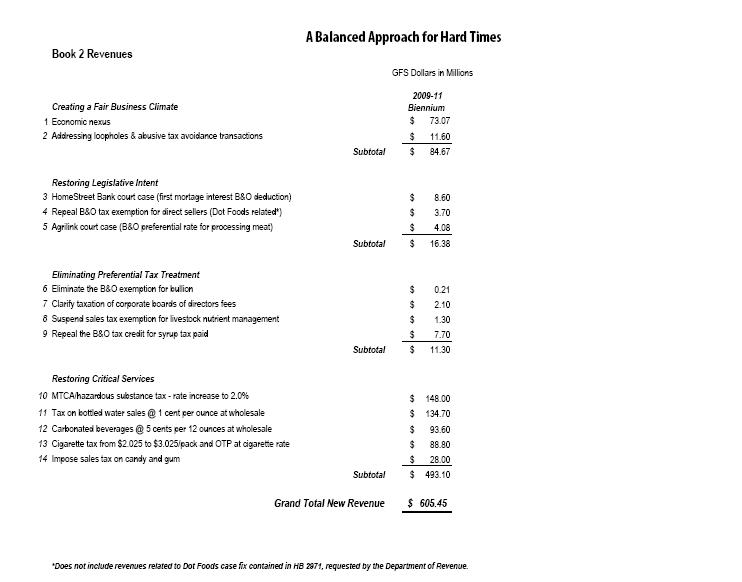
The Governor was first out of the gate with her revenue package last week (February 17) for $605 million.  The Governor’s revenue package is a two-pronged approach: (1) Closing tax loopholes ($112.35 million) and (2) Increasing “sin” taxes ($493.1 million).

Governor Revenue Package

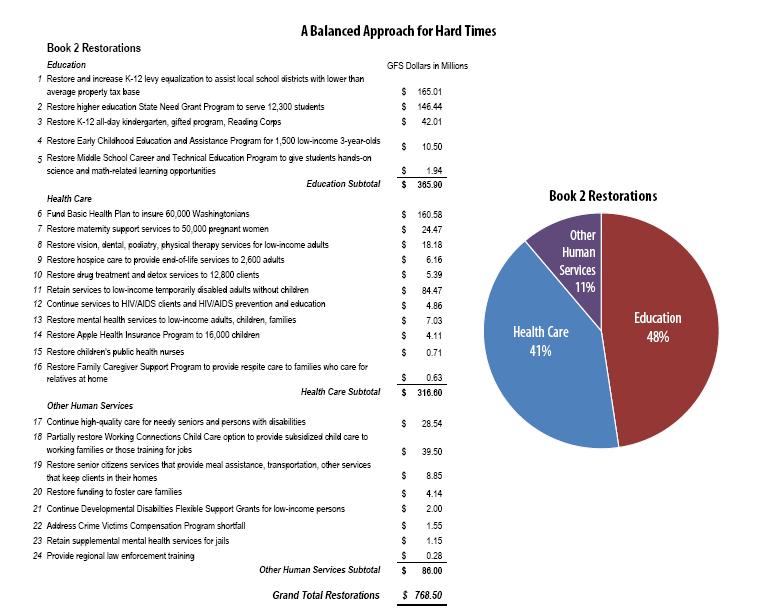
The Governor’s revenue package restores funding to a variety of public services and programs in the areas of education, health care and human services.  Specific to higher education, the Governor restores full funding to the State Need Grant.

Governor's Restoration

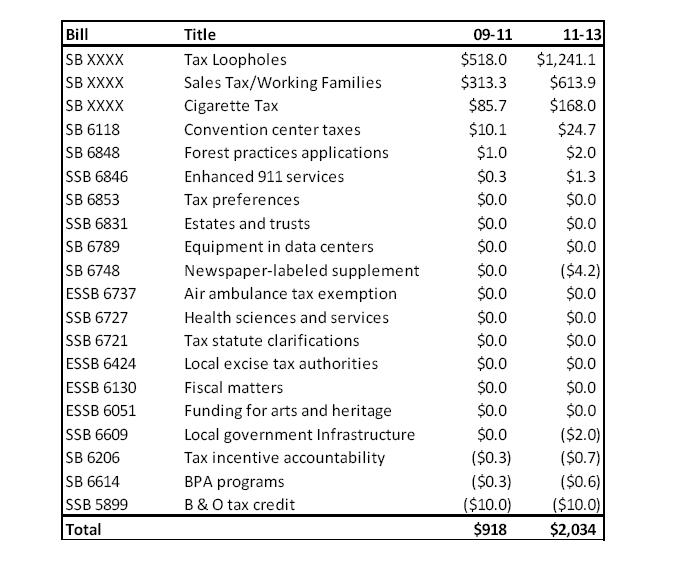
The Senate’s revenue package is $313 million dollars larger than the Governor’s proposed package (Total revenue increase of $918 million).

The Senate, like the Governor, targets closing tax loopholes and increasing “sin” taxes. However, the Senate only raises a single “sin” tax (i.e. cigarette tax) and also incorporates revenue from a  temporaray sales tax increase and savings from the implementation of various Senate Bills.

As eluded to above, the Senate used a four-pronged approach in the development of its revenue package: (1) Closing tax loopholes ($518 million); (2) Temporary 0.3%  increase in sales tax ($313 million); (3) Increase cigarette tax by $1 per pack ($85.7 million); and Enactment of various Senate Bills ($1.3 million).Senate Revenue SummaryThe Senate restores funding to many of the same public services and programs that the Governor’s revenue package identifies. Specific to higher education, the Senate restores full funding to the State Need Grant, restores partial funding to the State Work Study program, and maintains commitments to recipients of several smaller financial aid programs that are suspended for the second year of the biennium.

Any revenue increase proposal still has a long way to go in the legislative process before it is law. The Senate and the House must first move their revenue proposals through the appropriate committees in their respective chambers as well as the committees in the opposite chamber.

Any differences between the House and Senate proposals, after the process has been conducted, will need to be settled through conference committee and both chambers will have to concur on any final legislative revenue package.