

House Education Moves Teacher Preparation Legislation Forward

Yesterday the House Education Committee moved a number of bills Evergreen has tracked related to teacher preparation.

House Bill 3068 passed out of committee with no amendments. HB 3068 provides that, if scholarship funds are available after qualified paraeducators have been accepted, individuals who participated in one of the Recruiting Washington Teachers programs for high school students can participate in the Pipeline for Pareducators conditional scholarship program.

Though Evergreen expressed support for HB 3068 in general the College expressed concerns that the bill would limit access to Retooling Grants to only those individuals who seek math and science endorsements. This would leave out students seeking endorsements in other areas, such as special education and ELL. Evergreen encouraged the committee to reconsider limiting Retooling Grants to only math and science endorsements.

House Bill 3068 will have a public hearing tomorrow, February 4 before House Education Appropriations.

HB 2654 provides that, if scholarship funds are available after qualified paraeducators have been accepted, individuals who participated in one of the Recruiting Washington Teachers programs for high school students can participate in the Pipeline for Pareducators conditional scholarship program.

HB 2654 passed out of committee amended as follows: (1) In the prototypical school funding formula, removes the separate allocation of one Elementary Math Specialist per elementary school, but includes them as a type of “professional development coach” (which is an existing staffing category in the formula); (2) Specifies that the PESB must develop the standards for the new specialty endorsement by July 1, 2011; (3) Revises the description of the role of an Elementary Math Specialist to include not only direct instruction to students, but also serving as a coach by demonstrating best practices to the regularly assigned teacher, using a research-based coaching model; and (4) Makes the standards for the specialty endorsement reflect the coaching role.

Evergreen shared our excitement about the potential prospect of incorporating a track for this training in The Evergreen State College’s M.Ed. program. In addition, Evergreen shared two ways in which HB 2654 could be strengthened. First, Evergreen hopes the Committee will think broadly with regard to the current terminology in the bill, “widely accessible to elementary teachers across the state,” to mean more than online coursework. Second, we encourage legislators to push for more than the “minimum of additional coursework” required in the bill.

House Bill 2852 passed out of committee with no amendments. HB 2852 excludes public and accredited institutions of higher education from laws that regulate providers of online learning in K-12 schools and authorizes school districts to claim basic education funding for students enrolled in college credit-bearing courses offered by these types of higher education institutions. Evergreen did not weigh in on the bill. HB 2852 will have a public hearing before House Education Appropriations tomorrow, February 4.

A substitute bill for House Bill 3059 was passed out of committee. Substitute HB 3059, among other changes,: (1) Clarifies candidates who complete residency program in 2012-13 must take the new assessment, (2) Adds authority for the PESB to contract for the administration of the assessment with a third party, and (3) Requires all public colleges of education that offer a residency certificate who are not already offering an alternative route program to submit a proposal to PESB, does not allow these colleges to submit a “summary of flexible procedures” as an alternative to submitting a proposal. Instead makes this a part of the proposal.

Evergreen expressed concerns regarding the lack of funding that accompanies the requirement to provide a teacher preparation alternative route program and the impact on institutional mission. HB 3059 will have a public hearing before House Education Appropriations tomorrow, February 4.

House Bill 3035 passed out of committee as amended. HB 3035 requires all school districts to establish revised evaluation criteria and a four-level rating system for classroom teachers and principals and specifies minimum criteria for each system. HB 3035 was amended as follows: (1) Directs the Superintendent of Public Instruction to create common, statewide models for the criteria and the rating system, (2) Beginning in 2013-14, requires all school districts to either: a) implement the common statewide models; or b) submit a modified evaluation system to SPI, (3) Requires any modifications to the teacher evaluation system to have been developed through collective bargaining, and (4) Revises one of the minimum criteria for teacher evaluation to be “communicating and collaborating with parents and the school community.”

House Bill 3035 moved to House Ways & Means.
Obama Releases Proposed 2011 Budget – Education Focus

Early this week President Obama released his proposed budget for 2011. The proposed budget makes a strong statement about the importance of investing in higher education.

The 2011 fiscal year budget request seeks to increase discretionary education spending by $4.5 billion to $50.7 billion and implements many of the student aid changes proposed in the 2010 budget.

The budget:

– Makes Pell Grants an entitlement by funding it entirely with mandatory funds.

– Increases the maximum Pell award by $160 to $5,710 in 2011. After 2011, the maximum award would increase annually by the rate of inflation plus 1 percent.

– Eliminates the Federal Family Education Loan Program (FFELP) and originates all federal student loans through the Direct Loan Program.

– Expands and redesigns the Perkins Loan Program.

– Funds, over seven years, a College Access and Completion Fund to support innovative strategies to increase the number and percentage of students entering and completing college.

– Invests funds over 10 years for the American Graduation Initiative to invest in promising reforms to raise graduation rates.

– Expands over 10 years income-based repayment.

– Funds over 10 years the American Opportunity Tax Credit to make it permanent.

– Provides level funding for Federal Work-Study, Supplemental Educational Opporuntity Grants, the Federal TRIO Program, and GEAR UP.

– Eliminates funding for the Leveraging Educational Assistance Partnerships (LEAP).

– Eliminates funding for the Byrd Honors Scholarship.

– Allows for the expiration of the Academic Competitiveness Grant (ACG) and the National SMART Grant.

– Eliminates the Department of Labor’s Career Pathways Innovation Fund.

– Reduces the budget of the National Endowment for the Humanities.

– Increases funding for several key scientific research agencies for job creation purposes.

– Increases financial support for the AmeriCorps national service program.

House Moves Furlough Bill Forward to the Floor

Monday evening the House Ways & Means Committee passed Senate Bill 6503 (a.k.a. the furlough bill) out of committee and to the House floor. After four scheduled executive sessions on the bill the committee finally moved the bill forward by a 12-10 vote along party lines.

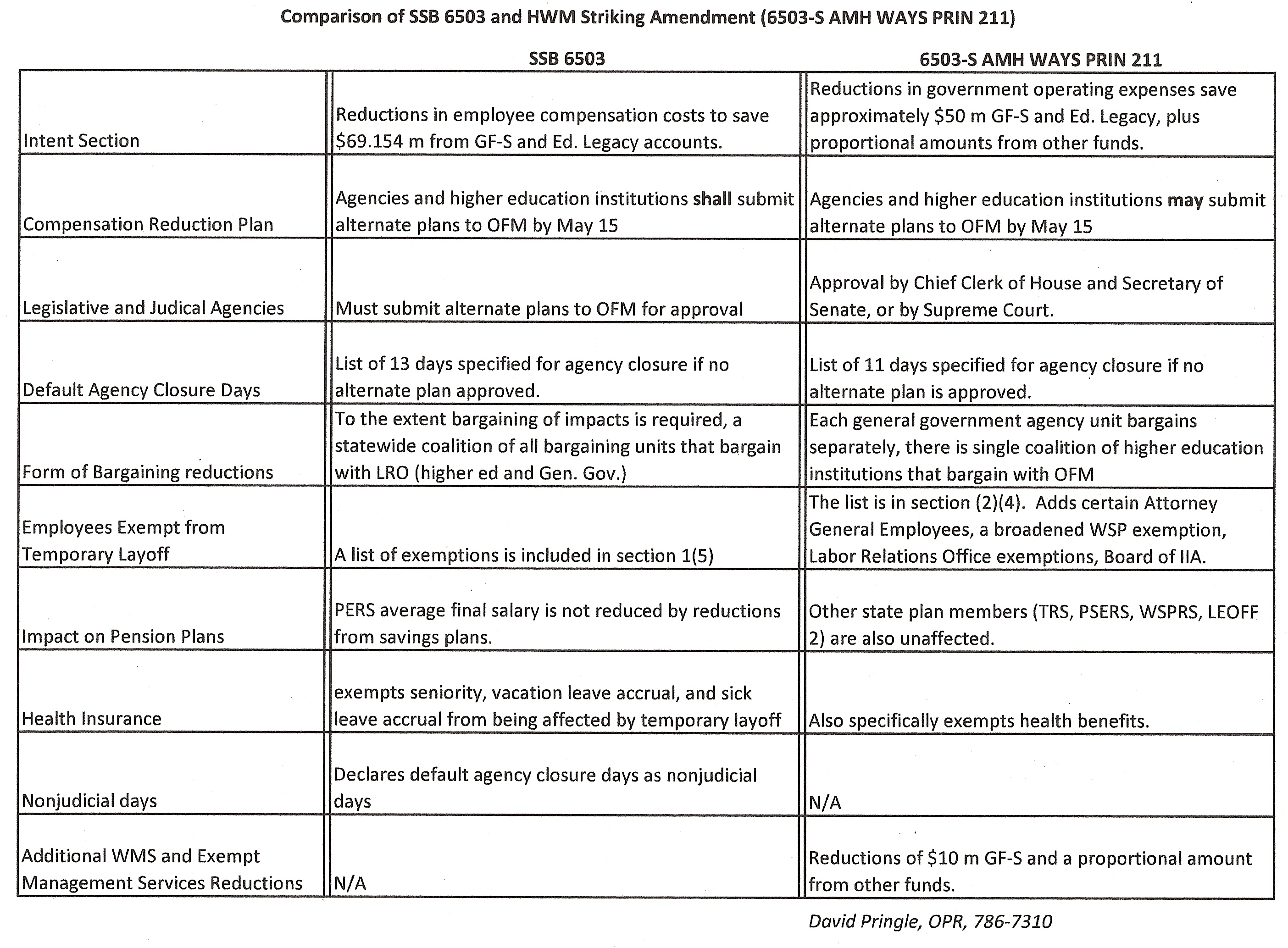
The bill headed to the House floor for a vote looks different than the bill received from the Senate.

scan0005

The subsitute bill includes, but is not limited to, the following:

– An intent section is added stating the Legislature intends that state agencies and institutions of higher education reduce government operating costs through the methods described in the act by $50 million from the General Fund-State and the Education Legacy Account, as well as additional proportionate amounts from other funds.

– The Office of Financial Management (OFM) shall certify to each state agency the compensation reduction amount to be achieved by the executive branch agency or institution.

– Executive branch general government state agencies and higher education institutions may submit plans that achieve compensation cost savings equal to closing the agency for 11 days to the OFM by May 15, 2010.

– Compensation reduction plans submitted by higher education institutions may include leave without pay, temporary layoffs, reductions in force, reduced work hours, and voluntary retirement, separation, and other incentive programs authorized by law. By June 1, 2010, the OFM shall review, approve, and submit the higher education institution plans that achieve the required cost reductions to the legislative fiscal committees. Those institutions that do not have approved plans will close on the 11 dates specified in the amendment.

Senate Bill 6503 now goes to the House floor for a vote. If it passes the House, the bill will return to the Senate for consideration of the amended legislation.

Two Bills Pass Senate Higher Ed

Senate Bill 5237, allowing institutions in Washington to develop accelerated 3-year baccalaureate programs, and Senate Bill 6409, establishing the Washington Investment in Excellence Account by way of Lottery revenue, received adequate votes to pass out of committee this morning.

Each bill consisted of a proposed substitute, and a fair amount of discussion accompanied SB 6409, which would divert Lottery funds from the K-12 Construction account to be used in support of higher education financial aid, including the State Work Study program. SB 6409 was referred to the Ways & Means Committee, while 5237 was referred to the Rules Committee.

Senate Higher Education Ends Week Strong Moving Additional Legislation Forward

At the end of the third week of the 2010 supplemental session, the Senate Higher Education and Workforce Committee held public hearings on three bills.

The Committee held a public hearing on Senate Bill 6467. SB 6467 authorizes honorary degrees for students at the public, four-year institutions in Washington who were ordered into internment camps. Immediately following the public hearing, the Committee entered Executive Session and moved the bill to Senate Rules for consideration.

The Committee also heard Senate Bill 5237. Senate Bill 5237 would require Washington’s public, four-year institutions to develop three-year baccalaureate programs. Currently, 9% of Evergreen students, who begin as first-years, graduate within three years.

Language is being considered that would replace mandating language in the original bill with more permissive language and require the institutions to report their progress and plans to the Higher Education Coordinating Board (HECB).

The Council of Presidents testified in support of Senate Bill 5237 with the revised language.

House Higher Education Executive Session Amends Performance Agreement, Student Loan and Teacher Preparation Bills

The House Committee on Higher Education met this morning to pass several bills out of committee.

House Bill 2979, establishing performance agreements for institutions of higher learning, received two amendments by Representatives Sells and Wallace. The amendments would establish space in performance agreement committees for faculty and student representatives, as well as establish high employer demand programs of study and require the Joint Legislative Audit and Review Committee to conduct an evaluation of the higher education performance agreements and make recommendations to the Governor and Legislature regarding their continuation and expansion.

House Bill 2930, providing for conditional scholarships and loan repayment programs for potential teachers in high-demand fields, was introduced as a proposed substitute bill. The substitute would bill would take effect in the 2013-2014 school year and increase the amount of the award for both the Future Teachers Conditional Scholarship and Loan Repayment Program and the Alternate Routes to Certification Conditional Scholarship Program to cover the full cost of attendance or $15,000 per academic year, whichever is less. In addition, the substitute bill stipulates that teachers in high-demand fields receive loan reimbursement per year of service, while students in non-high-demand fields receive one year of loan repayment for every two years of service.

Finally, a proposed substitute to House Bill 2854 would add career colleges to the list of institutions and agencies that must be
consulted when the HECB conducts periodic assessments of the HELP program, remove the reference that requires students to be enrolled in an “academic” field of study, clarify that students can be enrolled in an aid-eligible certificate program and still qualify for HELP, and clarify that students enrolled in both academic and technical associate degrees are eligible.

All of these bills received enough votes in the committee to be referred to fiscal or rules committees.

Legislature Week 4: What is Happening

The fourth week of session will be heavily dictated by cut-off deadlines for policy committees. All House policy committees (i.e. House Higher Education) must move any House bills out of committee by February 2. All Senate policy committees (i.e. Senate Higher Education & Workforce Development) must move any Senate bills out of committee by February 5.

This week the focus of the higher education policy committees (i.e. House Higher Education and Senate Higher Education & Workforce Development) will be to move several bills impacting Washington’s institutions of higher education out of committee and either to the floor for consideration or to an appropriation committee. Any bill that may have a fiscal impact must go through an appropriations committee once it passes out of a policy committee.

Both the House and Senate higher education committees will look to move legislation that focuses on issues, such as performance agreements, system design, teacher preparation, tuition policy, three-year degree, and financial aid.

In addition, the appropriations committees (i.e. Senate Ways & Means and House Ways & Means) will meet to continue their work on budget related matters.

The workload will shift for a time from the policy committees to the appropriation committees as the cut-off date for policy bills passes this coming week and the cut-off date for appropriation bills looms the following week.

State of the Union – Education Focus

On Wednesday evening, President Obama gave the first State of the Union address of his presidency. The address focused on issues ranging from health care to green jobs to education.

Below are some of the excerpts from President Obama’s speech in which education was the focus:

…we need to invest in the skills and education of our people.

Now, this year, we’ve broken through the stalemate between left and right by launching a national competition to improve our schools. And the idea here is simple: Instead of rewarding failure, we only reward success. Instead of funding the status quo, we only invest in reform — reform that raises student achievement; inspires students to excel in math and science; and turns around failing schools that steal the future of too many young Americans, from rural communities to the inner city. In the 21st century, the best anti-poverty program around is a world-class education. And in this country, the success of our children cannot depend more on where they live than on their potential.

When we renew the Elementary and Secondary Education Act, we will work with Congress to expand these reforms to all 50 states. Still, in this economy, a high school diploma no longer guarantees a good job. That’s why I urge the Senate to follow the House and pass a bill that will revitalize our community colleges, which are a career pathway to the children of so many working families.

To make college more affordable, this bill will finally end the unwarranted taxpayer subsidies that go to banks for student loans. Instead, let’s take that money and give families a $10,000 tax credit for four years of college and increase Pell Grants. And let’s tell another one million students that when they graduate, they will be required to pay only 10 percent of their income on student loans, and all of their debt will be forgiven after 20 years –- and forgiven after 10 years if they choose a career in public service, because in the United States of America, no one should go broke because they chose to go to college.

And by the way, it’s time for colleges and universities to get serious about cutting their own costs -– because they, too, have a responsibility to help solve this problem.

Now, the price of college tuition is just one of the burdens facing the middle class. That’s why last year I asked Vice President Biden to chair a task force on middle-class families.

Teacher Preparation Legislation in Senate

This morning the Senate Committee on Early Learning and K-12 Education held a public hearing on Senate Bill 6761. Senate Bill 6761 implements recommendations put forth by the Quality Education Council (QEC).

The QEC was established as a part of the Basic Education overhall legislation passed in 2009 (HB 2261). The QEC develops strategic recommendations for implementation of a new definition of Basic Education and the financing necessary to support it.

Though this may seem only to be a K-12 related policy council, the QEC and the implementing legislation (HB 2261) also established criteria for teacher evaluations and teacher compensations. Both of which are critical issues for Masters in Teaching and Masters in Education faculty and students.

The implementing legislation created a compensation work group that is tasked with developing an enhanced, collaboratively designed salary allocation model. The new model will align educator development and certification with compensation. A critical part of this conversation is the relationship between earning an advanced teaching degree and receiving an increase in salary for this achievement.

Evergreen worked hard during the 2009 session to bring legislative attention to the value-added when an educator earns an advanced degree in education. Evergreen was successful in refocusing the conversation on compensation and away from the initial assumption that education beyond a bachelors was not value-added in the classroom.

As a result of Evergreen’s work and the work of others a compensation work group was created to develop a compensation model in Washington for teachers. This replaced the initial proposal to not provide increases in compensation for teachers who earn an advanced degree.

That is the long way of saying, one of the recommendations of the QEC, as stated in SB 6761, is to convene the compensation work group in 2010 with a report due December 2010. This would move the convening of the work group and the recommendations of the group up a year.

Evergreen did not weigh in on this change to the implementing legislation. Instead Evergreen attended the public hearing to learn more about SB 6761 and to hear public testimony from other partners.

SB 6761 is expected to be moved out of committee early next week.

Senate Higher Education Hears Financial Aid and Surcharge Legislation and Moves Other Bills

The Senate Higher Education & Workforce Development Committee heard two higher education related bills this afternoon and moved a handful of other bills while confirming several gubernatorial appointments.

Senate Bill 6409 would create the Washington Investment in Excellence Account. The account created in SB 6409 would be supported by lottery proceeds. The proceeds would be directed to recruit entrepreneurial researchers, innovation partnership zones, and research teams and financially support opportunity grants, educational opportunity grants, GET ready for math and science scholarships, passport to college promise, college bound scholarships, and the Washington promise scholarship.

Evergreen testified in support of SB 6409, encouraging lawmakers to ensure that the investment in financial aid identified in the bill is additive to the state’s current investment.

In addition substitute bill to Senate Bill 6358 was heard by the Committee. The substitute to Senate Bill 6358 requires four-year and two-year institutions to develop policies that ensure that students complete their programs in a timely manner in order to make the most efficient use of instructional resources and provide capacity within the institution for additional students. Sen. Kilmer, Chair and sponsor of the bill, struck prior language that would have placed a surcharge on students who do not complete their degrees in a timely manner in the substitute bill heard by the Committee.

The Committee also moved two higher education related bills out of committee and to the Rules Committee for consideration.

Substitute Senate Bill 6355, which implements the Higher Education Coordinating Board’s System Design recommendations, rewrites the intent of the original bill, does not subject the development of applied baccalaureates to appropriations, does not subject the expansion of applied baccalaureates to the major expansion process, changes the definition of “mission change” and “major expansion”, both major expansion and mission change are subject to the Higher Education Coordinating Board’s assessment and viability evaluation process, and makes eligible private, non-profit institutions for innovation incentive grants.

Substitute Senate Bill 6357 relating to the academic recognition of prior learning clarifies the policies on prior learning based upon prior experiences and adds the Workforce Training and Education Coordinating Board to the list of institutions to be consulted.

Finally, the Committee approved several gubernatorial appointments including three to The Evergreen State College Board of Trustees – Irene Gonzales, Dixon McReynolds, and the reappointment of Kristin Hayden.