

Senate Committee Moves Salary and Furlough Legislation

The Senate Ways & Means Committee moved two bills from committee to Rules this afternoon.

Substitute Senate Bill 6382  and Senate Bill 6503 were passed out of Senate Ways & Means to Senate Rules for consideration.  The original bill was not considered. Instead a substitute bill was heard and acted upon.

Substitute Senate Bill 6382 extends the current prohibition of  salary and wage increases for exempt and Washington Management Service (WMS) employees of state agencies and institutions of higher learning  through June 30, 2011. An employer may grant a salary increase to a position for which it has a demonstrated difficulty retaining qualified personnel, provided that the increase can be paid within existing resources and without adversely impacting the delivery of client services. Any agency ;giving a salary increase for an exempt or WMS position must submit a reort to the fiscal committees of the Legislature by July 31, 2011, describing the increases given and the reasons for the increases. The prohibition on salary increases is expanded to include awards of cash or cash equivalents given in recognition for performance or longevity.

Senate Bill 6503 also passed out of Senate Ways & Means.  The final version of SB 6503 to pass out of committee was different from the original bill in four major ways:

1.  State agencies are directed to acheive a $69.154 million reduction in employee compensation costs from the near G-F through mandatory and voluntary furloughs, leave without pay, reduced work hours, voluntary retirements and separations, layoffs, and other methods. Agency compensation reduction plans must be submitted by May 15 and approved by OFM by June 1. Agencies that fail to submit an approved compensation reduction plan will be subject to 13 specified agency closure dates beginning in June 2010.

2. Additional exemptions are provided along with those originally outlined in the bill. None of the new exemptions are higher education related.

3.  OFM may designate alternative closure dates if necessary for a particular agency and various technical changes were made to facilitate implementation and collective bargaining.

4. Removes requirement that collective bargaining take place with a single consolidated union.

Senate Rules   is expected to act on SB 6382  ans SB 6503 quickly, moving the bills to the Senate Floor for action tomorrow.
Tuition the Topic of Conversation in the Senate

The Senate Higher Education & Workforce Development Committee held a public hearing this afternoon focused on tuition policy. Four bills held the attention of Committee Members and a packed hearing room for nearly three hours.

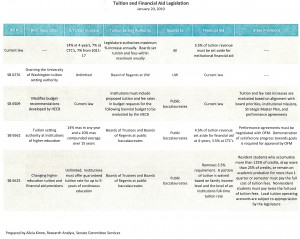
SB 6276 – Grants the University of Washington tuition-setting authority.

SB 6562 – Authorizes the governing boards of the four-year, public institutions to set tuition and fees for resident undergraduate students with constraints, requires institutions to develop performance agreements with the state, and increases the amount that institutions must maintain for financial aid.

SB 6509 – Modifies the current budget proposal process between the HECB and the institutions to include recommendations on tuition and fees.

SB 6625 – Changes higher education tuition and financial aid provisions.

Each of the Senate bills approached tuition policy in a different way, especially with regard to levels of flexibility, required financial aid investments, and the establishment of performance agreements between the four-year public institutions and the State of Washington.

Tuition Comparison

Students from across Washington expressed concerns regarding shifting tuition setting authority from the Legislature to the governing boards of the four-year, public institutions. Most students spoke in favor of SB 6509 and shared concerns about the three remaining bills. Students shared specific concerns with regard to SB 6562 including the high tuition cap,  lack of oversight in the bill, and exclusion of graduate tuition and fees.

The six presidents of the public baccalaureate institutions spoke as a panel to the bills and tuition policy overall.  Chair Kilmer captured the comments of the presidents well by restating five principles/themes he noted from their comments.

1.  Optimize the state investment in higher education.

2. Any tuition policy does not release the state from its responsibility to fund higher education.

3. The unique missions and students mixes of each institution must be acknowledged relative to state appropriations, tuition, and financial aid.

4. Tuition policy should provide limits that will allow students greater predictability and stability.

5. Accountability of the institutions is a critical component of any tuition policy dialogue.

In his comments to the Committee, President Purce acknowledged the major role tuition plays in our higher education funding structure and the  unprecedented economic times facing Washington, which will require non-traditional thinking and strategies to manage our public institutions.

Purce affirmed Evergreen’s long-held position on tuition by stating that the College believes that any conversation regarding higher education funding must integrate and acknowledge the interplay between state appropriations, financial aid, and tuition. In addition, he welcomed the active dialogue Evergreen is engaged in with  the other public, four-year institutions in Washington to move forward a policy by which higher education can have the tools necessary to manage in times of even more cuts this year and those projected for the 2011-13 biennium.

Purce echoed the need for the state and higher education to make a commitment to find a way(s) that recognize the different missions among the institutions, different student bodies, a strength of Washington’s higher education sector, and  meet the unusual circumstances we find ourselves in as a sector and as a state.

State Treasurer Jim McIntire provided his personal support for SB 6562. He stated that institutions should be responsible to set their own tuition prices that reflect the unique markets each institution works within. In addition, he recognized the limited authority provided in the bill to raise tuition, presence of accountability measures via performance agreements, and need to maintain the integrity and quality of Washington institutions of higher learning.

Ann Daley, Executive Director for the Higher Education Coordinating Board, discussed tuition policy within the context of the Board’s recent tuition policy study. She encouraged policymakers to aim to recalibrate the relationship between tuition, financial aid, and state approprations.

In addition, representatives from the Governor’s Office, League of Education Voters, business community, faculty, and the community colleges also testified to the need to protect the quality of higher education while keeping the doors open to students.

Senate Committee on Ways and Means Outlines Capital Budget

Senate Ways & Means Capital Budget Coordinator Brian Sims presented an overview of the current state of Washington’s Capital Budget during Wednesdays’ committee hearing.

The Capital Budget is comprised of $3.3 billion dollars, half of which is money borrowed from investors in the form of bonds and other debt. The budget itself is the smallest of the three state budgets, which also include the large Operating Budget ($58.7 billion) and the Transportation Budget ($6.6 billion).

Sims pointed out during his presentation that the majority of funds disbursed from the Capital Budget go to parties other than state interests. This means that state funds are being used as grants for construction and maintenance of institutions other than the state’s own. Among the funds used to build and maintain state institutions’ interests, funding for public schools has grown the fastest. Most of these funds are not cash, however, and come in the form of bonding authority. Higher Education’s bond funds from the Capital Budget have grown, too, while other funds – including cash – have remained flat for a decade.

As the state deals with a budget crisis, another issue the legislature has to confront is the constitutionally-mandated debt limit. The debt limit, monitored by the State Treasurer, cannot exceed 9% of the average annual general revenue for the preceding three fiscal years. In addition, because the Capital Budget, unlike the Operating Budget, does not have an “ending fund balance,” a margin of 0.25% is set aside as an ending balance. According to Governor’s proposed Capital Budget, that 0.25% ending balance is maintained by cutting $375 million from the budget. The Governor’s budget also proposes an increase in bond spending of $86 million and a transfer of $147 million from the Capital to the Operating Budget, a short-term maneuver to create more liquidity in the Operating Budget.

What does this mean for Evergreen? The college has identified a need for an allocation of $125,000 from the Capital Budget to complete funding for a Biomass Gasification plant. TESC students and the college itself have each generated $125,000 to put toward a feasibility study for the project. As the Capital Budget writing process plays out, the college will be asking legislators to support the sustainable vision for a biomass plant, which would help the college realize its 2020 goal of carbon neutrality while providing synthetic gas to heat and potentially power the institution’s facilities.

Higher Education in the House Education Committee

The House Education Committee, which focuses K-12 education, heard House Bill 2654 focusing on preparing teachers for a career in teaching during its hearing on Wednesday. Teacher preparation is one of many areas in which higher education intersects with K-12.

House Bill 2654 defines an Elementary Math Specialist as an elementary teacher with a specialty endorsement in elementary mathematics and directs the Professional Educator Standards Board (PESB) to adopt a specialty endorsement for Specialists, based on standards that include enhanced mathematics content knowledge for grades K-6 and instructional strategies.

The Evergreen State College testified in support of HB 2654 and offered two major suggestions for improving the bill. First, Evergreen believes that the current terminology in the bill, “widely accessible to elementary teachers across the state,” should be broadly interpreted to mean more than online coursework. A critical element of coursework in math education is that teachers learn math from teachers who model good pedagogy. Without this modeling the ability to learn effective teaching methods is limited.

Second, we encouraged legislators to push for more than the “minimum of additional coursework” required in the bill. If the state truly wants to scale up teachers in the mathematical and pedagogical preparation it is critical that teachers receive substantive opportunities to learn.

Senate Ways and Means Hears Furlough and Salary Bills

Tuesday afternoon many state agencies, programs, and services were focused on the work of the Senate Ways & Means Committee.

Among the bills before the Committee this afternoon was Senate Bill 6503.

Senate Bill 6503 would:

– Direct state agencies to close one day per month from March 2010
through June 2011.

– Allow exemptions from statewide closure dates for state corrections and social service institutions, child protective services, law enforcement, military operations, emergency management, state parks and ferries, higher education classroom instruction, state liquor stores, unemployment insurance, workers compensation, state legislative agencies and the Office of Financial Management during legislative sessions, and employees necessary to protect state assets and public safety.

– Recognize that the state agency closures identified in the bill will result in the temporary layoff (furlough) and reduction of compensation of affected state employees.

In addition, the Committee heard public testimony on Senate Bill 6382 which extends the prohibition on salary and wage increases for exempt and Washington Management Service employees of state agencies and institutions of higher learning.

Representatives from higher education expressed concerns regarding the potential cost savings assumed by both bills as well as the difficulty in implementing the requirements of the bill.

Senate Hears Impact of Governor’s Proposed 2010 Supplemental Budget

Last week the key budget committees of the Washington State House focused on the impacts of the Governor’s proposed 2010 supplemental budget, including her “new budget”.

This week the Senate appropriation committee, Senate Ways & Means, will take on the same focus. Last week Governor Gregoire testified before Senate Ways & Means regarding her proposed 2010 supplemental budget and support for new revenue, this week the Committee will hear from the public.

This afternoon The Council of Presidents and representatives from each of the four-year public baccalaureate institutions testified before the Senate Ways & Means Committee regarding the impact to the baccalaureate sector.

Evergreen focused testimony on the impact of the reductions to date and the impact of additional cuts on students, faculty, and the institution proposed in the Governor’s 2010 supplemental budget. Evergreen emphasized the impact of the proposed reductions and eliminations of state financial aid programs on Greeners.

Today’s public hearing before the Senate Ways & Means Committee set the tone for the week. Several policy bills will be heard in the House and Senate that, if implemented, would impact the state budget. Included among these bills are SB 6355/HB 2655 which implements the Higher Education Coordinating Board (HECB) system design report; HB 2822 which includes tuition/fees in institutional budget proposals to the HECB; SB 6503 which mandates state agency closures throughout the year; and SB 6382 which restricts compensation.

Legislature Week 2: What is Happening

Several work sessions and public hearings are scheduled on critical issues that impact higher education the second week of session. To learn more follow the links below.

This week the focus of the appropriations committees (i.e. Senate Ways & Means and House Ways & Means) will be a review of the Governor’s proposed supplemental budgets, both capital and operating.

In addition, the higher education policy committees (i.e. House Higher Education and Senate Higher Education & Workforce Development) plan to tackle several critical issues impacting Washington’s institutions of higher learning, including system design, tuition policy, and financial aid.

Education Appropriations Listens to Higher Education and Jobs Bill Moves

This afternoon, the House Education Appropriations Committee heard testimony from the The Council of Presidents and representatives from each of the four-year public baccalaureate institutions.

Evergreen focused testimony on the impact of previous reductions to date and the potential impact of additional cuts on students, faculty, and the institution proposed in the Governor’s 2010 supplemental budget. Evergreen emphasized the impact of the proposed reductions and eliminations of state financial aid programs on Greeners.

At the same time the House Capital Budget Committee held an executive session on House Bill 2561, a bill that Evergreen supports. House Bill 2561 now moves to the House Floor for consideration and a vote.

Budget, Budget, Budget

Budget was the key word today at the Legislature. The House Ways & Means Committee held a public hearing on the Governor’s proposed 2010 supplemental budget. The House Education Appropriations Committee held a work session on the same issue. Finally, House Capital Budget held a public hearing on a jobs creation bill that would benefit education in Washington.

Governor Gregoire addressed the House Ways & Means Committee this afternoon. She shared the challenges posed in her all-cuts budget and hopes she has for restoration of some programs and services through additional state and federal revenues.

The Council of Presidents and representatives from each of the four-year public baccalaureate institutions testified before the House Committee. Evergreen focused testimony on the impact of the reductions to date and the impact of additional cuts on students, faculty, and the institution proposed in the Governor’s 2010 supplemental budget. Evergreen emphasized the impact of the proposed reductions and eliminations of state financial aid programs on Greeners.

On the capital front, The Evergreen State College provided testimony in support of House Bill 2561. Senate Bill 2561 would allow the State Finance Committee to issue $861 million in general obligation bonds, to be known as Jobs Act Bonds, for the purpose of creating jobs by constructing capital improvements that lead to energy-related cost savings in public schools, state colleges and universities, and other public facilities. House Bill 2561 establishes a competitive grant process for public schools and higher education institutions to attain the funds bonded in the bill.

Evergreen supports House Bill 2561 because of its focus on sustainable energy projects and education. In addition, HB 2561 provides the opportunity for Evergreen to discuss with legislators the value of investing in sustainability focused projects and programs, such as Evergreen’s Biomass Gasification Project.

Finally, The Evergreen State College attended a work session of the House Education Appropriations Committe focused on the impact to education of the Governor’s proposed 2010 supplemental budget.

House Higher Education Talks Tuition and Budget

The House Higher Education Committee today held a work session that focused on tuition and the Governor’s proposed 2010 supplemental budget.

Representatives from the Governor’s Office along with the Higher Education Coordinating Board and the Washington Student Association (WSA) provided invited testimony to the Committee regarding their concerns and hopes about tuition policy and budget this session.

George an Evergreen student shared his personal story with legislators along with several other students organized through WSA.

Legislators raised questions regarding higher education costs, the level of budget reductions passed in the 2009 session, and efforts towards worker retraining.